Department of Biology, University of South Dakota, 414 East Clark Street, Vermillion, SD 57069, USA.
Renaissance Computing Institute, University of North Carolina, 100 Europa Drive, Suite 540, Chapel Hill, NC 27517, USA.
Syst Biol. 2020 Mar 1;69(2):345-362. doi: 10.1093/sysbio/syz067.
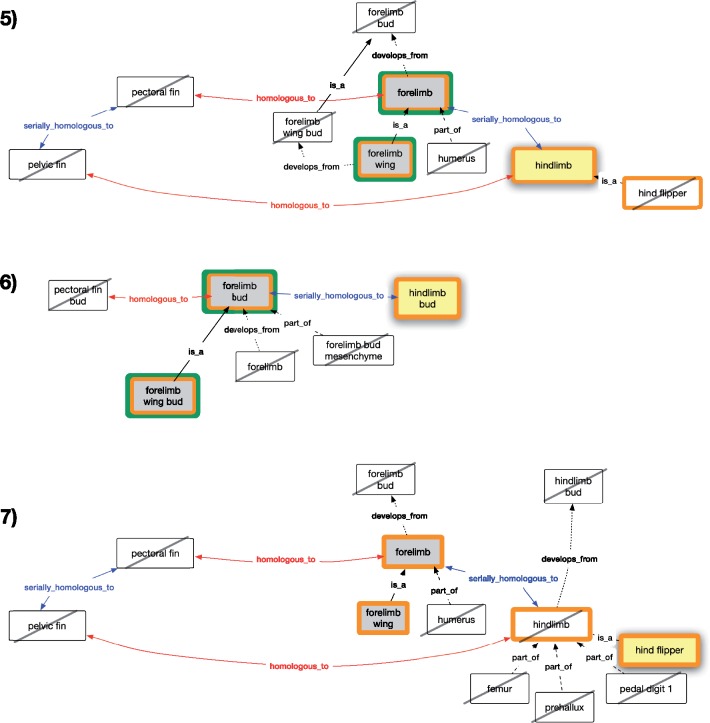
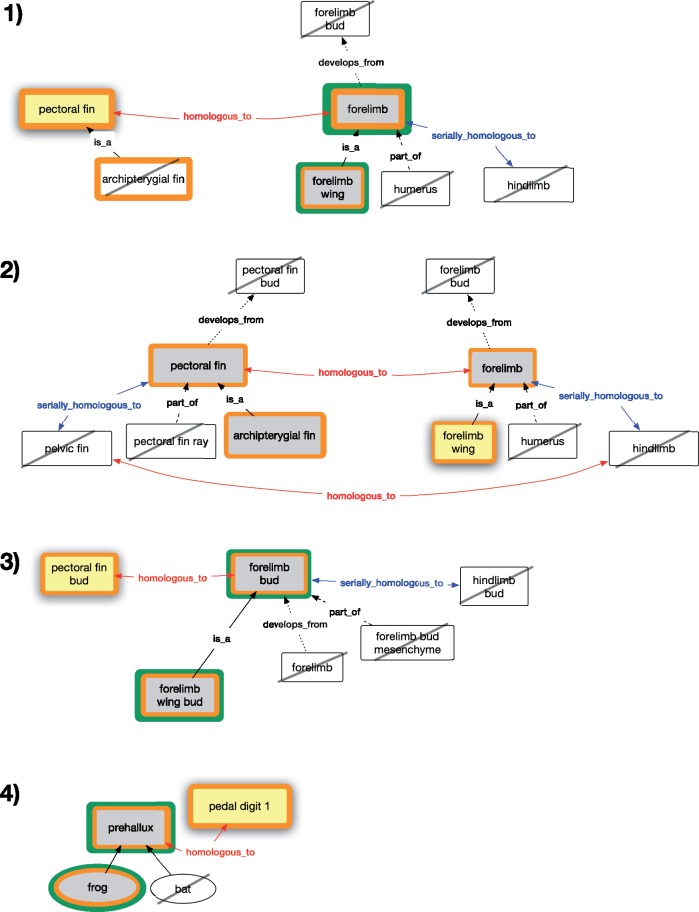
There is a growing body of research on the evolution of anatomy in a wide variety of organisms. Discoveries in this field could be greatly accelerated by computational methods and resources that enable these findings to be compared across different studies and different organisms and linked with the genes responsible for anatomical modifications. Homology is a key concept in comparative anatomy; two important types are historical homology (the similarity of organisms due to common ancestry) and serial homology (the similarity of repeated structures within an organism). We explored how to most effectively represent historical and serial homology across anatomical structures to facilitate computational reasoning. We assembled a collection of homology assertions from the literature with a set of taxon phenotypes for the skeletal elements of vertebrate fins and limbs from the Phenoscape Knowledgebase. Using seven competency questions, we evaluated the reasoning ramifications of two logical models: the Reciprocal Existential Axioms (REA) homology model and the Ancestral Value Axioms (AVA) homology model. The AVA model returned all user-expected results in addition to the search term and any of its subclasses. The AVA model also returns any superclass of the query term in which a homology relationship has been asserted. The REA model returned the user-expected results for five out of seven queries. We identify some challenges of implementing complete homology queries due to limitations of OWL reasoning. This work lays the foundation for homology reasoning to be incorporated into other ontology-based tools, such as those that enable synthetic supermatrix construction and candidate gene discovery. [Homology; ontology; anatomy; morphology; evolution; knowledgebase; phenoscape.].
越来越多的研究关注于各种生物体的解剖结构进化。通过计算方法和资源,这些发现可以得到极大的加速,这些方法和资源可以使不同研究和不同生物体之间的发现进行比较,并与负责解剖结构改变的基因联系起来。同源性是比较解剖学的一个关键概念;两种重要的同源性是历史同源性(由于共同祖先而具有相似性的生物体)和系列同源性(生物体内部重复结构的相似性)。我们探索了如何最有效地表示解剖结构中的历史和系列同源性,以促进计算推理。我们从文献中收集了一组同源性断言,并从 Phenoscape 知识库中收集了脊椎动物鳍和肢骨骼元素的一组分类群表型。使用七个能力问题,我们评估了两种逻辑模型的推理结果:相互存在公理(REA)同源模型和祖先值公理(AVA)同源模型。除了搜索词及其任何子类之外,AVA 模型还返回了所有用户预期的结果。AVA 模型还返回了已断言同源关系的查询词的任何超类。REA 模型对七个查询中的五个返回了用户预期的结果。由于 OWL 推理的限制,我们确定了实施完整同源性查询的一些挑战。这项工作为将同源性推理纳入其他基于本体的工具奠定了基础,例如那些能够实现合成超级矩阵构建和候选基因发现的工具。[同源性;本体论;解剖学;形态学;进化;知识库;phenoscape。]