Department of Psychology, The Chinese University of Hong Kong, Hong Kong Special Administrative Region, China.
Neuropsychology and Applied Cognitive Neuroscience Laboratory, CAS Key Laboratory of Mental Health, Institute of Psychology, Chinese Academy of Sciences, Beijing, China.
Sci Rep. 2019 Oct 11;9(1):14723. doi: 10.1038/s41598-019-51280-z.
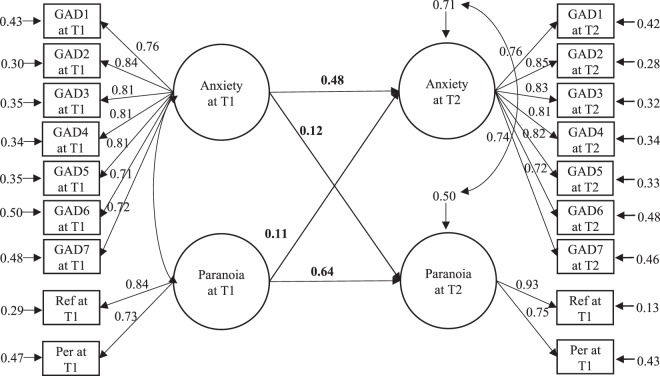
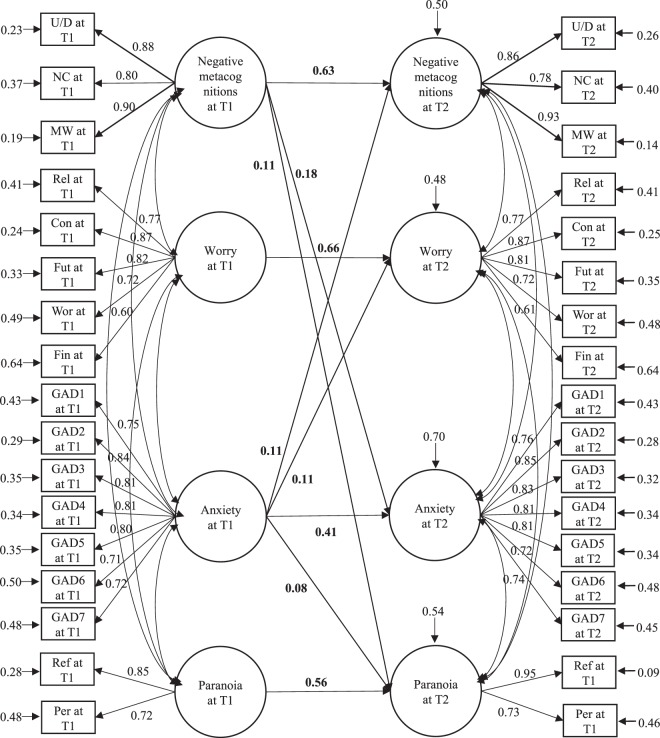
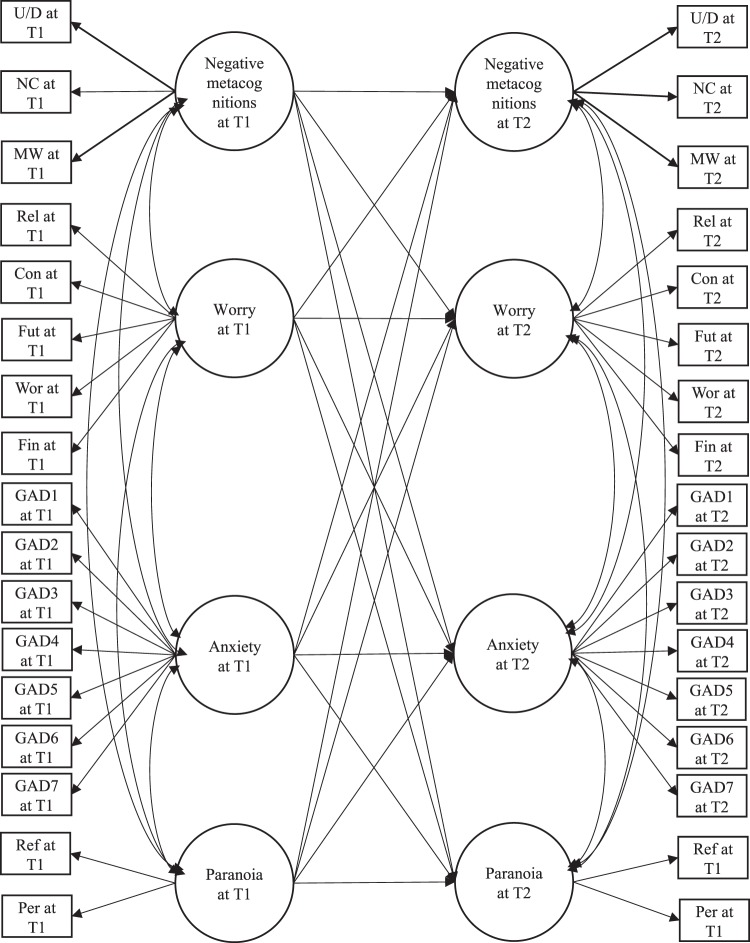
Recent studies have shown that worry and related negative metacognitions are characteristic in generalized anxiety and paranoia respectively. However, most of these studies did not take into account common co-occurrence of anxiety and paranoia, and longitudinal modelling of the role of worry and metacognitions on the development of anxiety and paranoia is rare. The current study aimed at examining the bidirectional longitudinal relationship between anxiety and paranoia, as well as the importance of worry and metacognitions in the development of these symptoms. Our validated sample consisted of 2291 participants recruited from universities, among whom 1746 participants (76.21%) completed online questionnaires at baseline and at one year, reporting levels of anxiety, paranoia, worry, and negative metacognitions. Structural equation modeling analyses, followed by path comparisons, revealed that anxiety and paranoia mutually reinforced each other over time. Negative metacognitions, rather than worry itself, were contributive to the development of both symptoms over time. Negative metacognitions showed bi-directional relationships with anxiety over the time period assessed and showed uni-directional relationships with paranoia. Clinical implications of our findings are discussed.
最近的研究表明,担忧和相关的消极元认知分别是广泛性焦虑和偏执狂的特征。然而,这些研究大多没有考虑到焦虑和偏执狂的共同发生,并且很少有关于担忧和元认知对焦虑和偏执发展的作用的纵向建模。本研究旨在检验焦虑和偏执之间的双向纵向关系,以及担忧和元认知在这些症状发展中的重要性。我们的验证样本由 2291 名从大学招募的参与者组成,其中 1746 名参与者(76.21%)在基线和一年时完成了在线问卷,报告了焦虑、偏执、担忧和消极元认知的水平。结构方程模型分析,随后是路径比较,显示焦虑和偏执随着时间的推移相互加强。随着时间的推移,消极的元认知,而不是担忧本身,对这两种症状的发展都有贡献。消极的元认知在评估期间与焦虑呈双向关系,与偏执呈单向关系。讨论了我们研究结果的临床意义。