Sheffield Julia M, Brinen Aaron P, Freeman Daniel
Department of Psychiatry and Behavioral Sciences, Vanderbilt University Medical Center, Nashville, TN, United States.
Department of Psychiatry, University of Oxford, Oxford, United Kingdom.
Front Psychiatry. 2021 Apr 30;12:668152. doi: 10.3389/fpsyt.2021.668152. eCollection 2021.
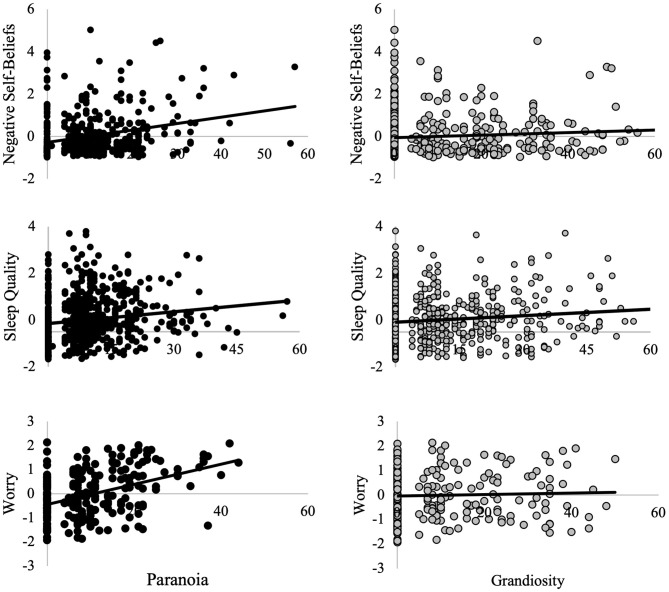
Worry, negative self-beliefs, and sleep disturbance have been identified as contributory factors to the onset, maintenance, and severity of paranoia. We tested the specificity of these contributory factors to paranoia compared to grandiosity, a different type of delusional ideation. Data were used from 814 adults from the Nathan Kline Institute-Rockland (NKI-Rockland) study, a general population dataset. Paranoid and grandiose delusional ideation was assessed using the Peters Delusions Inventory (PDI-21) and correlated with self-reported worry ( = 228), negative self-beliefs ( = 485), and sleep quality ( = 655). Correlations were compared using Fisher's r-to-z transform to examine whether the magnitude of relationships differed by delusion type. Paranoia was significantly associated with worry, negative self-belief, and sleep quality. Grandiosity demonstrated significantly weaker relationships with worry and negative self-beliefs. Relationships with sleep quality were similar. We replicate previous reports that worry, negative self-beliefs and sleep quality are associated with paranoid ideation in the general population. We extend these findings by demonstrating that these contributory factors, particularly worry and negative self-beliefs, are associated with paranoid ideation to a greater extent than grandiosity. This suggests a degree of specificity of contributory factors to different types of delusional thinking, supporting the pursuit of specific psychological models and treatments for each delusion type.
担忧、消极的自我认知和睡眠障碍已被确定为妄想症发作、持续和严重程度的促成因素。我们测试了这些促成因素对妄想症的特异性,并与夸大观念(一种不同类型的妄想思维)进行了比较。数据来自内森·克莱因研究所-罗克兰(NKI-罗克兰)研究中的814名成年人,这是一个普通人群数据集。使用彼得斯妄想量表(PDI-21)评估偏执和夸大妄想思维,并将其与自我报告的担忧(n = 228)、消极的自我认知(n = 485)和睡眠质量(n = 655)相关联。使用费舍尔r-to-z变换比较相关性,以检验关系的强度是否因妄想类型而异。妄想症与担忧、消极的自我认知和睡眠质量显著相关。夸大观念与担忧和消极的自我认知之间的关系明显较弱。与睡眠质量的关系相似。我们重复了之前的报告,即担忧、消极的自我认知和睡眠质量与普通人群中的偏执观念有关。我们通过证明这些促成因素,特别是担忧和消极的自我认知,与偏执观念的关联程度比夸大观念更大,扩展了这些发现。这表明促成因素对不同类型的妄想思维具有一定程度的特异性,支持针对每种妄想类型寻求特定的心理模型和治疗方法。