Julius Wolff Institute, Charité-Universitätsmedizin Berlin, Corporate Member of Freie Universität Berlin, Berlin Institute of Health, Humboldt-Universität zu Berlin, Berlin, Germany.
Berlin Institute of Health Center for Regenerative Therapies, Charité-Universitätsmedizin Berlin, Berlin, Germany.
Front Immunol. 2019 Sep 18;10:2232. doi: 10.3389/fimmu.2019.02232. eCollection 2019.
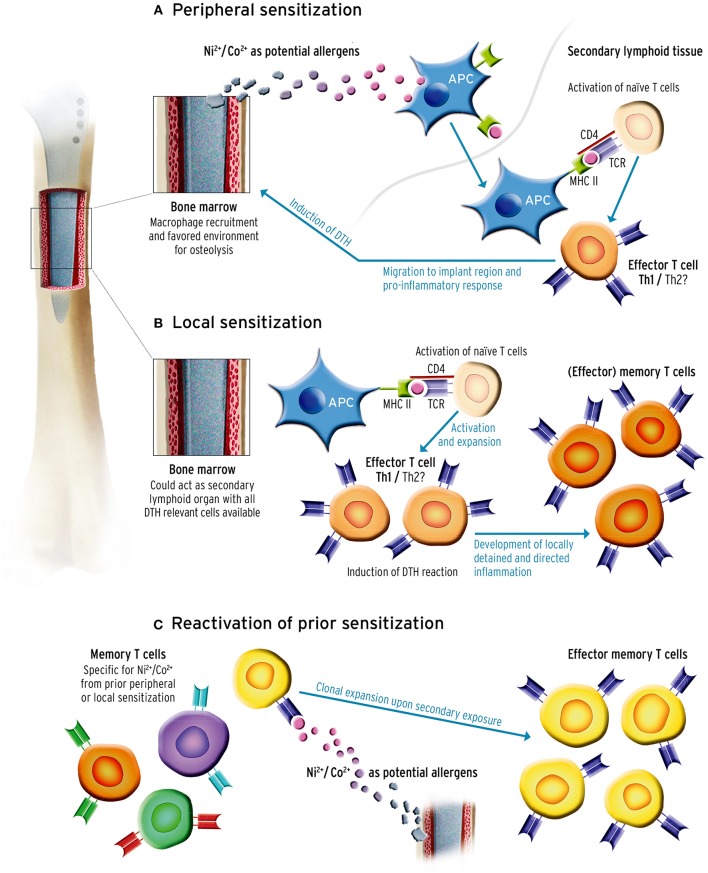
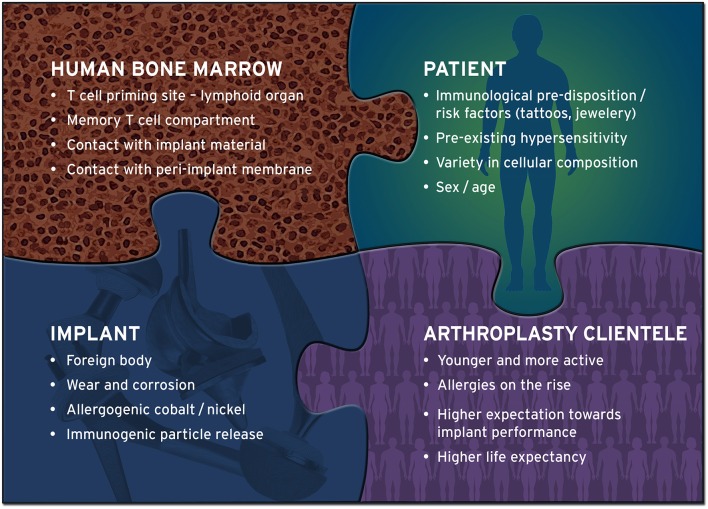
Arthroplasty ranks among the greatest achievements of surgical medicine, with total hip replacement termed "the operation of the century." Despite its wide success, arthroplasty bears risks, such as local reactions to implant derived wear and corrosion products. Prevalence of allergies across Western society increases and along the number of reported hypersensitivity reactions to orthopedic implant materials. In this context the main focus is on delayed hypersensitivity (DTH). This mechanism is mainly attributed to T cells and an overreaction of the adaptive immune system. Arthroplasty implant materials are in direct contact with bone marrow (BM), which is discussed as a secondary lymphoid organ. However, the mechanisms of sensitization toward implant wear remain elusive. Nickel and cobalt ions can form haptens with native peptides to activate immune cell receptors and are therefore common T helper allergens in cutaneous DTH. The rising prevalence of metal-related allergy in the general population and evidence for the immune-modulating function of BM allow for the assumption hypersensitivity reactions could occur in peri-implant BM. There is evidence that pro-inflammatory factors released during DTH reactions enhance osteoclast activity and inhibit osteoblast function, an imbalance characteristic for osteolysis. Even though some mechanisms are understood, hypersensitivity has remained a diagnosis of exclusion. This review aims to summarize current views on the pathomechanism of DTH in arthroplasty with emphasis on BM and discusses recent advances and future directions for basic research and clinical diagnostics.
关节成形术是外科医学的重大成就之一,全髋关节置换术被称为“世纪手术”。尽管它取得了广泛的成功,但关节成形术也存在风险,例如对植入物衍生的磨损和腐蚀产物的局部反应。在西方社会,过敏的患病率不断增加,同时报告的对骨科植入物材料的超敏反应数量也在增加。在这种情况下,主要关注的是迟发型超敏反应(DTH)。这种机制主要归因于 T 细胞和适应性免疫系统的过度反应。关节成形术植入物材料与骨髓(BM)直接接触,BM 被认为是次级淋巴器官。然而,对植入物磨损致敏的机制仍不清楚。镍和钴离子可以与天然肽形成半抗原,激活免疫细胞受体,因此是皮肤 DTH 中的常见 T 辅助过敏原。金属相关过敏在普通人群中的患病率上升,以及对 BM 免疫调节功能的证据,使得假设超敏反应可能发生在植入物周围的 BM 中。有证据表明,DTH 反应释放的促炎因子增强破骨细胞活性并抑制成骨细胞功能,这是溶骨性的特征性失衡。尽管一些机制已经被理解,但超敏反应仍然是一种排除性诊断。这篇综述旨在总结关节成形术中 DTH 的病理机制的最新观点,重点讨论 BM,并讨论基础研究和临床诊断的最新进展和未来方向。