Schoon Janosch, Hesse Bernhard, Rakow Anastasia, Ort Melanie J, Lagrange Adrien, Jacobi Dorit, Winter Annika, Huesker Katrin, Reinke Simon, Cotte Marine, Tucoulou Remi, Marx Uwe, Perka Carsten, Duda Georg N, Geissler Sven
Julius Wolff Institute Charité - Universitätsmedizin Berlin Berlin 13353 Germany.
Berlin Institute of Health Center for Regenerative Therapies Berlin Institute of Health Berlin 10178 Germany.
Adv Sci (Weinh). 2020 Aug 3;7(20):2000412. doi: 10.1002/advs.202000412. eCollection 2020 Oct.
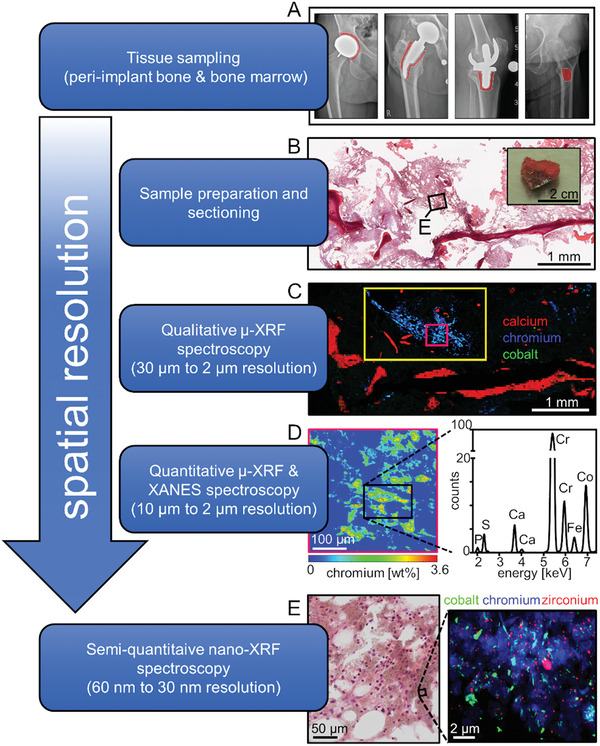
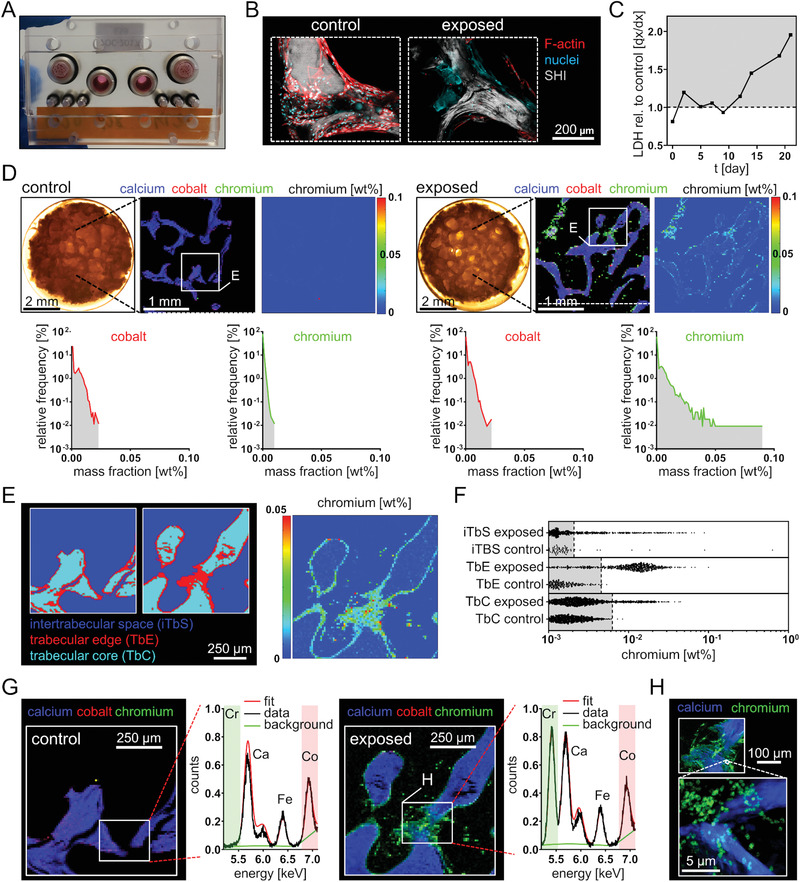
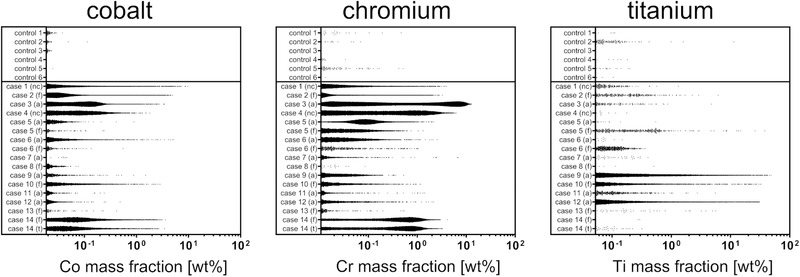
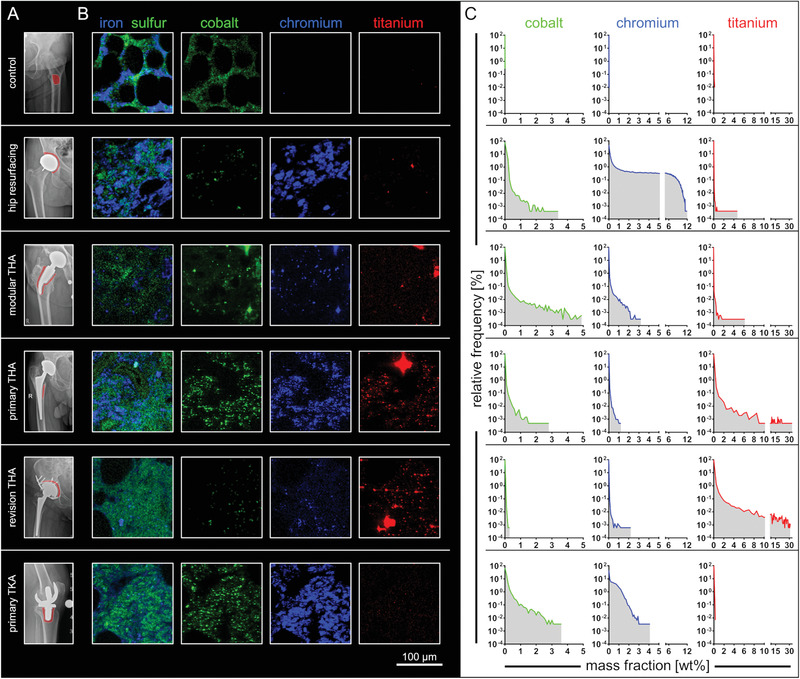
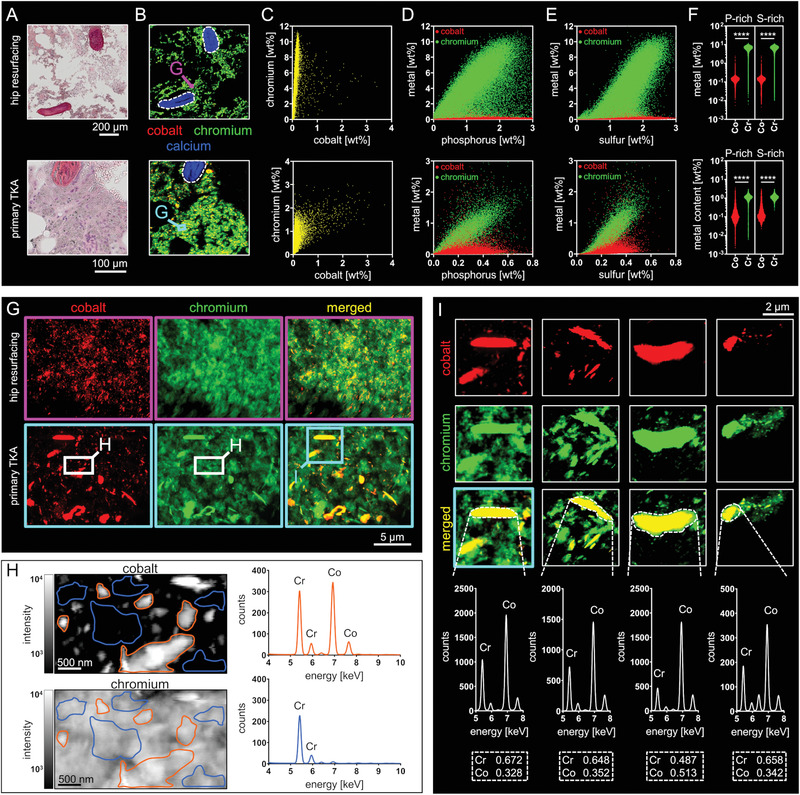
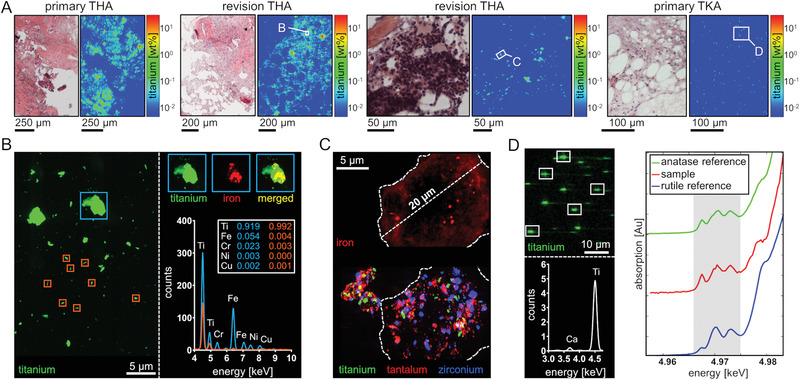
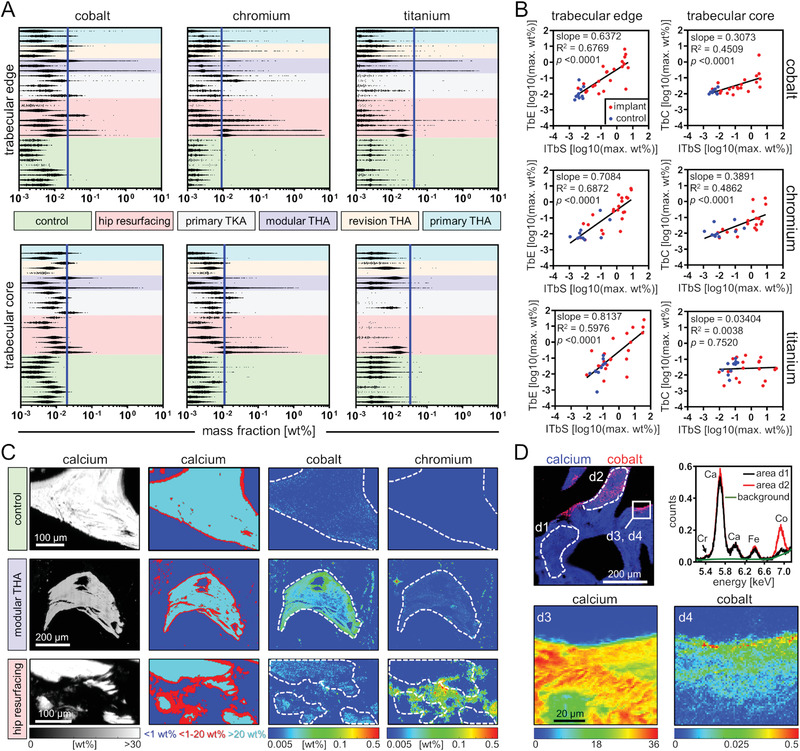
Metallic implants are frequently used in medicine to support and replace degenerated tissues. Implant loosening due to particle exposure remains a major cause for revision arthroplasty. The exact role of metal debris in sterile peri-implant inflammation is controversial, as it remains unclear whether and how metals chemically alter and potentially accumulate behind an insulating peri-implant membrane, in the adjacent bone and bone marrow (BM). An intensively focused and bright synchrotron X-ray beam allows for spatially resolving the multi-elemental composition of peri-implant tissues from patients undergoing revision surgery. In peri-implant BM, particulate cobalt (Co) is exclusively co-localized with chromium (Cr), non-particulate Cr accumulates in the BM matrix. Particles consisting of Co and Cr contain less Co than bulk alloy, which indicates a pronounced dissolution capacity. Particulate titanium (Ti) is abundant in the BM and analyzed Ti nanoparticles predominantly consist of titanium dioxide in the anatase crystal phase. Co and Cr but not Ti integrate into peri-implant bone trabeculae. The characteristic of Cr to accumulate in the intertrabecular matrix and trabecular bone is reproducible in a human 3D in vitro model. This study illustrates the importance of updating the view on long-term consequences of biomaterial usage and reveals toxicokinetics within highly sensitive organs.
金属植入物在医学中经常用于支撑和替代退化组织。因颗粒暴露导致的植入物松动仍然是翻修关节成形术的主要原因。金属碎屑在无菌性植入物周围炎症中的确切作用存在争议,因为尚不清楚金属是否以及如何在绝缘的植入物周围膜后、相邻骨骼和骨髓(BM)中发生化学改变并可能蓄积。高强度聚焦且明亮的同步加速器X射线束能够在空间上解析接受翻修手术患者植入物周围组织的多元素组成。在植入物周围骨髓中,颗粒状钴(Co)仅与铬(Cr)共定位,非颗粒状Cr在骨髓基质中蓄积。由Co和Cr组成的颗粒所含Co比块状合金少,这表明其具有显著的溶解能力。颗粒状钛(Ti)在骨髓中含量丰富,分析显示Ti纳米颗粒主要由锐钛矿晶相的二氧化钛组成。Co和Cr而非Ti整合到植入物周围骨小梁中。Cr在小梁间基质和小梁骨中蓄积的特征在人体三维体外模型中具有可重复性。本研究说明了更新对生物材料使用长期后果看法的重要性,并揭示了高敏器官内的毒物动力学。