Departments of Family Medicine and Community Health and of Population Health Science and Policy, Icahn School of Medicine at Mount Sinai, New York, New York, United States of America.
Center for Primary Health Care Research, Department of Clinical Sciences, Lund University, Malmö, Sweden.
PLoS Med. 2019 Oct 18;16(10):e1002947. doi: 10.1371/journal.pmed.1002947. eCollection 2019 Oct.
Preterm birth has previously been linked with cardiovascular disease (CVD) in adulthood. However, associations with lipid disorders (e.g., high cholesterol or triglycerides), which are major risk factors for CVD, have seldom been examined and are conflicting. Clinicians will increasingly encounter adult survivors of preterm birth and will need to understand the long-term health sequelae. We conducted the first large population-based study to determine whether preterm birth is associated with an increased risk of lipid disorders.
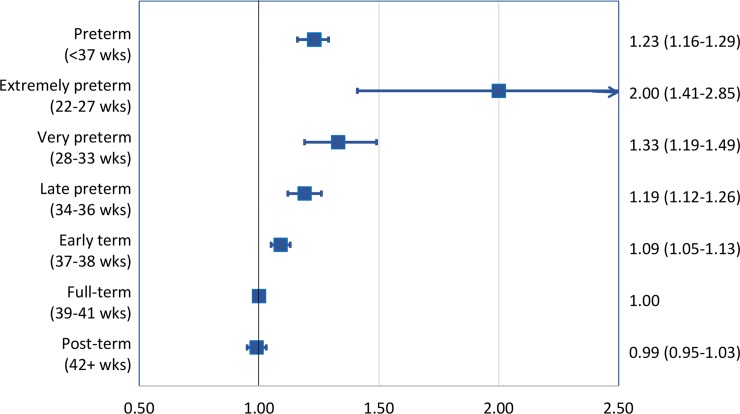
A retrospective national cohort study was conducted of all 2,235,012 persons born as singletons in Sweden during 1973 to 1995 (48.6% women), who were followed up for lipid disorders identified from nationwide inpatient, outpatient, and pharmacy data through 2016 (maximum age 44 years). Cox regression was used to adjust for other perinatal and maternal factors, and co-sibling analyses assessed the potential influence of unmeasured shared familial (genetic and/or environmental) factors. A total of 25,050 (1.1%) persons were identified with lipid disorders in 30.3 million person-years of follow-up. Each additional 5 weeks of gestation were associated with a 14% reduction in risk of lipid disorders (adjusted hazard ratio [HR], 0.86; 95% CI, 0.83-0.89; P < 0.001). Relative to full-term birth (gestational age 39-41 weeks), the adjusted HR associated with preterm birth (<37 weeks) was 1.23 (95% CI, 1.16-1.29; P < 0.001), and further stratified was 2.00 (1.41-2.85; P < 0.001) for extremely preterm (22-27 weeks), 1.33 (1.19-1.49; P < 0.001) for very preterm (28-33 weeks), and 1.19 (1.12-1.26; P < 0.001) for late preterm (34-36 weeks). These findings were similar in men and women (e.g., preterm versus full-term, men: HR, 1.22; 95% CI, 1.14-1.31; P < 0.001; women: HR, 1.23; 1.12-1.32; P < 0.001). Co-sibling analyses suggested that they were substantially though not completely explained by shared genetic or environmental factors in families. The main study limitation was the unavailability of laboratory data to assess specific types or severity of lipid disorders.
In this large national cohort, preterm birth was associated with an increased risk of lipid disorders in early- to midadulthood. Persons born prematurely may need early preventive evaluation and long-term monitoring for lipid disorders to reduce their future cardiovascular risks.
先前的研究表明早产与成年人心血管疾病(CVD)有关。然而,早产与血脂异常(如胆固醇或甘油三酯升高)的关联很少被研究,且研究结果存在争议。血脂异常是 CVD 的主要危险因素。临床医生将越来越多地遇到早产的成年幸存者,需要了解长期的健康后果。我们进行了首次大规模的基于人群的研究,以确定早产是否与血脂异常风险增加有关。
这是一项回顾性全国性队列研究,纳入了 1973 年至 1995 年期间在瑞典出生的 2235012 名单胎婴儿(48.6%为女性),随访时间为脂质异常的全国性住院、门诊和药房数据,截至 2016 年(最大年龄 44 岁)。Cox 回归用于调整其他围产期和产妇因素,同胞对照分析评估未测量的共同家族(遗传和/或环境)因素的潜在影响。在 3030 万随访人年中,共有 25050 人(1.1%)被诊断为脂质异常。每增加 5 周的妊娠期,患脂质异常的风险降低 14%(调整后的危险比 [HR],0.86;95%CI,0.83-0.89;P < 0.001)。与足月出生(胎龄 39-41 周)相比,胎龄<37 周早产的调整 HR 为 1.23(95%CI,1.16-1.29;P < 0.001),进一步分层为极早产(胎龄 22-27 周)的调整 HR 为 2.00(1.41-2.85;P < 0.001),非常早产(胎龄 28-33 周)为 1.33(1.19-1.49;P < 0.001),晚期早产(胎龄 34-36 周)为 1.19(1.12-1.26;P < 0.001)。男性和女性的这些发现相似(例如,早产与足月相比,男性:HR,1.22;95%CI,1.14-1.31;P < 0.001;女性:HR,1.23;1.12-1.32;P < 0.001)。同胞对照分析表明,它们在很大程度上(尽管不是完全)可以用家庭中的共同遗传或环境因素来解释。主要研究局限性是缺乏实验室数据来评估脂质异常的具体类型或严重程度。
在这项大型全国性队列研究中,早产与成年早期至中期血脂异常的风险增加有关。早产儿可能需要早期预防评估和长期监测血脂异常,以降低其未来的心血管风险。