Hamdi Islam Mahmoud
Ophthalmology Department, Faculty of Medicine, Ain Shams University, Cairo, Egypt.
Ophthalmology Consultant, The Eye Consultants Center, Jeddah, Saudi Arabia.
Clin Ophthalmol. 2019 Oct 2;13:1955-1961. doi: 10.2147/OPTH.S223062. eCollection 2019.
To study the patients' perception of trifocal IOL (Panoptix™) performance.
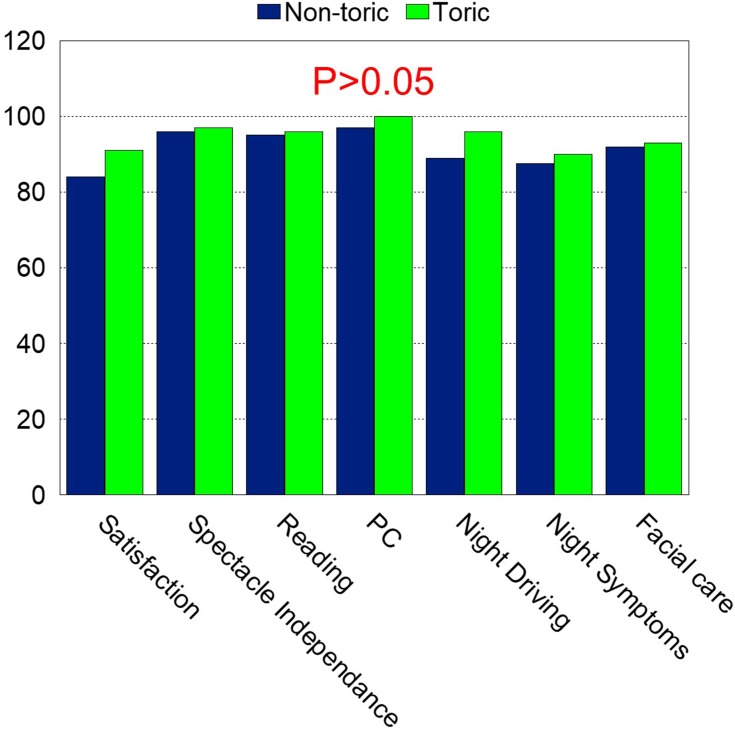
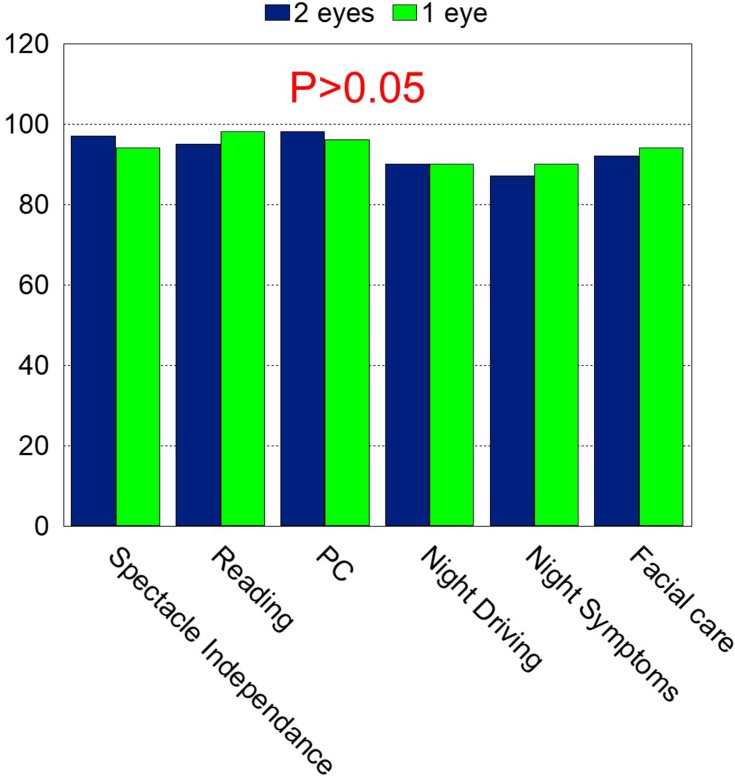
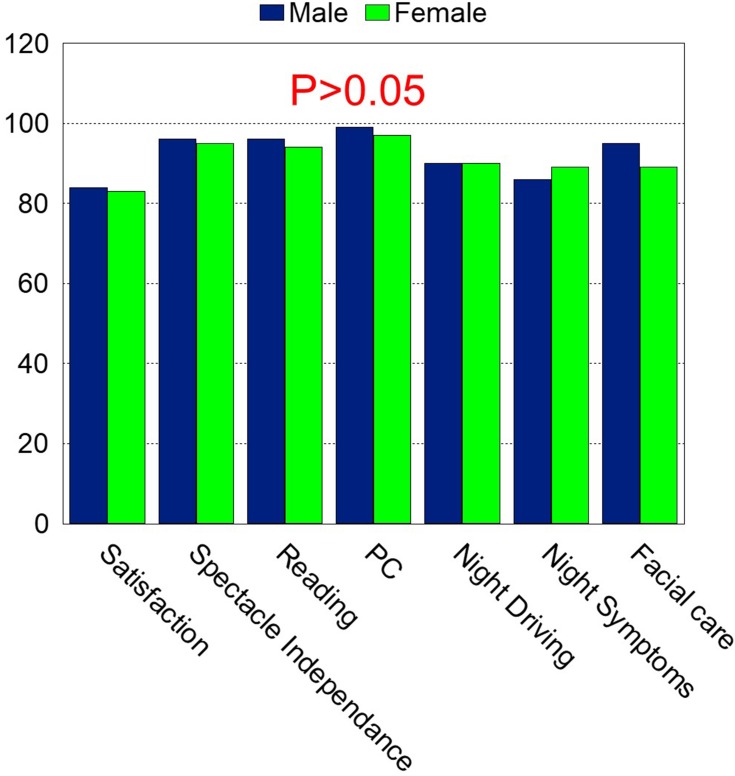
60 eyes of 35 were implanted with trifocal IOL. Refractive (sphere - S, cylinder - Cyl and spherical equivalent - SE, all in D) and visual (distance uncorrected - VAsc, distance corrected - VAcc, intermediate - IntVA, near uncorrected - NVAsc and distance corrected near - NVAcc, all in LogMAR) results were recorded. Patients were asked about satisfaction (per eye), spectacle independence, near and intermediate activities, distance activities in quantity and quality, finally about personal facial care (per patient). Comparison was made between non-toric (48) and toric models, genders (18 males) and between bilateral (25 patients) and unilateral implantations. Results were correlated to age and IOL power.
With a SE of mean -0.3 ± 0.5 D, cases achieved mean VAsc 0.09 ± 0.1 (20/25), VAcc 0.05 ± 0.1 (20/22), IntVA 0.05 ± 0.9 (~20/22), NVAsc 0.05 ± 0.09 (20/22) and NVAcc 0.04 ± 0.8 (20/22). Mean level of satisfaction was 85.7 ± 16.5, spectacle independence 96.0 ± 10.6, near activities 95.4 ± 9.8, intermediate activities 97.7 ± 6.4, quantity of distance activities 90.2 ± 10.1, quality of distance activities 88.0 ± 12.1 and facial care 92.6 ± 11.9. All comparisons (non-toric and toric, male and female and bilateral and unilateral implantation) were statistically insignificant (P>0.05). Correlation with age and IOL power was also statistically insignificant (P>0.05).
As perceived by patients, trifocal IOL resulted in very high level of satisfaction. This satisfaction is reflected on diverse visual activities. This level is achieved regardless of gender, IOL model or even unilateral implantation. It is also achieved regardless the age of patients or preoperative eye status.
研究患者对三焦点人工晶状体(Panoptix™)性能的感知。
35例患者的60只眼植入了三焦点人工晶状体。记录屈光结果(球镜度-S、柱镜度-Cyl和等效球镜度-SE,均以屈光度为单位)和视觉结果(未矫正远视力-VAsc、矫正远视力-VAcc、中间视力-IntVA、未矫正近视力-NVAsc和矫正近视力-NVAcc,均以最小分辨角对数[LogMAR]为单位)。询问患者关于满意度(每只眼)、不依赖眼镜情况、近距和中间距离活动、远距活动的数量和质量,最后询问个人面部护理情况(每位患者)。对非散光型(48只眼)和散光型人工晶状体、性别(18例男性)以及双侧植入(25例患者)和单侧植入情况进行比较。结果与年龄和人工晶状体度数相关。
等效球镜度平均为-0.3±0.5D,患者的平均未矫正远视力VAsc为0.09±0.1(约20/25),矫正远视力VAcc为0.05±0.1(约20/22),中间视力IntVA为0.05±0.9(约20/22),未矫正近视力NVAsc为0.05±0.09(约20/22),矫正近视力NVAcc为0.04±0.8(约20/22)。平均满意度为85.7±16.5,不依赖眼镜情况为96.0±10.6,近距活动为95.4±9.8,中间距离活动为97.7±6.4,远距活动数量为90.2±10.1,远距活动质量为88.0±12.1,面部护理为92.6±11.9。所有比较(非散光型与散光型、男性与女性以及双侧与单侧植入)均无统计学意义(P>0.05)。与年龄和人工晶状体度数的相关性也无统计学意义(P>0.05)。
在患者看来,三焦点人工晶状体带来了非常高的满意度。这种满意度体现在各种视觉活动中。无论性别、人工晶状体型号甚至单侧植入情况如何,均可达到这种满意度水平。无论患者年龄或术前眼部状况如何,也能达到这一水平。