Department of Global Health, University of Washington, Seattle, WA.
International Research Consortium, Kampala, Uganda.
J Acquir Immune Defic Syndr. 2020 Jan 1;83(1):37-46. doi: 10.1097/QAI.0000000000002224.
Knowledge of HIV-positive status may result in depressive symptoms, which may be a concern to scaling novel HIV testing interventions that move testing outside the health system and away from counselor support.
Uganda and Zambia.
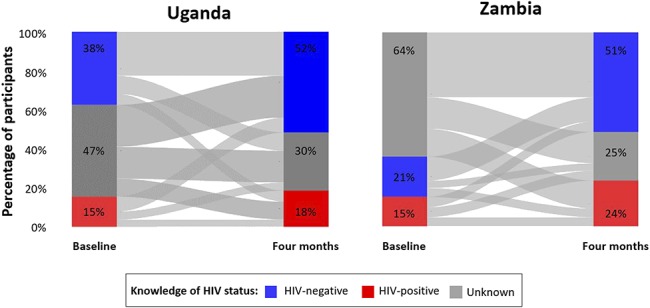
We used longitudinal data from 2 female sex worker (FSW) cohorts in Uganda (n = 960) and Zambia (n = 965). Over 4 months, participants had ample opportunity to HIV testing using standard-of-care services or self-tests. At baseline and 4 months, we measured participants' perceived knowledge of HIV status, severity of depressive symptoms (continuous PHQ-9 scale, 0-27 points), and prevalence of likely depression (PHQ-9 scores ≥10). We estimated associations using individual fixed-effects estimation.
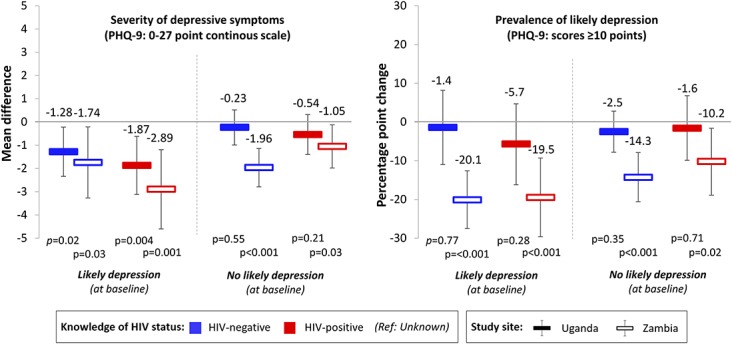
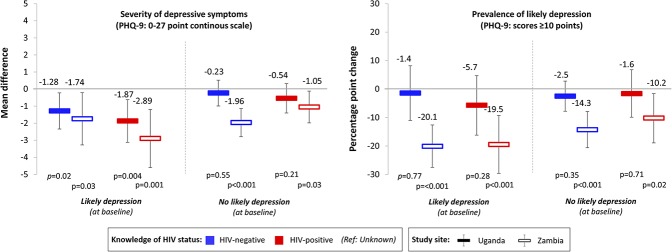
Compared with unknown HIV status, knowledge of HIV-negative status was significantly associated with a decrease in depressive symptoms of 1.06 points in Uganda (95% CI -1.79 to -0.34) and 1.68 points in Zambia (95% CI -2.70 to -0.62). Knowledge of HIV-positive status was significantly associated with a decrease in depressive symptoms of 1.01 points in Uganda (95% CI -1.82 to -0.20) and 1.98 points in Zambia (95% CI -3.09 to -0.88). The prevalence of likely depression was not associated with knowledge of HIV status in Uganda but was associated with a 14.1% decrease with knowledge of HIV-negative status (95% CI -22.1% to -6.0%) and a 14.3% decrease with knowledge of HIV-positive status (95% CI -23.9% to -4.5%) in Zambia.
Knowledge of HIV status, be it positive or negative, was significantly associated with a decrease in depressive symptoms in 2 FSW populations. The expansion of HIV testing programs may have mental health benefits for FSWs.
艾滋病病毒阳性状态的知识可能导致抑郁症状,这可能是关注新型艾滋病病毒检测干预措施的一个问题,这些措施将检测移出卫生系统并远离顾问支持。
乌干达和赞比亚。
我们使用了乌干达(n=960)和赞比亚(n=965)两个女性性工作者队列的纵向数据。在 4 个月的时间里,参与者有充分的机会使用标准护理服务或自我检测进行 HIV 检测。在基线和 4 个月时,我们测量了参与者对 HIV 状况的感知知识、抑郁症状的严重程度(连续 PHQ-9 量表,0-27 分)和可能抑郁的患病率(PHQ-9 得分≥10)。我们使用个体固定效应估计来估计关联。
与未知的 HIV 状态相比,乌干达的 HIV 阴性状态知识与抑郁症状的减少显著相关,为 1.06 分(95%CI -1.79 至 -0.34),赞比亚为 1.68 分(95%CI -2.70 至 -0.62)。乌干达 HIV 阳性状态知识与抑郁症状减少 1.01 分显著相关(95%CI -1.82 至 -0.20),赞比亚为 1.98 分(95%CI -3.09 至 -0.88)。在乌干达,HIV 状态知识与可能抑郁的患病率无关,但与 HIV 阴性状态知识相关,患病率降低 14.1%(95%CI -22.1%至 -6.0%),与 HIV 阳性状态知识相关,患病率降低 14.3%(95%CI -23.9%至 -4.5%)。
在两个女性性工作者群体中,HIV 状态的知识,无论是阳性还是阴性,都与抑郁症状的减少显著相关。扩大艾滋病毒检测方案可能对女性性工作者有心理健康益处。