Department of Chemistry, Tufts University, Medford, MA 02155, USA.
Dipartimento di Scienza e Tecnologia del Farmaco, Università degli Studi di Torino, 10125 Turin, Italy.
Molecules. 2019 Oct 18;24(20):3757. doi: 10.3390/molecules24203757.
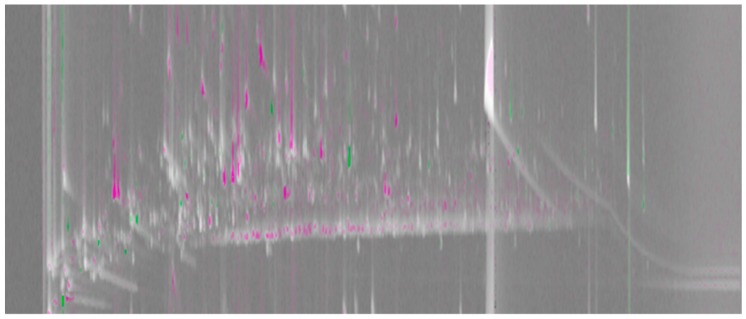
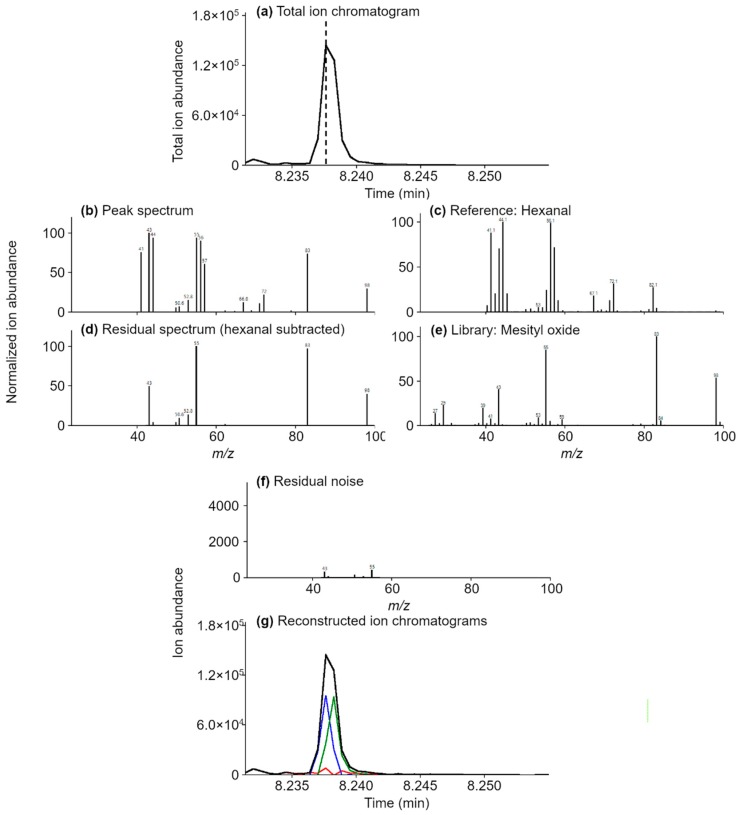
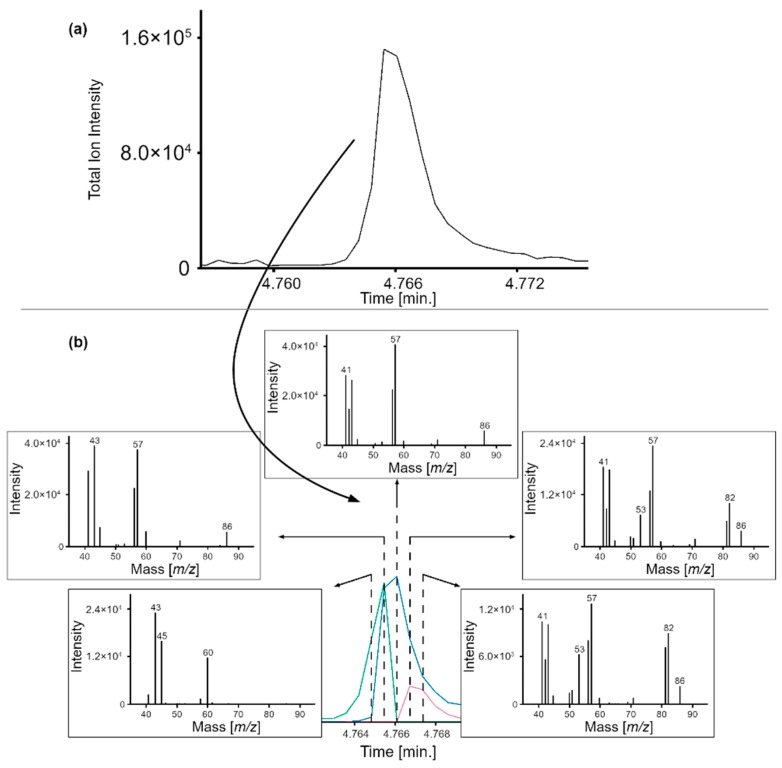
Identifying all analytes in a natural product is a daunting challenge, even if fractionated by volatility. In this study, comprehensive two-dimensional gas chromatography/mass spectrometry (GC×GC-MS) was used to investigate relative distribution of volatiles in green, pu-erh tea from leaves collected at two different elevations (1162 m and 1651 m). A total of 317 high and 280 low elevation compounds were detected, many of them known to have sensory and health beneficial properties. The samples were evaluated by two different software. The first, GC Image, used feature-based detection algorithms to identify spectral patterns and peak-regions, leading to tentative identification of 107 compounds. The software produced a composite map illustrating differences in the samples. The second, Ion Analytics, employed spectral deconvolution algorithms to detect target compounds, then subtracted their spectra from the total ion current chromatogram to reveal untargeted compounds. Compound identities were more easily assigned, since chromatogram complexities were reduced. Of the 317 compounds, for example, 34% were positively identified and 42% were tentatively identified, leaving 24% as unknowns. This study demonstrated the targeted/untargeted approach taken simplifies the analysis time for large data sets, leading to a better understanding of the chemistry behind biological phenomena.
鉴定天然产物中的所有分析物是一项艰巨的挑战,即使通过挥发性进行了分段。在这项研究中,我们使用全面的二维气相色谱/质谱联用技术(GC×GC-MS)来研究在两个不同海拔高度(1162 米和 1651 米)采集的绿茶和普洱茶叶中挥发性物质的相对分布。共检测到 317 种高海拔化合物和 280 种低海拔化合物,其中许多化合物已知具有感官和健康益处。这些样品由两种不同的软件进行评估。第一种软件 GC Image 使用基于特征的检测算法来识别光谱模式和峰区,从而对 107 种化合物进行了初步鉴定。该软件生成了一个组合图,说明了样品之间的差异。第二种软件 Ion Analytics 采用光谱解卷积算法来检测目标化合物,然后从总离子流色谱图中减去它们的光谱,以揭示非目标化合物。由于减少了色谱复杂性,更容易对化合物的身份进行鉴定。例如,在 317 种化合物中,有 34%被确认为已知化合物,42%被初步鉴定,还有 24%为未知化合物。这项研究表明,采用靶向/非靶向方法简化了大型数据集的分析时间,从而更好地了解了生物现象背后的化学原理。