Buijs Stephanie, Muns Ramon
Agriculture Branch, Sustainable Agri-Food Sciences Division, Agri-Food and Biosciences Institute, Hillsborough BT26 6DR, UK.
Animals (Basel). 2019 Oct 18;9(10):824. doi: 10.3390/ani9100824.
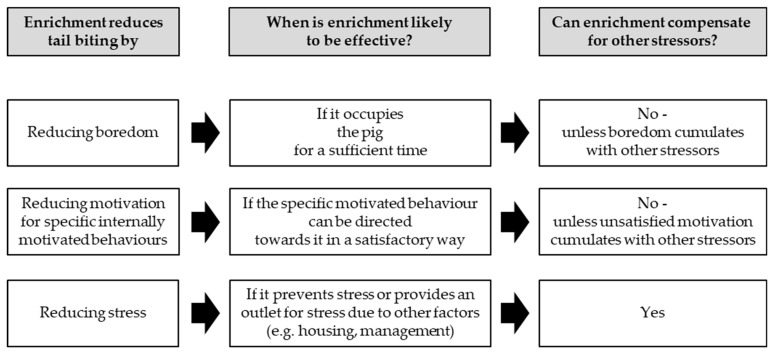
Tail biting remains a common problem in pig production. As producers are reluctant to use straw to reduce this behaviour, we review studies on the effectiveness of other types of enrichment. Roughage, hessian sacks, compost, fresh wood, space dividers, rope, and providing new objects regularly can significantly reduce tail damage. These results should be interpreted with some caution, as often only one study per enrichment could be identified. No evidence was found that commonly applied enrichment objects (processed wood, plastic or metal) reduce tail biting significantly unless exchanged regularly, even though multiple studies per type of enrichment were identified. Many studies evaluated the duration of enrichment use, but few evaluated the manner of use. This hampers identification of combinations of enrichment that will satisfy the pig's motivation to eat/smell, bite, root and change enrichments, which is suggested to reduce tail biting. New objects designed to satisfy specific motivations were shown to receive high levels of interaction, but their effectiveness at reducing tail damage remains unknown. More in-depth study of how pigs interact with non-straw enrichment, which motivations this satisfies and how this affects behaviour towards conspecifics, is necessary to optimize enrichment strategies. Optimization is necessary because ceasing tail docking in a way that improves pig welfare requires more effective enrichments than those described in this review, or alternatively, better control over other factors influencing tail biting.
咬尾仍是生猪养殖中的常见问题。由于养殖户不愿使用稻草来减少这种行为,我们综述了关于其他类型富集物有效性的研究。粗饲料、粗麻袋、堆肥、新鲜木材、空间分隔物、绳索以及定期提供新物品可显著减少尾部损伤。这些结果应谨慎解读,因为通常每种富集物只能找到一项研究。未发现常用的富集物(加工过的木材、塑料或金属)能显著减少咬尾行为,除非定期更换,尽管每种富集物都有多项研究。许多研究评估了富集物的使用时长,但很少评估其使用方式。这妨碍了确定能满足猪进食/嗅闻、啃咬、拱掘和更换富集物动机的富集物组合,而满足这些动机被认为可减少咬尾行为。旨在满足特定动机的新物品显示出较高的互动水平,但其减少尾部损伤的有效性仍未知。有必要更深入地研究猪如何与非稻草富集物互动、这种互动满足了哪些动机以及如何影响其对同类的行为,以优化富集策略。优化是必要的,因为要以改善猪福利的方式停止断尾,就需要比本综述中描述的更有效的富集物,或者更好地控制其他影响咬尾的因素。