• 文献检索
  • 文档翻译
  • 深度研究
  • 学术资讯
  • Suppr Zotero 插件Zotero 插件
  • 邀请有礼
  • 套餐&价格
  • 历史记录
应用&插件
Suppr Zotero 插件Zotero 插件浏览器插件Mac 客户端Windows 客户端微信小程序
定价
高级版会员购买积分包购买API积分包
服务
文献检索文档翻译深度研究API 文档MCP 服务
关于我们
关于 Suppr公司介绍联系我们用户协议隐私条款
关注我们

Suppr 超能文献

核心技术专利:CN118964589B侵权必究
粤ICP备2023148730 号-1Suppr @ 2026

文献检索

告别复杂PubMed语法,用中文像聊天一样搜索,搜遍4000万医学文献。AI智能推荐,让科研检索更轻松。

立即免费搜索

文件翻译

保留排版,准确专业,支持PDF/Word/PPT等文件格式,支持 12+语言互译。

免费翻译文档

深度研究

AI帮你快速写综述,25分钟生成高质量综述,智能提取关键信息,辅助科研写作。

立即免费体验

基于贝叶斯空间多层模型的社区环境对韩国成年人肥胖的影响

Influence of Neighborhood Environment on Korean Adult Obesity Using a Bayesian Spatial Multilevel Model.

机构信息

Institute for Health and Society, Hanyang University, Seoul 04763, Korea.

Department of Preventive Medicine, College of Medicine, Hanyang University, Seoul 04763, Korea.

出版信息

Int J Environ Res Public Health. 2019 Oct 18;16(20):3991. doi: 10.3390/ijerph16203991.

DOI:10.3390/ijerph16203991
PMID:31635403
原文链接:https://pmc.ncbi.nlm.nih.gov/articles/PMC6843842/
Abstract

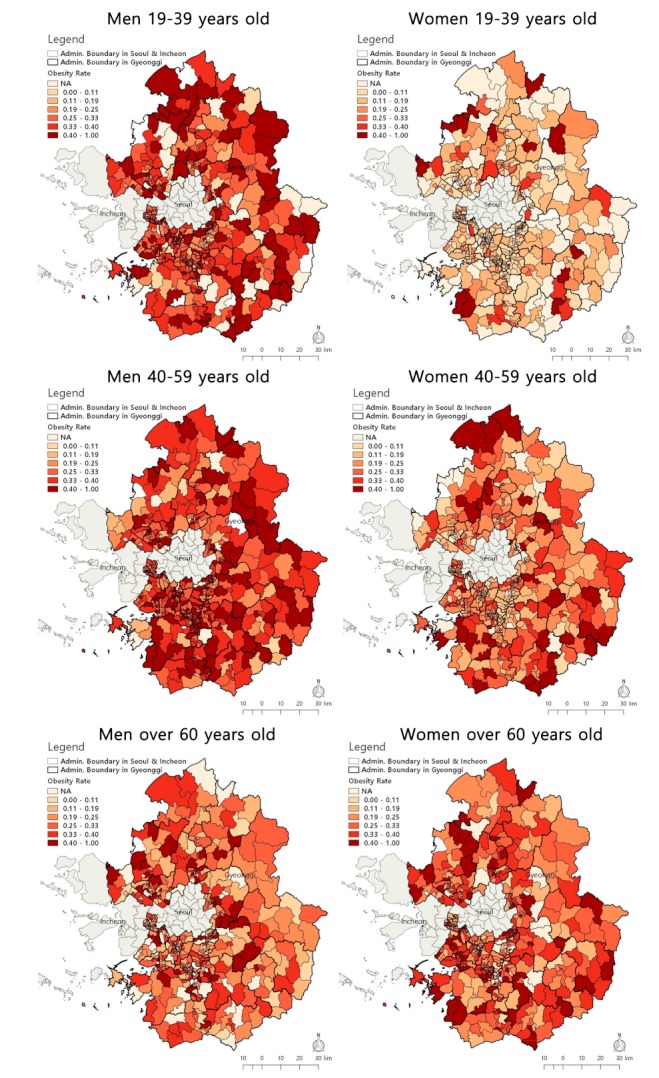
Previous studies using spatial statistical modeling that account for spatial associations between geographic areas are scarce. Therefore, this study examines the association between neighborhood environment and obesity using a Bayesian spatial multilevel model. Data from 78,014 adults living in Gyeonggi province in Korea were drawn from the 2013-2014 Korean Community Health Survey. Korean government databases and ArcGIS software (version 10.1, ESRI, Redlands, CA) were used to measure the neighborhood environment for 546 administrative districts of Gyeonggi province. A Bayesian spatial multilevel model was implemented across gender and age groups. The findings indicate that women aged 19-39 years who lived in neighborhoods farthest away from parks were more likely to be obese. Men aged 40-59 years who lived in neighborhoods farther from public physical activity facilities and with lower population density were more likely to be obese. Obesity for women aged 19-39 years was the most spatially dependent, while obesity for women aged 40-59 years was the least spatially dependent. The results suggest that neighborhood environments that provide more opportunities for physical activity are negatively related to obesity. Therefore, the creation of physical activity in favorable neighborhood environments, considering gender and age, may be a valuable strategy to reduce obesity.

摘要

先前使用空间统计建模来考虑地理区域之间空间关联的研究很少。因此,本研究使用贝叶斯空间多层模型来检验邻里环境与肥胖之间的关联。本研究的数据来自韩国京畿道 2013-2014 年韩国社区健康调查的 78014 名成年人。韩国政府数据库和 ArcGIS 软件(版本 10.1,ESRI,雷德兰兹,加利福尼亚州)用于测量京畿道 546 个行政区域的邻里环境。在性别和年龄组之间实施了贝叶斯空间多层模型。研究结果表明,19-39 岁的女性居住在距离公园最远的社区中,更有可能肥胖。40-59 岁的男性居住在距离公共体育活动设施较远且人口密度较低的社区中,更有可能肥胖。19-39 岁女性的肥胖症最具空间依赖性,而 40-59 岁女性的肥胖症最不具空间依赖性。结果表明,提供更多体育活动机会的邻里环境与肥胖呈负相关。因此,考虑到性别和年龄,在有利的邻里环境中创造体育活动可能是减少肥胖的一种有价值的策略。
https://cdn.ncbi.nlm.nih.gov/pmc/blobs/a87c/6843842/0ede93d15df2/ijerph-16-03991-g001.jpg

相似文献

1
Influence of Neighborhood Environment on Korean Adult Obesity Using a Bayesian Spatial Multilevel Model.基于贝叶斯空间多层模型的社区环境对韩国成年人肥胖的影响
Int J Environ Res Public Health. 2019 Oct 18;16(20):3991. doi: 10.3390/ijerph16203991.
2
Objectively Measured Built Environments and Cardiovascular Diseases in Middle-Aged and Older Korean Adults.客观测量的建筑环境与中老年韩国成年人的心血管疾病。
Int J Environ Res Public Health. 2021 Feb 14;18(4):1861. doi: 10.3390/ijerph18041861.
3
Association between objectively measured built environments and adult physical activity in Gyeonggi province, Korea.韩国京畿道客观测量建成环境与成人身体活动的关系。
Int J Public Health. 2018 Dec;63(9):1109-1121. doi: 10.1007/s00038-018-1138-y. Epub 2018 Jun 30.
4
Neighborhood built and social environment characteristics: a multilevel analysis of associations with obesity among children and their parents.邻里环境特征和社会环境特征:与儿童及其父母肥胖相关的多层次分析。
Int J Obes (Lond). 2013 Oct;37(10):1328-35. doi: 10.1038/ijo.2013.81. Epub 2013 May 21.
5
Socio-spatial patterns of neighborhood effects on adult obesity in Taiwan: a multi-level model.台湾地区成年人体重肥胖的邻里效应社会空间模式:多层次模型。
Soc Sci Med. 2010 Mar;70(6):823-33. doi: 10.1016/j.socscimed.2009.11.030. Epub 2010 Jan 22.
6
Relationships between neighborhoods, physical activity, and obesity: a multilevel analysis of a large Canadian city.社区、身体活动与肥胖之间的关系:对加拿大一大型城市的多层次分析。
Obesity (Silver Spring). 2012 Oct;20(10):2093-100. doi: 10.1038/oby.2011.392. Epub 2012 Jan 19.
7
Associations between neighborhood effects and physical activity, obesity, and diabetes: The Jamaica Health and Lifestyle Survey 2008.社区环境与身体活动、肥胖和糖尿病之间的关联:2008 年牙买加健康与生活方式调查。
J Clin Epidemiol. 2015 Sep;68(9):970-8. doi: 10.1016/j.jclinepi.2014.08.004. Epub 2015 Apr 22.
8
Perceived and Objective Measures of Neighborhood Walkability and Physical Activity among Adults in Japan: A Multilevel Analysis of a Nationally Representative Sample.日本成年人对邻里步行便利性和身体活动的感知与客观测量:对全国代表性样本的多层次分析
Int J Environ Res Public Health. 2015 Oct 23;12(10):13350-64. doi: 10.3390/ijerph121013350.
9
A spatially filtered multilevel model to account for spatial dependency: application to self-rated health status in South Korea.一种用于考虑空间相关性的空间滤波多层模型:在韩国自评健康状况中的应用。
Int J Health Geogr. 2014 Feb 27;13:6. doi: 10.1186/1476-072X-13-6.
10
Determinants of unhealthy living by gender, age group, and chronic health conditions across districts in Korea using the 2010-2017 Community Health Surveys.利用 2010-2017 年社区健康调查数据,按性别、年龄组和慢性健康状况对韩国各地区不良生活方式的决定因素进行分析。
Epidemiol Health. 2024;46:e2024014. doi: 10.4178/epih.e2024014. Epub 2024 Jan 4.

引用本文的文献

1
Objectively Measured Built Environments and Cardiovascular Diseases in Middle-Aged and Older Korean Adults.客观测量的建筑环境与中老年韩国成年人的心血管疾病。
Int J Environ Res Public Health. 2021 Feb 14;18(4):1861. doi: 10.3390/ijerph18041861.
2
Targeting the spatial context of obesity determinants via multiscale geographically weighted regression.通过多尺度地理加权回归来针对肥胖决定因素的空间背景。
Int J Health Geogr. 2020 Apr 5;19(1):11. doi: 10.1186/s12942-020-00204-6.

本文引用的文献

1
Cross-sectional and longitudinal analysis of the active commuting behaviors of U.S. Department of the Interior employees.美国内政部员工的主动通勤行为的横断面和纵向分析。
BMC Public Health. 2019 May 8;19(1):526. doi: 10.1186/s12889-019-6746-9.
2
Is BMI the best measure of obesity?体重指数是衡量肥胖的最佳指标吗?
BMJ. 2018 Mar 29;360:k1274. doi: 10.1136/bmj.k1274.
3
Gender Difference and Spatial Heterogeneity in Local Obesity.局部肥胖的性别差异和空间异质性。
Int J Environ Res Public Health. 2018 Feb 10;15(2):311. doi: 10.3390/ijerph15020311.
4
Associations between fast food and physical activity environments and adiposity in mid-life: cross-sectional, observational evidence from UK Biobank.中年时期快餐和身体活动环境与肥胖的关联:来自英国生物库的横断面观察证据。
Lancet Public Health. 2018 Jan;3(1):e24-e33. doi: 10.1016/S2468-2667(17)30212-8. Epub 2017 Dec 13.
5
Characterizing the neighborhood obesogenic environment in the Multiethnic Cohort: a multi-level infrastructure for cancer health disparities research.多族裔队列中邻里致肥胖环境的特征分析:癌症健康差异研究的多层次基础设施
Cancer Causes Control. 2018 Jan;29(1):167-183. doi: 10.1007/s10552-017-0980-1. Epub 2017 Dec 8.
6
Residential greenness and adiposity: Findings from the UK Biobank.居住环境绿化与肥胖:来自英国生物库的研究发现。
Environ Int. 2017 Sep;106:1-10. doi: 10.1016/j.envint.2017.05.016. Epub 2017 May 25.
7
The interaction between physical activity and obesity gene variants in association with BMI: Does the obesogenic environment matter?身体活动与肥胖基因变异之间的相互作用与体重指数的关系:致肥胖环境重要吗?
Health Place. 2016 Nov;42:159-165. doi: 10.1016/j.healthplace.2016.09.003. Epub 2016 Oct 20.
8
Determinants and Consequences of Obesity.肥胖的决定因素及后果
Am J Public Health. 2016 Sep;106(9):1656-62. doi: 10.2105/AJPH.2016.303326. Epub 2016 Jul 26.
9
Trends in adult body-mass index in 200 countries from 1975 to 2014: a pooled analysis of 1698 population-based measurement studies with 19·2 million participants.1975年至2014年200个国家成人身体质量指数的趋势:对1698项基于人群测量研究的汇总分析,涉及1920万参与者。
Lancet. 2016 Apr 2;387(10026):1377-1396. doi: 10.1016/S0140-6736(16)30054-X.
10
Park availability and physical activity, TV time, and overweight and obesity among women: Findings from Australia and the United States.澳大利亚和美国女性的公园可及性与身体活动、看电视时间以及超重和肥胖状况:研究结果
Health Place. 2016 Mar;38:96-102. doi: 10.1016/j.healthplace.2015.12.004. Epub 2016 Feb 1.