Center for Geospatial Information Science, Department of Geographical Sciences, University of Maryland, College Park, MD, 20740, USA.
School of Geographical Sciences & Urban Planning, Arizona State University, Tempe, AZ, 85281, USA.
Int J Health Geogr. 2020 Apr 5;19(1):11. doi: 10.1186/s12942-020-00204-6.
Obesity rates are recognized to be at epidemic levels throughout much of the world, posing significant threats to both the health and financial security of many nations. The causes of obesity can vary but are often complex and multifactorial, and while many contributing factors can be targeted for intervention, an understanding of where these interventions are needed is necessary in order to implement effective policy. This has prompted an interest in incorporating spatial context into the analysis and modeling of obesity determinants, especially through the use of geographically weighted regression (GWR).
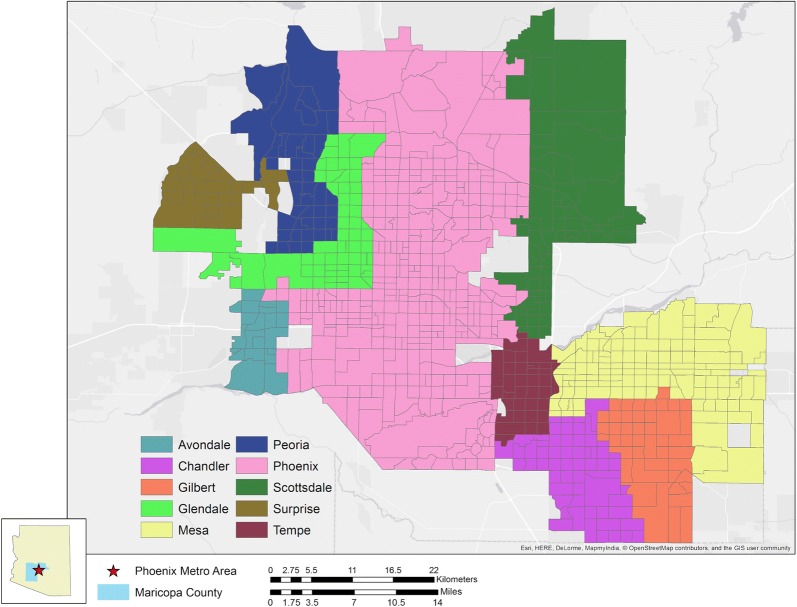
This paper provides a critical review of previous GWR models of obesogenic processes and then presents a novel application of multiscale (M)GWR using the Phoenix metropolitan area as a case study.
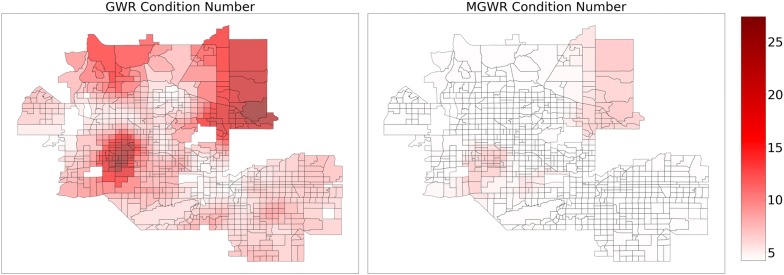
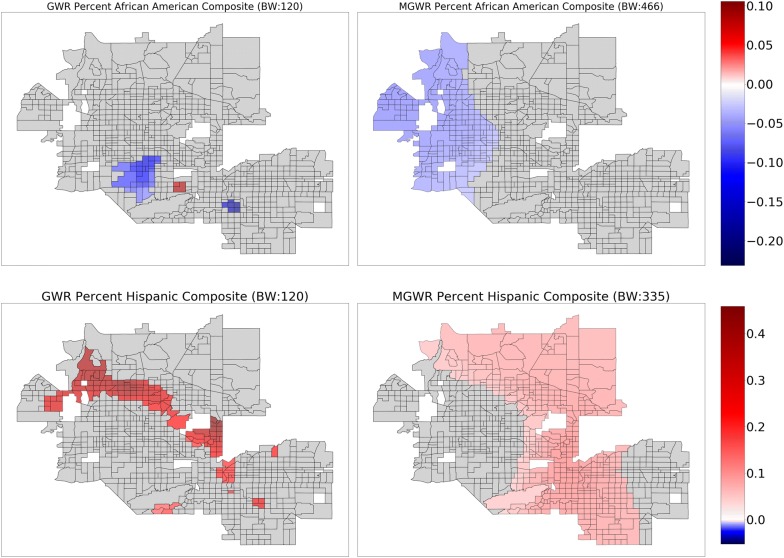
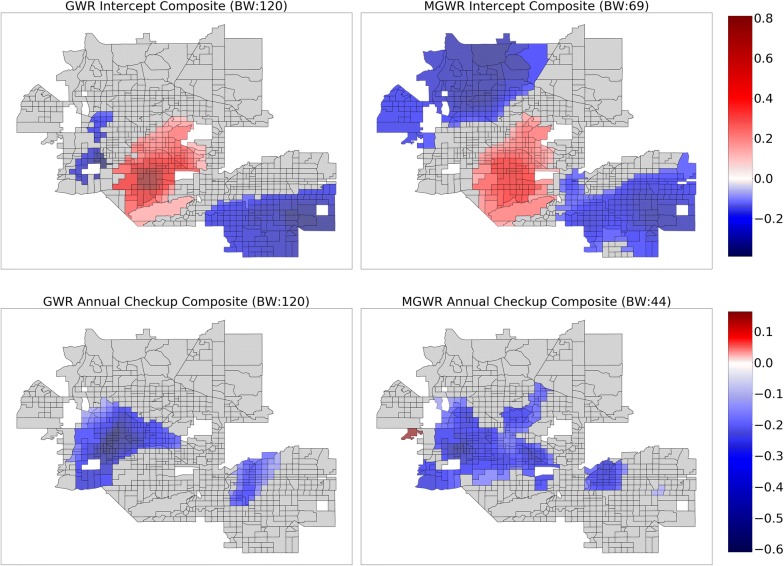
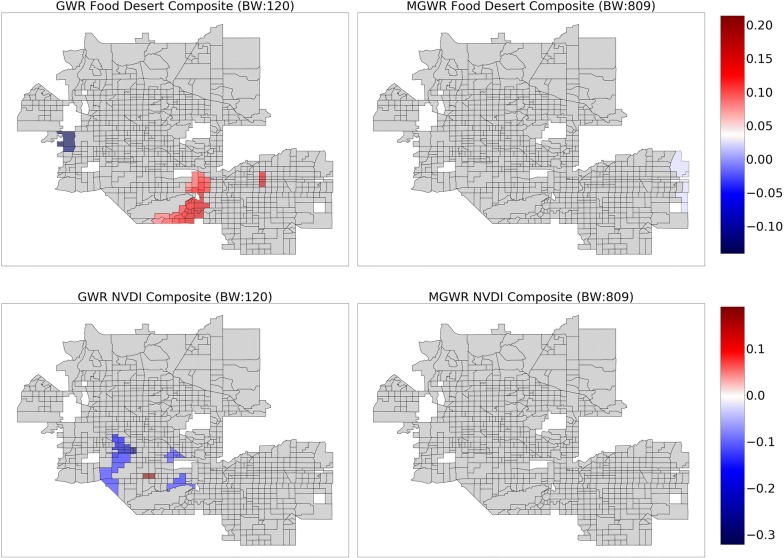
Though the MGWR model consumes more degrees of freedom than OLS, it consumes far fewer degrees of freedom than GWR, ultimately resulting in a more nuanced analysis that can incorporate spatial context but does not force every relationship to become local a priori. In addition, MGWR yields a lower AIC and AICc value than GWR and is also less prone to issues of multicollinearity. Consequently, MGWR is able to improve our understanding of the factors that influence obesity rates by providing determinant-specific spatial contexts.
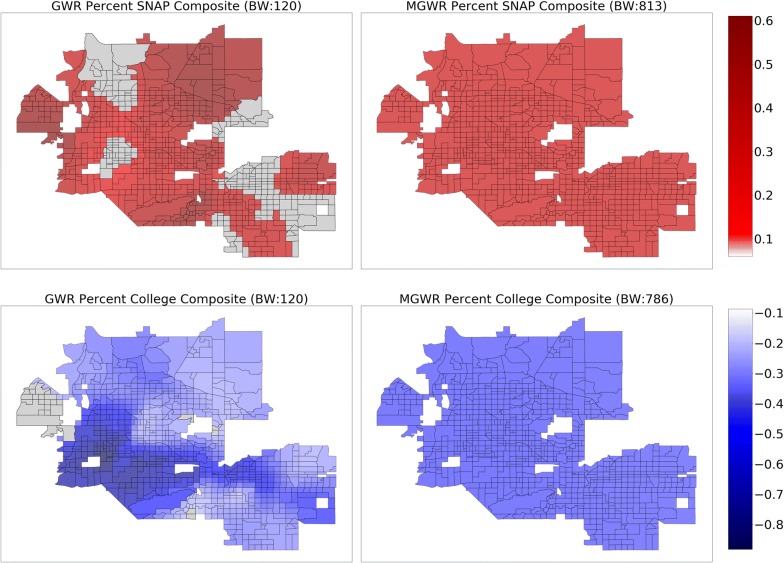
The results show that a mix of global and local processes are able to best model obesity rates and that MGWR provides a richer yet more parsimonious quantitative representation of obesity rate determinants compared to both GWR and ordinary least squares.
肥胖率在世界上许多地方都被认为处于流行水平,对许多国家的健康和财政安全构成了重大威胁。肥胖的原因可能各不相同,但往往是复杂的和多因素的,虽然许多促成因素可以作为干预目标,但为了实施有效的政策,了解需要干预的地方是必要的。这促使人们有兴趣将空间背景纳入肥胖决定因素的分析和建模中,特别是通过使用地理加权回归(GWR)。
本文对以前肥胖决定因素的 GWR 模型进行了批判性回顾,然后提出了一种使用凤凰大都市区作为案例研究的多尺度(M)GWR 的新应用。
虽然 MGWR 模型消耗的自由度比 OLS 多,但消耗的自由度比 GWR 少得多,最终产生了更细致的分析,可以纳入空间背景,但不会强制每个关系都成为先验的局部关系。此外,MGWR 产生的 AIC 和 AICc 值低于 GWR,也较少出现多重共线性问题。因此,MGWR 能够通过提供特定于决定因素的空间背景来提高我们对影响肥胖率因素的理解。
结果表明,全球和局部过程的混合能够最好地模拟肥胖率,并且与 GWR 和普通最小二乘法相比,MGWR 为肥胖率决定因素提供了更丰富但更简约的定量表示。