Centre for International Health, University of Otago, Dunedin, New Zealand.
Colorado Department of Public Health and Environment, Denver, Colorado, USA.
Antimicrob Agents Chemother. 2019 Dec 20;64(1). doi: 10.1128/AAC.01974-19.
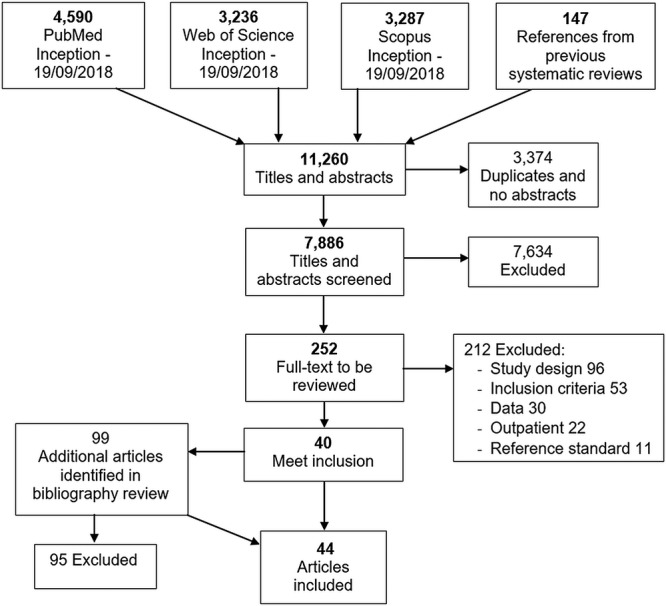
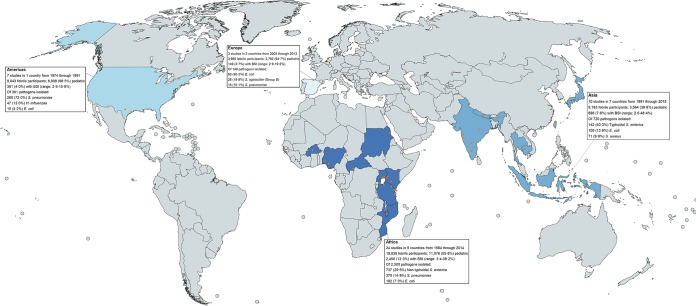
Community-onset bloodstream infections (CO-BSI) are major causes of severe febrile illness and death worldwide. In light of new data and the growing problem of antimicrobial resistance (AMR) among pathogens causing BSI, we undertook a systematic review of hospital-based studies of CO-BSI among patients hospitalized with fever. Without restriction to language or country, we searched PubMed, Web of Science, and Scopus for prospective hospital-based studies of culture-confirmed CO-BSI among febrile inpatients. We determined by study the prevalence of BSI among participants, the pathogens responsible for BSI, and the antimicrobial susceptibility patterns of pathogens causing BSI, according to place and time. Thirty-four (77.3%) of 44 eligible studies recruited 29,022 participants in Africa and Asia combined. Among participants in these two regions, the median prevalence of BSI was 12.5% (range, 2.0 to 48.4%); of 3,220 pathogens isolated, 1,119 (34.8%) were , 425 (13.2%) , and 282 (8.8%) Antimicrobial susceptibility testing was reported in 16 (36.4%) studies. When isolates collected prior to 2008 were compared to those collected in the period of 2008 through 2018, the proportions of typhoidal and isolates resistant to several clinically relevant antimicrobials increased over time, while susceptibility was stable. CO-BSI remain a major cause of severe febrile illness among hospitalized patients in Africa and Asia, with , , and predominating. There is a concerning increase in AMR among serious infections caused by community-onset pathogens. Ongoing surveillance is needed to inform empirical management and strategies to control AMR.
社区获得性血流感染(CO-BSI)是全球范围内导致严重发热疾病和死亡的主要原因。鉴于新数据和导致 BSI 的病原体的抗菌药物耐药性(AMR)日益严重的问题,我们对因发热住院的患者中基于医院的 CO-BSI 进行了系统评价。我们没有对语言或国家进行限制,在 PubMed、Web of Science 和 Scopus 上搜索了关于发热住院患者中经培养确认的 CO-BSI 的基于医院的前瞻性研究。我们根据地点和时间确定了研究中参与者的 BSI 患病率、导致 BSI 的病原体以及导致 BSI 的病原体的抗菌药物敏感性模式。在 44 项符合条件的研究中,有 34 项(77.3%)在非洲和亚洲共招募了 29022 名参与者。在这两个地区的参与者中,BSI 的中位数患病率为 12.5%(范围为 2.0%至 48.4%);在分离出的 3220 种病原体中,1119 种(34.8%)为 ,425 种(13.2%)为 ,282 种(8.8%)为 。16 项(36.4%)研究报告了抗菌药物敏感性测试。当比较 2008 年前收集的分离株与 2008 年至 2018 年期间收集的分离株时,随着时间的推移,伤寒 和 分离株对几种临床相关抗菌药物的耐药比例增加,而 敏感性保持稳定。CO-BSI 仍然是非洲和亚洲住院患者严重发热疾病的主要原因,以 、 、 和 为主。社区获得性病原体引起的严重感染的 AMR 令人担忧地增加。需要进行持续监测,以为经验性管理和控制 AMR 的策略提供信息。