Sigdel Anil, Abdollahi-Arpanahi Rostam, Aguilar Ignacio, Peñagaricano Francisco
Department of Animal Sciences, University of Florida, Gainesville, FL, United States.
Instituto Nacional de Investigación Agropecuaria, Canelones, Uruguay.
Front Genet. 2019 Oct 4;10:928. doi: 10.3389/fgene.2019.00928. eCollection 2019.
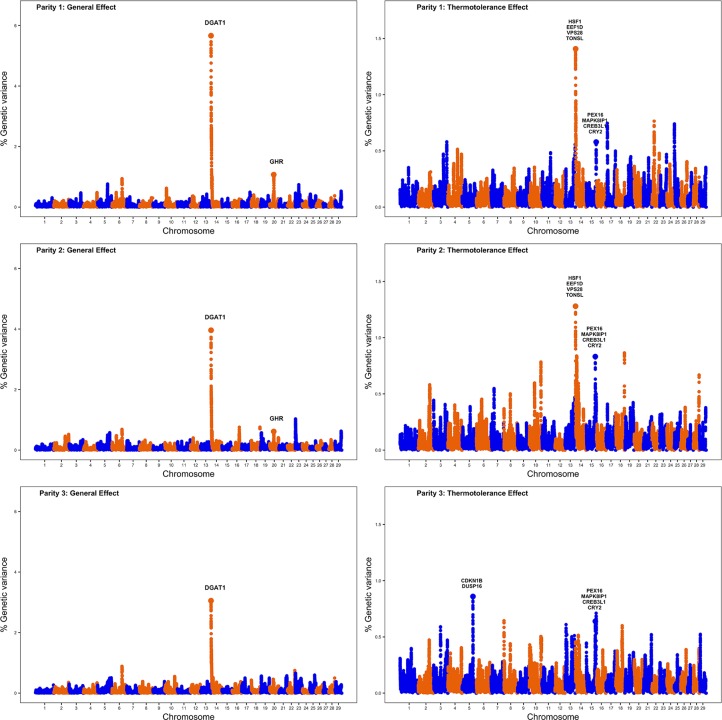
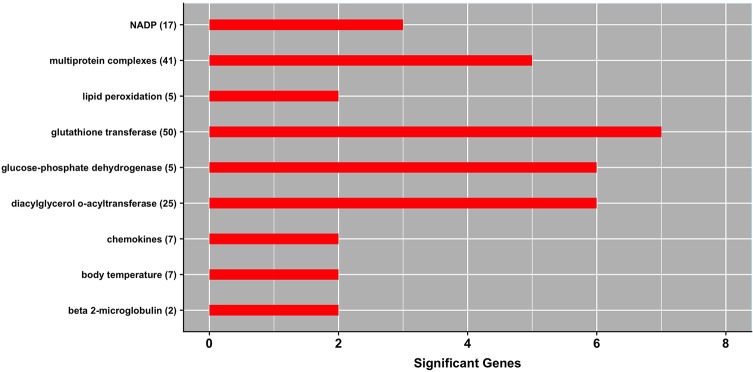
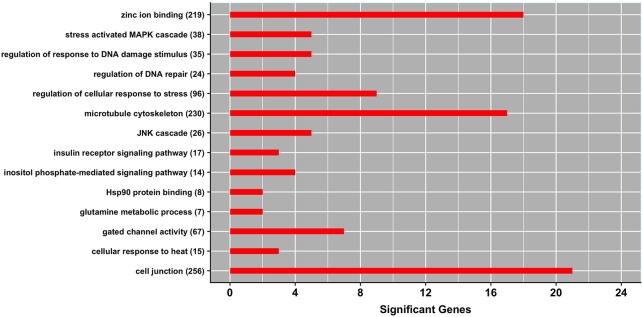
Heat stress represents a major environmental factor that negatively affects the health and performance of dairy cows, causing huge economic losses to the dairy industry. Identifying and selecting animals that are thermotolerant is an attractive alternative for reducing the negative effects of heat stress on dairy cattle performance. As such, the objectives of the present study were to estimate genetic components of milk yield, fat yield, and protein yield considering heat stress and to perform whole-genome scans and a subsequent gene-set analysis for identifying candidate genes and functional gene-sets implicated in milk production under heat stress conditions. Data consisted of about 254k test-day records from 17,522 Holstein cows. Multi-trait repeatability test day models with random regressions on a function of temperature-humidity index (THI) values were used for genetic analyses. The models included herd-test-day and DIM classes as fixed effects, and general and thermotolerance additive genetic and permanent environmental as random effects. Notably, thermotolerance additive genetic variances for all milk traits increased across parities suggesting that cows become more sensitive to heat stress as they age. In addition, our study revealed negative genetic correlations between general and thermotolerance additive effects, ranging between -0.18 to -0.68 indicating that high producing cows are more susceptible to heat stress. The association analysis identified at least three different genomic regions on BTA5, BTA14, and BTA15 strongly associated with milk production under heat stress conditions. These regions harbor candidate genes, such as , and that are directly involved in the cellular response to heat stress. Moreover, the gene-set analysis revealed several functional terms related to heat shock proteins, apoptosis, immune response, and oxidative stress, among others. Overall, the genes and pathways identified in this study provide a better understanding of the genetic architecture underlying dairy cow performance under heat stress conditions. Our findings point out novel opportunities for improving thermotolerance in dairy cattle through marker-assisted breeding.
热应激是一个主要的环境因素,会对奶牛的健康和生产性能产生负面影响,给乳制品行业造成巨大经济损失。识别和选择耐热的动物是减少热应激对奶牛生产性能负面影响的一个有吸引力的选择。因此,本研究的目的是考虑热应激因素来估计产奶量、产脂量和产蛋白量的遗传成分,并进行全基因组扫描和后续的基因集分析,以识别与热应激条件下产奶相关的候选基因和功能基因集。数据包括来自17522头荷斯坦奶牛的约25.4万条测定日记录。采用多性状重复性测定日模型,并对温度湿度指数(THI)值进行随机回归分析以进行遗传分析。模型包括牛群-测定日和产犊间隔类别作为固定效应,以及一般和耐热性加性遗传效应和永久环境效应作为随机效应。值得注意的是,所有产奶性状的耐热性加性遗传方差在不同胎次间均有所增加,这表明奶牛随着年龄增长对热应激变得更加敏感。此外,我们的研究揭示了一般加性效应和耐热性加性效应之间存在负遗传相关性,范围在-0.18至-0.68之间,这表明高产奶牛更容易受到热应激的影响。关联分析确定了BTA5、BTA14和BTA15上至少三个不同的基因组区域与热应激条件下的产奶量密切相关。这些区域包含候选基因,如 、 和 ,它们直接参与细胞对热应激的反应。此外,基因集分析揭示了几个与热休克蛋白、细胞凋亡、免疫反应和氧化应激等相关的功能术语。总体而言,本研究中确定的基因和途径有助于更好地理解热应激条件下奶牛生产性能的遗传结构。我们的研究结果指出了通过标记辅助育种提高奶牛耐热性的新机会。