Yang Hee Won, Lee Miji, Shin Jong Wook, Jeong Hye Seon, Kim Jei, Kim Jeong Lan
Department of Psychiatry, Chungnam National University Hospital, Daejeon, Republic of Korea.
Department of Neurology, Chungnam National University Hospital, Daejeon, Republic of Korea.
Psychiatry Investig. 2019 Nov;16(11):852-859. doi: 10.30773/pi.2019.0120. Epub 2019 Oct 28.
This study evaluated the outcomes of ischemic stroke patients according to delirium motor subtype.
This study included patients who were admitted to the stroke unit between August 2017 and March 2019 and met the DSM-5 diagnostic criteria for delirium. Patients were assessed twice weekly throughout their delirium episodes using the Korean version of the Delirium Motor Subtype Scale (K-DMSS) and the Korean version of the Delirium Rating Scale-Revised-98 (K-DRS-98). The clinical characteristics and short-term outcomes of the patients were also assessed.
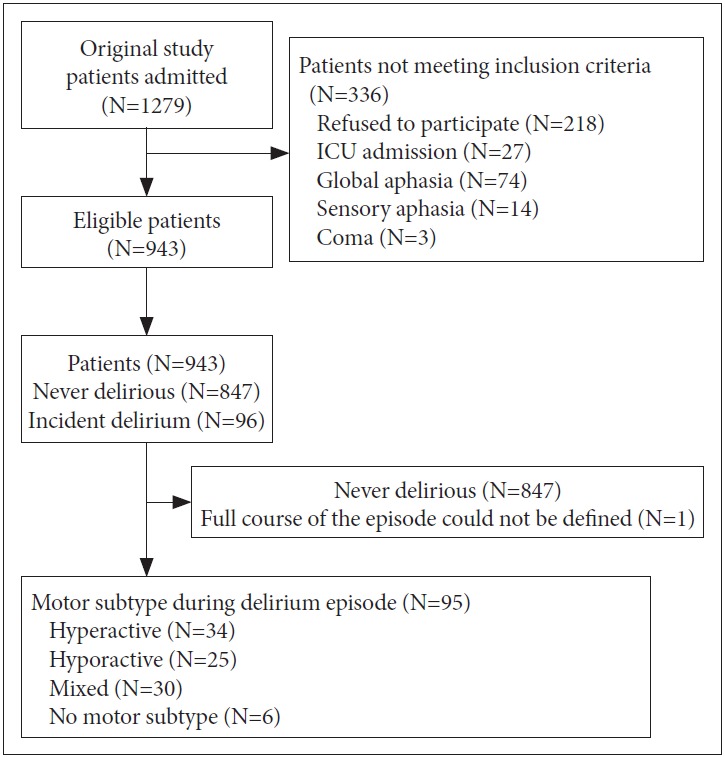
A total of 943 stroke patients were included; the rate of incident delirium was 10.18%. Of the 95 delirium patients, 34 were classified as the hyperactive subtype, 30 as the mixed subtype, 25 as the hypoactive and six as no subtype. Among the subtype groups, the hypoactive subtype had the highest initial scores on the National Institutes of Health Stroke Scale (NIHSS; 6.72±4.75, p=0.02) and the modified Rankin Scale (mRS; 3.96±1.24, p<0.01). Additionally, the mixed and hypoactive subtypes had longer durations (p<0.01) and more severe symptoms of delirium (p=0.03) than the other motor subtypes, and the hypoactive subtype group had a significantly longer hospital stay (36.88±27.71 days, p<0.01) than the other subtype groups. After adjusting for baseline covariates in a multiple linear regression analysis, these differences remained significant.
The present results suggest that the motor subtype of delirium is associated with different characteristics and outcomes in ischemic stroke patients.
本研究根据谵妄运动亚型评估缺血性中风患者的预后。
本研究纳入了2017年8月至2019年3月期间入住卒中单元且符合DSM-5谵妄诊断标准的患者。在谵妄发作期间,每周对患者进行两次评估,使用韩国版谵妄运动亚型量表(K-DMSS)和韩国版谵妄评定量表修订版98(K-DRS-98)。还评估了患者的临床特征和短期预后。
共纳入943例中风患者;谵妄发生率为10.18%。在95例谵妄患者中,34例被分类为多动型,30例为混合型,25例为少动型,6例无亚型。在各亚型组中,少动型在国立卫生研究院卒中量表(NIHSS;6.72±4.75,p=0.02)和改良Rankin量表(mRS;3.96±1.24,p<0.01)上的初始得分最高。此外,混合型和少动型的谵妄持续时间更长(p<0.01),症状比其他运动亚型更严重(p=0.03),少动型组的住院时间明显长于其他亚型组(36.88±27.71天,p<0.01)。在多元线性回归分析中对基线协变量进行调整后,这些差异仍然显著。
目前的结果表明,谵妄的运动亚型与缺血性中风患者的不同特征和预后相关。