Nursing research Campus Kiel University Hospital of Schleswig-Holstein Kiel Germany.
Faculty of Health School of Nursing Science Witten/Herdecke University Witten Germany.
Brain Behav. 2017 Jun 23;7(8):e00748. doi: 10.1002/brb3.748. eCollection 2017 Aug.
This study investigates the prevalence of delirium in acute stroke patients on a primary stroke unit (SU) analyzing associated risk factors and clinical outcomes.
Prospective, 4-month observational study from 2015 to 2016 on patients aged ≥18 years with stroke at a German university hospital's SU. The presence of delirium as first outcome was rated at three times daily using the Confusion Assessment Method (CAM). Secondary outcome measures were duration of delirium, rehabilitation in SU, length of stay in SU and hospital, complications, and mortality. Significant risk factors were used to conduct a confounder-matched case-control analysis.
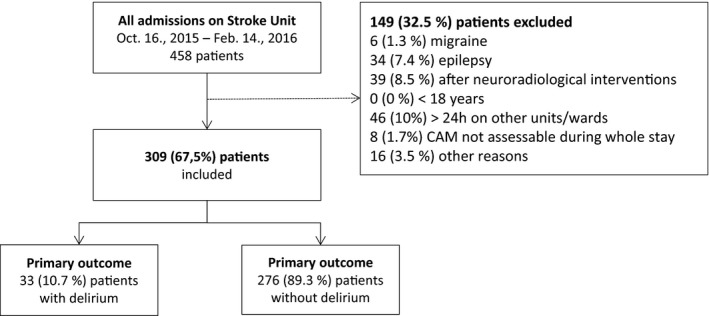
309 patients were included. The overall prevalence of delirium was 10.7% (33 patients) mostly on the first and second hospital day. Duration of delirium on SU was in median 1.0 day (Interquartile range: 0.3-2 days). In 39.4% of patients delirium was present in a short time interval (≤8 hr) and in 24% of patients delirium was diagnosed during nightshifts exclusively. Significant risk factors for delirium were dementia, age ≥72 years, severe neurological disability on admission, and increased C-reactive protein on admission. The case-control analysis showed that delirious patients had more complications and a trend toward a worse rehabilitation.
These results underline the importance of delirium screening in stroke patients specifically during the night. Since even short delirious episodes are associated with more complications and increased disability, future studies are needed to find delirium prevention strategies.
本研究旨在分析急性脑卒中患者在初级卒中单元(SU)中发生谵妄的患病率及相关危险因素和临床结局。
这是一项前瞻性、于 2015 年至 2016 年在德国一所大学附属医院 SU 中进行的 4 个月观察性研究,纳入年龄≥18 岁的卒中患者。使用意识模糊评估方法(CAM)每日 3 次评估谵妄的发生作为主要结局。次要结局包括谵妄持续时间、SU 内康复、SU 和医院住院时间、并发症和死亡率。使用有显著意义的危险因素进行混杂因素匹配的病例对照分析。
共纳入 309 例患者,谵妄总体患病率为 10.7%(33 例),大多发生在入院后第 1 天和第 2 天。SU 内谵妄持续时间中位数为 1.0 天(四分位间距:0.3-2 天)。39.4%的患者谵妄发生在短时间间隔(≤8 小时)内,24%的患者仅在夜班期间诊断出谵妄。发生谵妄的显著危险因素为痴呆、年龄≥72 岁、入院时严重神经功能障碍和入院时 C 反应蛋白升高。病例对照分析显示,谵妄患者的并发症更多,康复情况也呈恶化趋势。
这些结果强调了在卒中患者中特别是夜间进行谵妄筛查的重要性。由于即使短暂的谵妄发作也与更多的并发症和残疾增加有关,因此需要进一步研究来寻找预防谵妄的策略。