Kunwar Sundar, Pandey Puran, Lee Jihoon
Department of Electronic Engineering, College of Electronics and Information, Kwangwoon University, Nowon-gu, Seoul 01897, South Korea.
ACS Omega. 2019 Oct 14;4(17):17340-17351. doi: 10.1021/acsomega.9b02066. eCollection 2019 Oct 22.
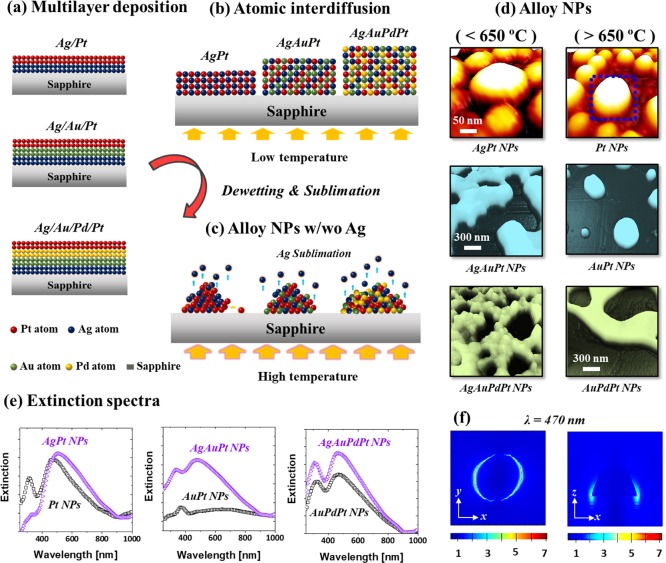
Multi-metallic alloy nanoparticles (NPs) can offer tunable or modifiable localized surface plasmon resonance (LSPR) properties depending upon their configurational and elemental alterations, which can be utilized in various applications, that is, in photon energy harvesting, optical sensing, biomedical imaging, photocatalysis, and spectroscopy. In this work, a systematic investigation on the morphological and LSPR properties of multi-metallic alloy NPs incorporating Ag, Au, Pd, and Pt is presented on -plane sapphire (0001). The resulting NPs exhibit much enhanced and tunable LSPR bands in the UV-VIS wavelength as compared to the previously reported mono-metallic NPs based on the considerable improvement in size and shape of nanostructures along with the electronic heterogeneity. Solid-state dewetting of sputtered bilayers (Ag/Pt), tri-layers (Ag/Au/Pt), and quad-layers (Ag/Au/Pd/Pt) is employed to demonstrate a wide variety of configurations, sizes, densities, and elemental compositions of Pt, AgPt, AuPt, AgAuPt, AgAuPt, and AgAuPdPt NPs by the systematic control of annealing temperature and deposition schemes. The distinct morphology and elemental composition of surface nanostructures are obtained by means of surface diffusion, intermixing, and surface/interface energy minimization along with the applied thermal energy. In addition, the sublimation of Ag atoms from the alloy nanostructure matrix significantly influences the structural, elemental, and thus optical properties of NPs by reducing the average size and Ag percentage in the alloy NPs. Based on the specific size, shape, and elemental composition of NPs, the excitation of LSPR is correlated to the dipolar, quadrupolar, multi-polar, and higher order (HO) modes along with the finite difference time domain simulation of local electric-field. The LSPR intensity is generally stronger with a higher percentage of Ag atoms in the alloy NPs and gradually diminished by the sublimation loss. However, even the mono-metallic and alloy NPs without Ag exhibited significantly improved and dynamic nature of plasmonic bands in the UV and VIS wavelength.
多金属合金纳米颗粒(NPs)可根据其结构和元素变化提供可调节或可修改的局域表面等离子体共振(LSPR)特性,这些特性可用于各种应用,即光子能量收集、光学传感、生物医学成像、光催化和光谱学。在这项工作中,对在平面蓝宝石(0001)上包含Ag、Au、Pd和Pt的多金属合金纳米颗粒的形态和LSPR特性进行了系统研究。与先前报道的单金属纳米颗粒相比,由于纳米结构的尺寸和形状以及电子不均匀性有了显著改善,所得纳米颗粒在紫外-可见波长范围内表现出大大增强且可调节的LSPR带。通过溅射双层(Ag/Pt)、三层(Ag/Au/Pt)和四层(Ag/Au/Pd/Pt)的固态去湿,通过系统控制退火温度和沉积方案,展示了Pt、AgPt、AuPt、AgAuPt、AgAuPt和AgAuPdPt纳米颗粒的各种配置、尺寸、密度和元素组成。通过表面扩散、混合以及表面/界面能量最小化和施加的热能,获得了表面纳米结构独特的形态和元素组成。此外,Ag原子从合金纳米结构基质中的升华通过减小合金纳米颗粒的平均尺寸和Ag百分比,显著影响纳米颗粒的结构、元素以及光学性质。基于纳米颗粒的特定尺寸、形状和元素组成,LSPR的激发与偶极、四极、多极和高阶(HO)模式以及局部电场的有限差分时域模拟相关。合金纳米颗粒中Ag原子百分比越高,LSPR强度通常越强,并因升华损失而逐渐减弱。然而,即使是不含Ag的单金属和合金纳米颗粒,在紫外和可见波长范围内也表现出等离子体带的显著改善和动态特性。