Ting Yuwen, Hu Yin-Ting, Hu Jing-Yu, Chang Wen-Chang, Huang Qingrong, Hsieh Shu-Chen
Graduate Institute of Food Science and Technology National Taiwan University Taipei City Taiwan.
Department of Food Science National Chiayi University Chiayi City Taiwan.
Food Sci Nutr. 2019 Sep 5;7(10):3216-3223. doi: 10.1002/fsn3.1176. eCollection 2019 Oct.
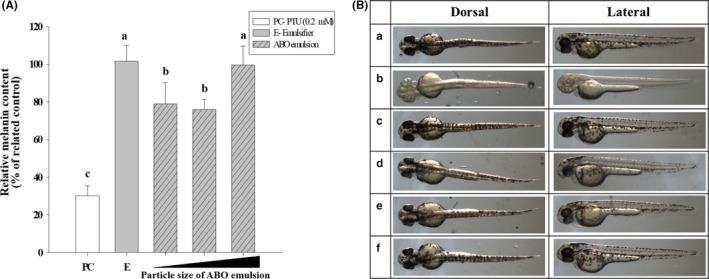
The efficacy of oily components is often difficult to evaluate due to their incompatibility with most models. Here, we emulsified adlay bran oil (ABO), processed it to a nanoscale, and investigated its anti-hyperpigmentation efficacy, assessed for its inhibitory effects against tyrosinase activity and melanin production, in an in vitro system (mouse melanoma B16F10 cells) and an in vivo system (zebrafish embryos). ABO induced dose-dependent reductions in tyrosinase activity and melanin production in both the melanoma cells and zebrafish, without affecting viability. The efficacy of ABO was strongly influenced by emulsion particle size in the zebrafish but not in the cells. These results indicate that ABO has potential as a tyrosinase inhibitor and anti-hyperpigmentation agent and that the emulsion system is an effective method for delivering the bioactive components of ABO to living systems that could be utilized for other oily components.
由于油性成分与大多数模型不兼容,其功效往往难以评估。在此,我们将薏仁麸皮油(ABO)乳化,将其加工至纳米级,并在体外系统(小鼠黑色素瘤B16F10细胞)和体内系统(斑马鱼胚胎)中研究其抗色素沉着功效,评估其对酪氨酸酶活性和黑色素生成的抑制作用。ABO在黑色素瘤细胞和斑马鱼中均诱导酪氨酸酶活性和黑色素生成呈剂量依赖性降低,且不影响细胞活力。ABO的功效在斑马鱼中受乳液粒径的强烈影响,但在细胞中不受影响。这些结果表明,ABO有潜力作为酪氨酸酶抑制剂和抗色素沉着剂,且乳液系统是将ABO的生物活性成分递送至生物系统的有效方法,该方法可用于其他油性成分。