Department of Forensic and Neurodevelopmental Sciences, Institute of Psychiatry, Psychology and Neuroscience, King's College London, London, United Kingdom.
Centre for Cognition, Neuroscience and Neuroimaging (CNNI), Department of Psychology, Roehampton University, London, United Kingdom.
PLoS One. 2019 Oct 29;14(10):e0224455. doi: 10.1371/journal.pone.0224455. eCollection 2019.
Psychopathy is a personality disorder characterised by two underlying factors. Factor 1 (affective and interpersonal deficits) captures affective deficits, whilst Factor 2 (antisocial and impulsive/disorganised behaviours) captures life course persistent antisocial behaviours. Impaired processing of threat has been proposed as an aetiologically salient factor in the development of psychopathy, but the relationship of this impairment to the factorial structure of the disorder in adult male offenders is unclear.
To investigate whether threat processing deficits are characteristic of psychopathy as a unitary construct or whether such deficits are specifically linked to higher scores on individual factors.
A systematic review of the literature was conducted by searching PubMed, Web of Science and PsycINFO.
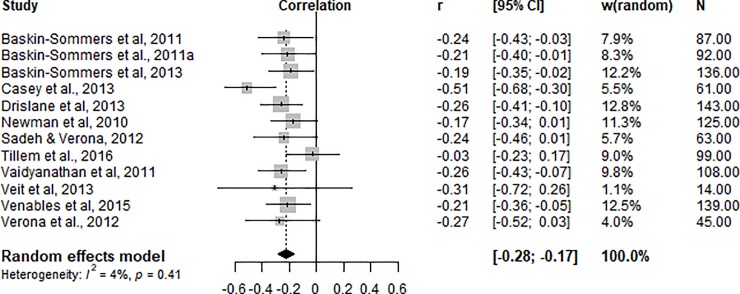
Studies were included if they (1) reported physiological measures of threat response as the primary outcome measure (2) indexed psychopathy using a well-validated clinician rated instrument such as the PCL-R (3) investigated male offenders between 18 and 60 years of age (4) reported threat processing analyses using both Factor 1 and Factor 2 scores (5) provided sufficient data to calculate effect sizes and (6) were published in English-language peer-reviewed journals. We identified twelve studies with data on 1112 participants for the meta-analysis of the relationship with Factor 1 scores, and nine studies with data on 801 participants for the meta-analysis of the relationship with Factor 2 scores. We conducted the meta-analyses to calculate correlations using random-effects models.
PCL-R/SV Factor 1 scores were significantly and negatively related to threat processing indices (r = -0.22, (95%CI [-0.28, -.017]). Neither PCL-R/SV Factor 2 scores (r = -0.005, 95%CI [-0.10, 0.09]), nor PCL-R total score (r = -0.05, (95%CI [-0.15, -0.04]) were related to threat processing indices. No significant heterogeneity was detected for the Factor score results.
The meta-analyses of the distinct psychopathy factors suggest that the threat processing deficits observed in male offenders with psychopathy are significantly associated with higher scores on Factor 1. A similar relationship does not exist with Factor 2 scores. Our findings highlight the importance of investigating the potentially discrete relationships between aetiological variables and the two factor constructs in the disorder.
精神病态是一种以两个潜在因素为特征的人格障碍。因素 1(情感和人际关系缺陷)捕捉情感缺陷,而因素 2(反社会和冲动/组织不良行为)捕捉生活过程中持续的反社会行为。威胁处理受损被认为是精神病态发展的一个重要病因因素,但这种损伤与成年男性罪犯中该障碍的因子结构之间的关系尚不清楚。
探讨威胁处理缺陷是否是精神病态的一个整体特征,还是这种缺陷与个体因素的高分具体相关。
通过搜索 PubMed、Web of Science 和 PsycINFO 进行文献系统综述。
如果研究(1)报告了威胁反应的生理测量作为主要结果测量,(2)使用经过良好验证的临床评定工具(如 PCL-R)对精神病态进行索引,(3)调查年龄在 18 至 60 岁之间的男性罪犯,(4)使用因素 1 和因素 2 分数进行威胁处理分析,(5)提供足够的数据来计算效应大小,以及(6)以英文同行评议期刊发表,则将其纳入研究。我们确定了十二项研究,其中有 1112 名参与者的数据用于因素 1 分数关系的荟萃分析,有九项研究,其中有 801 名参与者的数据用于因素 2 分数关系的荟萃分析。我们进行荟萃分析以使用随机效应模型计算相关系数。
PCL-R/SV 因素 1 分数与威胁处理指标显著负相关(r = -0.22,(95%CI [-0.28,-.017])。PCL-R/SV 因素 2 分数(r = -0.005,95%CI [-0.10,0.09])或 PCL-R 总分(r = -0.05,(95%CI [-0.15,-0.04])与威胁处理指标无关。因子得分结果未检测到显著异质性。
对不同精神病态因子的荟萃分析表明,在患有精神病态的男性罪犯中观察到的威胁处理缺陷与因子 1 的高分显著相关。与因子 2 分数不存在类似关系。我们的研究结果强调了在该疾病中调查病因变量与两个因子结构之间潜在离散关系的重要性。