Berman Anne H, Andersson Claes, Gajecki Mikael, Rosendahl Ingvar, Sinadinovic Kristina, Blankers Matthijs
Center for Psychiatry Research, Department of Clinical Neuroscience, Karolinska Institutet, & Stockholm Region Healthcare Services, Norra Stationsgatan 69, SE-11364 Stockholm, Sweden.
Stockholm Center for Dependency Disorders, Stockholm Region Healthcare Services, SE-112 81 Stockholm, Sweden.
J Clin Med. 2019 Oct 28;8(11):1807. doi: 10.3390/jcm8111807.
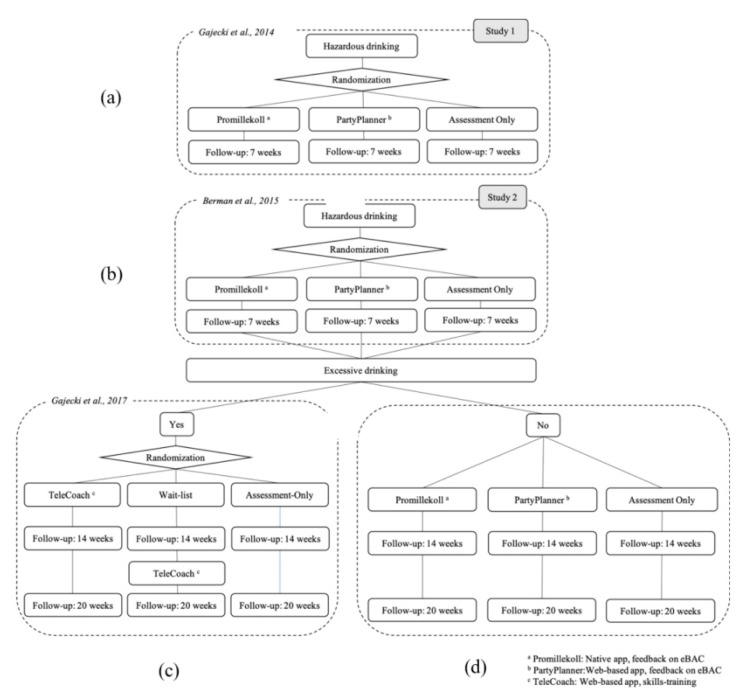
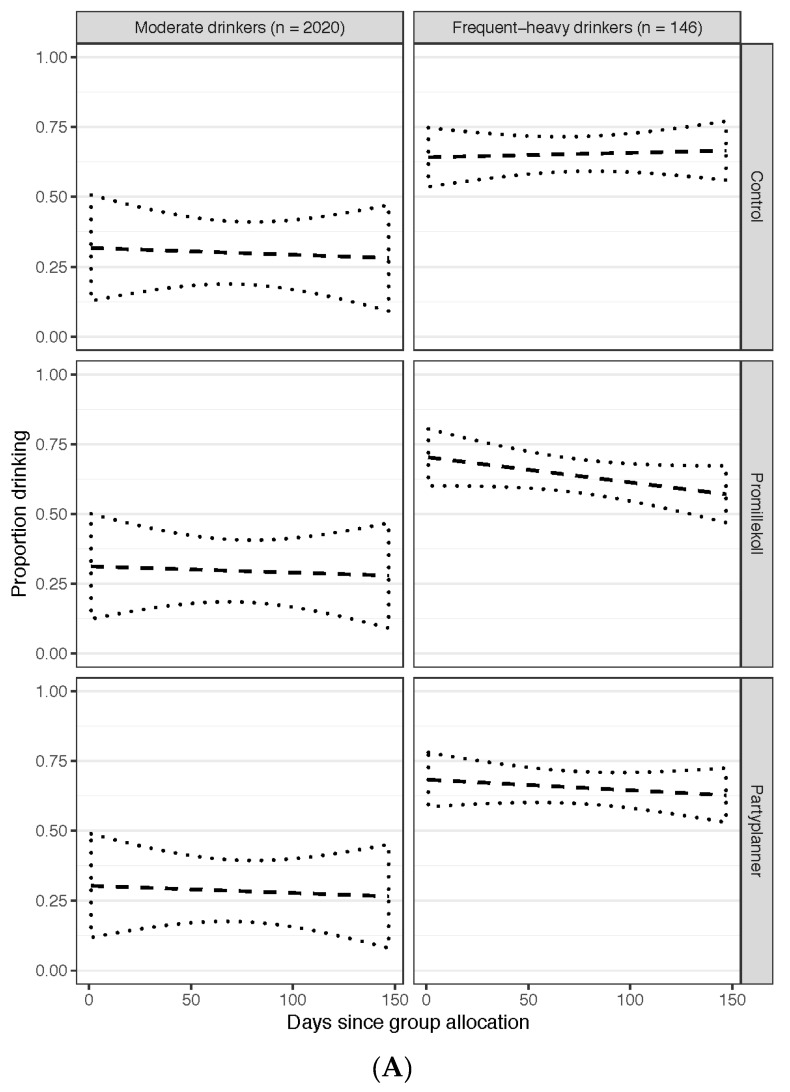
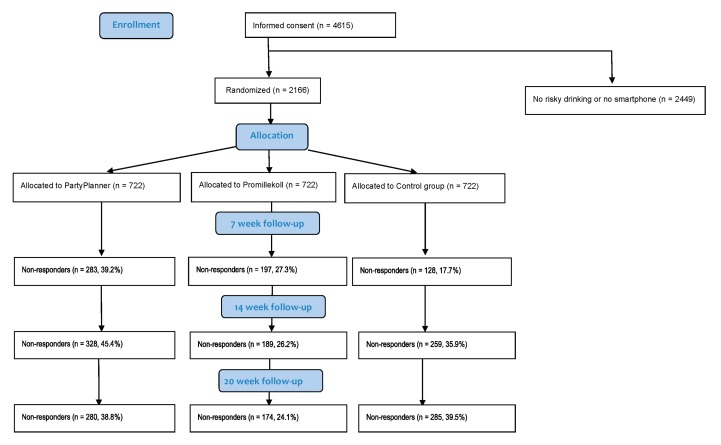
Overconsumption of alcohol, from hazardous to excessive, heavy, and harmful levels, is common among university students. Consenting Swedish students were assigned to one of two smartphone apps offering feedback on estimated blood alcohol concentration (eBAC; Promillekoll/PartyPlanner) or assessment only ( = 2166; 1:1:1 ratio). App participants with excessive drinking according to public health criteria (>9/>14 drinks/week for women/men, respectively) at a 7 week follow-up were additionally assigned to the skills-based TeleCoach app or waitlist ( = 186; 1:1 ratio). All participants were followed at 14 and 20 weeks. At 7 weeks, Promillekoll users showed higher risk of excessive drinking (odds ratio (OR) = 1.83; ≤ 0.01; = 1558). Students in eBAC app groups with only hazardous use showed fewer binge drinking occasions at 14 weeks and lower eBAC levels up to 20 weeks compared to controls ( = 1157). Also, more highly motivated participants at baseline in both eBAC app groups drank less compared to controls at 7 and 20 weeks. Hidden Markov model analysis revealed a frequent-heavy drinking group ( = 146; 4.6 days/week, SD = 1.4), where those with access to TeleCoach had fewer drinking days compared to assessment-only controls ( < 0.001). eBAC apps showed positive effects up to 20 weeks, particularly for motivated students, and a skills-based app can reduce consumption for those with frequent-heavy drinking patterns.
大学生中,酒精过度消费现象普遍,从危险饮酒到过度、重度和有害饮酒都有。同意参与的瑞典学生被分配到两款智能手机应用程序中的一款,一款提供估计血液酒精浓度(eBAC;Promillekoll/PartyPlanner)反馈,另一款仅进行评估(n = 2166;比例为1:1:1)。在7周随访时,根据公共卫生标准饮酒过量(女性/男性分别>9/14杯/周)的应用程序参与者被进一步分配到基于技能的TeleCoach应用程序组或等待名单组(n = 186;比例为1:1)。所有参与者在14周和20周时接受随访。在7周时,Promillekoll用户显示出更高的饮酒过量风险(优势比(OR)= 1.83;P≤0.01;n = 1558)。与对照组相比,仅存在危险饮酒情况的eBAC应用程序组学生在14周时的暴饮次数更少,在20周时的eBAC水平更低(n = 1157)。此外,在两个eBAC应用程序组中,基线时积极性更高的参与者在7周和20周时的饮酒量均低于对照组。隐马尔可夫模型分析显示出一个频繁重度饮酒组(n = 146;每周4.6天,标准差 = 1.4),与仅接受评估的对照组相比,使用TeleCoach的参与者饮酒天数更少(P<0.001)。eBAC应用程序在20周内显示出积极效果,特别是对有积极性的学生,并且一款基于技能的应用程序可以减少频繁重度饮酒模式者的饮酒量。