Department of Nursing, Air Force Medical University, Xi'an, Shanxi, China (mainland).
General Hospital of People's Liberation Army (PLA), Beijing, China (mainland).
Med Sci Monit. 2019 Oct 30;25:8120-8130. doi: 10.12659/MSM.916937.
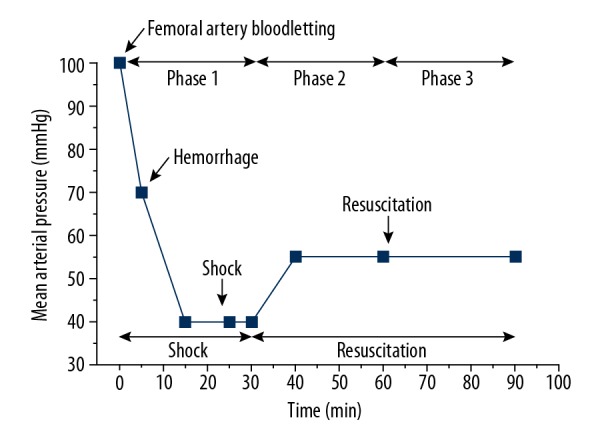
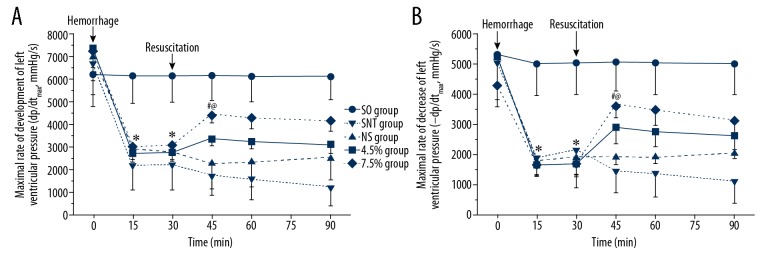
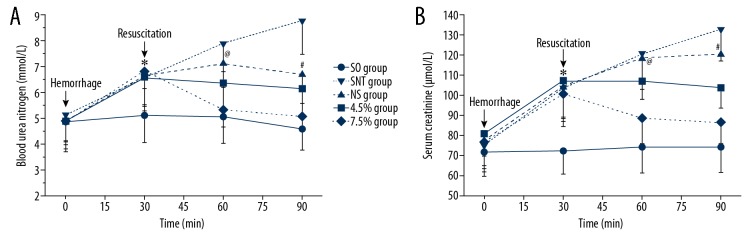
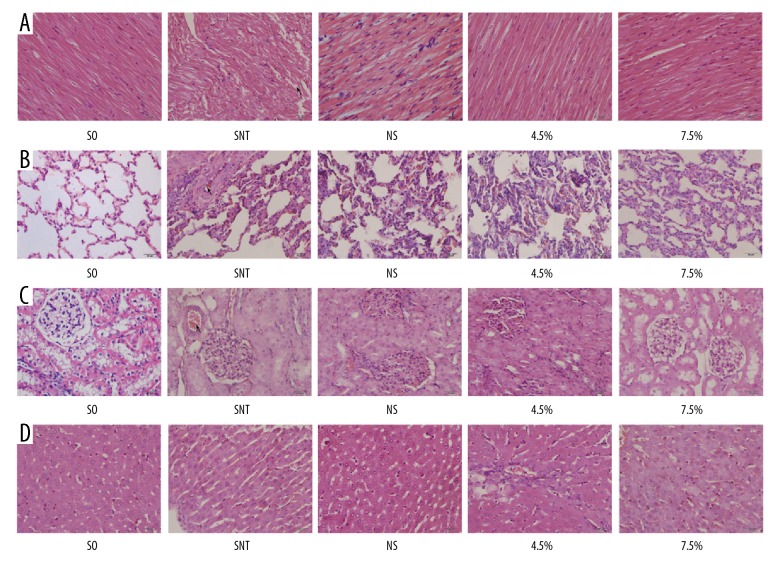
BACKGROUND Our previous study found a novel fluid combination with better resuscitation effects under hypotensive condition at the early stage of uncontrolled hemorrhagic shock (UHS). However, the optimal recovery concentration of hypertonic saline in this fluid combination remains unknown. This experiment aimed to explore the optimal concentration. MATERIAL AND METHODS New Zealand white rabbits (n=40) were randomly divided into 5 groups, including a sham-operated group (SO), a shock non-treated group (SNT), a normal saline group (NS), and hypertonic saline groups (4.5% and 7.5%). We established an UHS model and administered various fluid combinations (dose-related sodium chloride solution+crystal-colloidal solution) to the groups followed by monitoring indexes of hemodynamic and renal function, measuring infusion volume and blood loss, and analyzing pathological morphology by hematoxylin and eosin staining. RESULTS The hypertonic saline groups showed more stable hemodynamic indexes, reduced blood loss, fewer required infusions, and milder decreases in renal function than those of control groups (SNT and NS groups), and exhibited fewer pathological changes in the heart, lung, kidney, and liver. All indexes in the 4.5% and 7.5% groups were better than those of the NS group, and the hemodynamic indexes in the 7.5% group were more stable than those of the 4.5% group (P<0.05), with reduced blood loss and infusion volume and a milder decrease in renal function. CONCLUSIONS The novel fluid combination with 7.5% hypertonic saline group had a better recovery effect at the early stage of UHS before hemostasis compared to that of the 4.5% hypertonic saline group. This result may provide guidance for clinical fluid resuscitation.
我们之前的研究发现,在未控制的失血性休克(UHS)早期低血压情况下,一种新型液体组合具有更好的复苏效果。然而,这种液体组合中高渗盐水的最佳复苏浓度尚不清楚。本实验旨在探索最佳浓度。
新西兰白兔(n=40)随机分为 5 组,包括假手术组(SO)、休克未治疗组(SNT)、生理盐水组(NS)和高渗盐水组(4.5%和 7.5%)。我们建立了 UHS 模型,并给各组输注不同的液体组合(剂量相关的生理盐水溶液+晶体胶体溶液),监测血流动力学和肾功能指标,测量输液量和失血量,并通过苏木精-伊红染色分析病理形态。
高渗盐水组的血流动力学指标更稳定,失血量减少,输液量减少,肾功能下降较轻,与对照组(SNT 和 NS 组)相比,心、肺、肾和肝的病理变化较少。4.5%和 7.5%组的所有指标均优于 NS 组,7.5%组的血流动力学指标比 4.5%组更稳定(P<0.05),失血量和输液量减少,肾功能下降较轻。
与 4.5%高渗盐水组相比,在止血前 UHS 早期,含 7.5%高渗盐水的新型液体组合具有更好的复苏效果。这一结果可能为临床液体复苏提供指导。