Radiotherapy and OncoImmunology Laboratory, Department of Radiation Oncology, Radboud University Medical Center, Nijmegen, The Netherlands.
Department of Pathology, Radboud University Medical Center, Nijmegen, The Netherlands.
Thorac Cancer. 2019 Dec;10(12):2289-2299. doi: 10.1111/1759-7714.13226. Epub 2019 Oct 30.
Both hypoxia and oncogenic mutations rewire tumor metabolism. In this study, glucose and glutamine metabolism-related markers were examined in stage I - resectable stage IIIA non-small cell lung cancer (NSCLC). Furthermore, expression of metabolism-related markers was correlated with mutational status to examine mutations associated with rewired tumor metabolism.
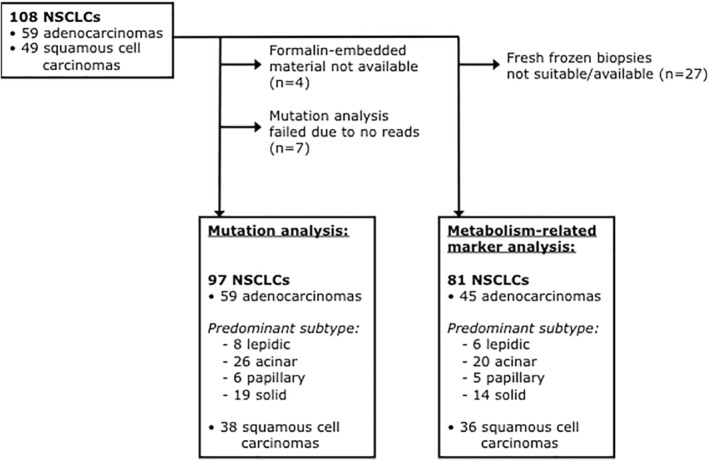
Mutation analysis was performed for 97 tumors. Glucose and glutamine metabolism-related marker expression was measured by immunofluorescent staining (protein) and qPCR (mRNA) (n = 81).
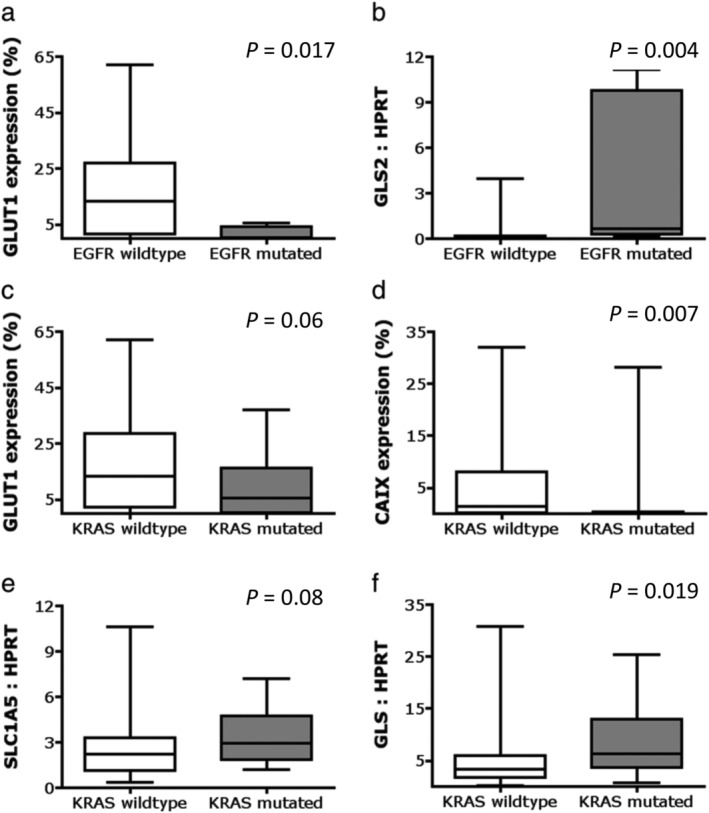
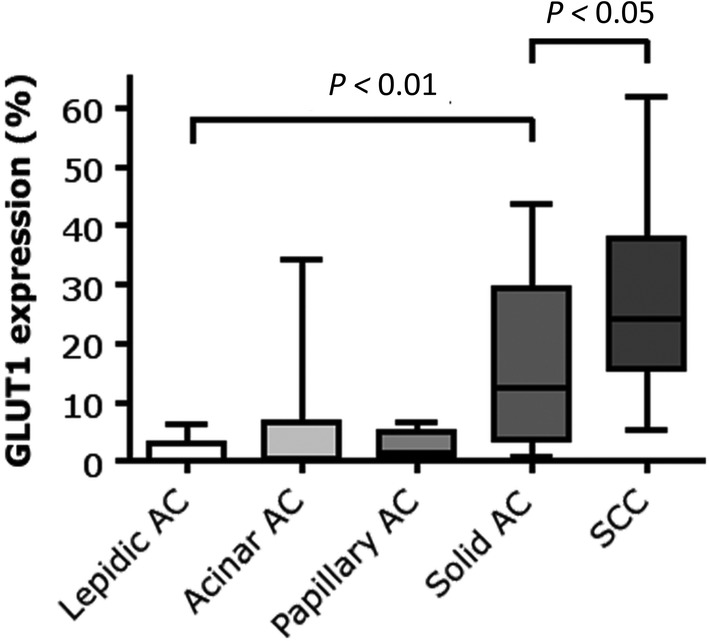
Glutamine metabolism-related markers were significantly higher in adeno- than squamous cell NSCLCs. Glucose transporter 1 (GLUT1) protein expression was higher in solid compared to lepidic adenocarcinomas (P < 0.01). In adenocarcinomas, mRNA expression of glutamine transporter SLC1A5 correlated with tumor size (r(p) = 0.41, P = 0.005). Furthermore, SLC1A5 protein expression was significantly higher in adenocarcinomas with worse pTNM stage (r(s) = 0.39, P = 0.009). EGFR-mutated tumors showed lower GLUT1 protein (P = 0.017), higher glutaminase 2 (GLS2) protein (P = 0.025) and higher GLS2 mRNA expression (P = 0.004), compared to EGFR wild-type tumors. GLS mRNA expression was higher in KRAS-mutated tumors (P = 0.019). TP53-mutated tumors showed higher GLUT1 expression (P = 0.009).
NSCLC is a heterogeneous disease, with differences in mutational status and metabolism-related marker expression between adeno- and squamous cell NSCLCs, and also within adenocarcinoma subtypes. GLUT1 and SLC1A5 expression correlate with aggressive tumor behavior in adenocarcinomas but not in squamous cell NSCLCs. Therefore, these markers could steer treatment modification for subgroups of adenocarcinoma patients. TP53, EGFR and KRAS mutations are associated with expression of glucose and glutamine metabolism-related markers in NSCLC.
缺氧和致癌突变都重新布线了肿瘤代谢。在这项研究中,检查了 I 期可切除 IIIA 期非小细胞肺癌(NSCLC)中的葡萄糖和谷氨酰胺代谢相关标志物。此外,还检测了代谢相关标志物的表达与突变状态的相关性,以检查与重新布线的肿瘤代谢相关的突变。
对 97 个肿瘤进行了突变分析。通过免疫荧光染色(蛋白质)和 qPCR(mRNA)测量葡萄糖和谷氨酰胺代谢相关标记物的表达(n=81)。
与鳞癌相比,腺癌的谷氨酰胺代谢相关标志物明显升高。与贴壁型腺癌相比,实性腺癌的葡萄糖转运蛋白 1(GLUT1)蛋白表达更高(P<0.01)。在腺癌中,谷氨酰胺转运体 SLC1A5 的 mRNA 表达与肿瘤大小相关(r(p)=0.41,P=0.005)。此外,SLC1A5 蛋白表达在 pTNM 分期较差的腺癌中显著升高(r(s)=0.39,P=0.009)。与 EGFR 野生型肿瘤相比,EGFR 突变型肿瘤的 GLUT1 蛋白表达较低(P=0.017),谷氨酰胺酶 2(GLS2)蛋白表达较高(P=0.025),GLS2 mRNA 表达较高(P=0.004)。KRAS 突变型肿瘤的 GLS mRNA 表达较高(P=0.019)。TP53 突变型肿瘤的 GLUT1 表达较高(P=0.009)。
NSCLC 是一种异质性疾病,在腺癌和鳞癌之间以及在腺癌亚型内,存在突变状态和代谢相关标志物表达的差异。GLUT1 和 SLC1A5 的表达与腺癌中侵袭性肿瘤行为相关,但与鳞癌无关。因此,这些标志物可以指导腺癌患者亚组的治疗改变。TP53、EGFR 和 KRAS 突变与 NSCLC 中葡萄糖和谷氨酰胺代谢相关标志物的表达相关。