Yoo Jeong Rae, Heo Sang Taek, Kim Miyeon, Song Sung Wook, Boo Ji Whan, Lee Keun Hwa
Department of Internal Medicine, Jeju National University, College of Medicine and Graduate School of Medicine, Jeju, Korea.
Department of Emergency Medicine, Jeju National University, College of Medicine and Graduate School of Medicine, Jeju, Korea.
Infect Chemother. 2019 Dec;51(4):337-344. doi: 10.3947/ic.2019.51.4.337. Epub 2019 Sep 27.
Severe fever with thrombocytopenia syndrome (SFTS) is a tick-borne zoonotic disease that is caused by the SFTS virus (SFTSV), and exhibits an overall mortality rate of approximately 20.0% in Korea. Most cases of this disease have been reported in Korea, East China, and Japan, and it mostly affects outdoor workers and farmers. This study aimed to investigate the seroprevalence of SFTSV among healthy farmers on Jeju Island, Korea.
In this prospective cross-sectional study, we analyzed 421 blood samples obtained from 254 farmers (mean age, 59.9 years; 68.9% male) to determine the seroprevalence of SFTSV in 16 rural areas of the Jeju Special Self-Governing Province over a period of 3 years (January 2015-December 2017). We used an enzyme-linked immunosorbent assay to detect immunoglobulin (Ig) G antibodies against SFTSV in the collected samples.
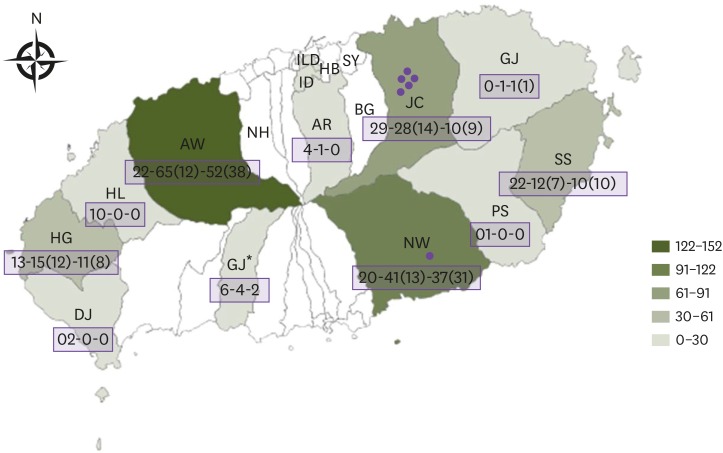
The seroprevalence of the SFTSV IgG among farmers on Jeju Island was observed to be 2.4%. One subject showed seropositivity over the entire 3-year study period. The areas with the highest SFTSV IgG seropositivity rates were Seonheul-ri in Jocheon-eup, followed by Namwon-eup. Fruit farmers were at a higher risk of exposure to SFTSV than other farmers.
The seroprevalence of SFTSV in the healthy agricultural population of Jeju Island was not high. However, personal hygiene management should be implemented for the agricultural population in the endemic areas. Surveillance of mild or asymptomatic infections is required in the endemic regions.
发热伴血小板减少综合征(SFTS)是一种由SFTS病毒(SFTSV)引起的蜱传人畜共患病,在韩国的总体死亡率约为20.0%。该病的大多数病例在韩国、中国东部和日本被报道,主要影响户外工作者和农民。本研究旨在调查韩国济州岛健康农民中SFTSV的血清流行率。
在这项前瞻性横断面研究中,我们分析了从254名农民(平均年龄59.9岁;68.9%为男性)采集的421份血样,以确定济州特别自治道16个农村地区在3年期间(2015年1月至2017年12月)SFTSV的血清流行率。我们使用酶联免疫吸附试验检测所采集样本中针对SFTSV的免疫球蛋白(Ig)G抗体。
观察到济州岛农民中SFTSV IgG的血清流行率为2.4%。一名受试者在整个3年研究期间均呈血清阳性。SFTSV IgG血清阳性率最高的地区是朝天邑的仙荷里,其次是南原邑。果农比其他农民接触SFTSV的风险更高。
济州岛健康农业人口中SFTSV的血清流行率不高。然而,应针对流行地区的农业人口实施个人卫生管理。流行地区需要对轻度或无症状感染进行监测。