City, University of London.
University of Kent.
J Abnorm Psychol. 2020 Feb;129(2):224-236. doi: 10.1037/abn0000467. Epub 2019 Oct 31.
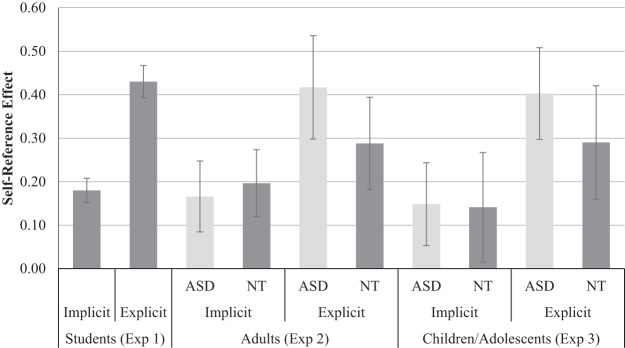
Three experiments investigated the extent to which (a) individuals with autism show a self-reference effect (i.e., better memory for self-relevant information), and (b) the size of the self-reference effect is associated with autism traits. Participants studied trait adjectives in relation to their own name (self-referent) or a celebrity's name (other-referent) under explicit and incidental/implicit encoding conditions. Explicit encoding involved judging whether the adjectives applied to self or other (denoted by proper names). Implicit encoding involved judging whether the adjectives were presented to the right or left of one's own or a celebrity's name. Recognition memory for the adjectives was tested using a yes/no procedure. Experiment 1 (individual differences; N = 257 neurotypical adults) employed the Autism-spectrum Quotient as a measure of autistic traits. Experiments 2 (n = 60) and 3 (n = 52) involved case-control designs with closely matched groups of autistic and neurotypical adults and children/adolescents, respectively. Autistic traits were measured using the Autism-spectrum Quotient and Social Responsiveness Scale, respectively. In all experiments, a significant self-reference effect was observed in both explicit and implicit encoding conditions. Most importantly, however, there was (a) no significant relation between size of the self-reference effect and number of autistic traits (Experiments 1, 2, and 3), and (b) no significant difference in the size of the self-reference effect between autistic and neurotypical participants (Experiments 2 and 3). In these respects, Bayesian analyses consistently suggested that the data supported the null hypothesis. These results challenge the notion that subjective or objective self-awareness are impaired in autism. (PsycINFO Database Record (c) 2020 APA, all rights reserved).
(a)自闭症患者是否表现出自指效应(即对与自身相关的信息记忆更好);(b)自指效应的大小是否与自闭症特征有关。在明确和偶然/内隐编码条件下,参与者研究与自己的名字(自指)或名人的名字(他指)相关的特质形容词。明确编码涉及判断形容词是否适用于自己或他人(由名字表示)。内隐编码涉及判断形容词是否出现在自己或名人名字的右侧或左侧。使用是/否程序测试形容词的识别记忆。实验 1(个体差异;N=257 名神经典型成年人)使用自闭症谱系商数作为自闭症特征的衡量标准。实验 2(n=60)和 3(n=52)采用病例对照设计,分别将自闭症和神经典型的成年和儿童/青少年匹配成两组。自闭症特征分别使用自闭症谱系商数和社会反应量表进行测量。在所有实验中,在明确和内隐编码条件下都观察到了显著的自指效应。然而,最重要的是,(a)自指效应的大小与自闭症特征的数量之间没有显著关系(实验 1、2 和 3);(b)自闭症和神经典型参与者之间的自指效应大小没有显著差异(实验 2 和 3)。在这些方面,贝叶斯分析一致表明,数据支持零假设。这些结果挑战了自闭症患者主观或客观自我意识受损的观点。(PsycINFO 数据库记录(c)2020 APA,保留所有权利)。