Department of Hypertension, Medical University of Lodz, Rzgowska, 281/289; 93-338, Łódź, Poland.
Department of Cardiology and Congenital Diseases of Adults, Polish Mother's Memorial Hospital Research Institute (PMMHRI), Lodz, Poland.
Lipids Health Dis. 2019 Oct 31;18(1):188. doi: 10.1186/s12944-019-1135-z.
The role of statins in patients with heart failure (HF) of different levels of left ventricular ejection fraction (LVEF) remains unclear especially in the light of the absence of prospective data from randomized controlled trials (RCTs) in non-ischemic HF, and taking into account potential statins' prosarcopenic effects. We assessed the association of statin use with clinical outcomes in patients with HF.
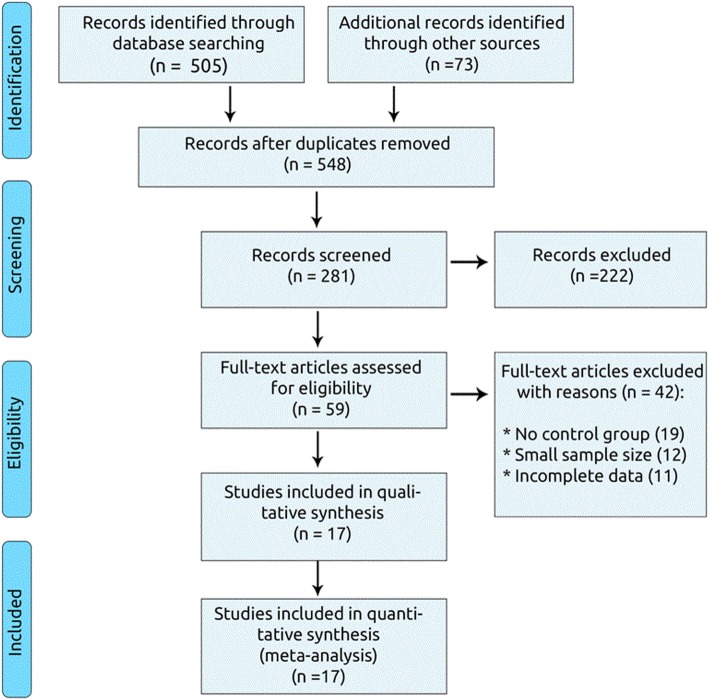
We searched PubMed, EMBASE, Scopus, Google Scholar and Cochrane Central until August 2018 for RCTs and prospective cohorts comparing clinical outcomes with statin vs non-statin use in patients with HF at different LVEF levels. We followed the guidelines of the 2009 PRISMA statement for reporting and applied independent extraction by multiple observers. Meta-analyses of hazard ratios (HRs) of effects of statins on clinical outcomes used generic inverse variance method and random model effects. Clinical outcomes were all-cause mortality, cardiovascular (CV) mortality and CV hospitalization.
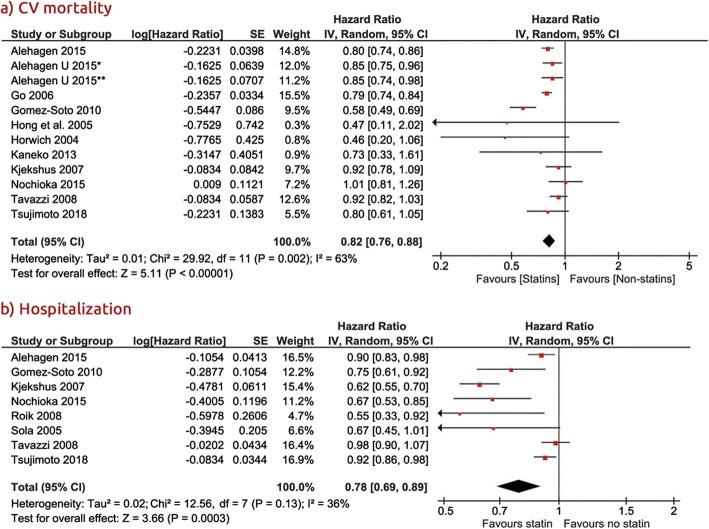
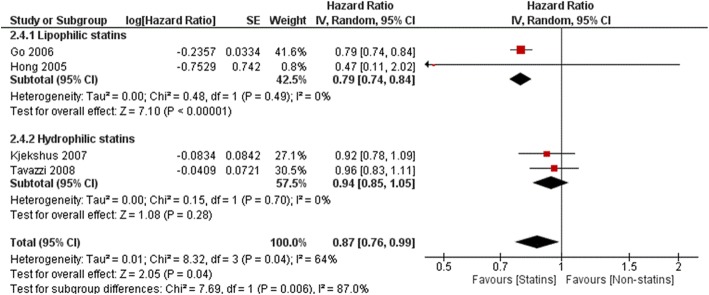
Finally we included 17 studies (n = 88,100; 2 RCTs and 15 cohorts) comparing statin vs non-statin users (mean follow-up 36 months). Compared with non-statin use, statin use was associated with lower risk of all-cause mortality (HR 0.77, 95% confidence interval [CI], 0.72-0.83, P < 0.0001, I = 63%), CV mortality (HR 0.82, 95% CI: 0.76-0.88, P < 0.0001, I = 63%), and CV hospitalization (HR 0.78, 95% CI: 0.69-0.89, P = 0.0003, I = 36%). All-cause mortality was reduced on statin therapy in HF with both EF < 40% and ≥ 40% (HR: 0.77, 95% Cl: 0.68-0.86, P < 0.00001, and HR 0.75, 95% CI: 0.69-0.82, P < 0.00001, respectively). Similarly, CV mortality (HR 0.86, 95% CI: 0.79-0.93, P = 0.0003, and HR 0.83, 95% CI: 0.77-0.90, P < 0.00001, respectively), and CV hospitalizations (HR 0.80 95% CI: 0.64-0.99, P = 0.04 and HR 0.76 95% CI: 0.61-0.93, P = 0.009, respectively) were reduced in these EF subgroups. Significant effects on all clinical outcomes were also found in cohort studies' analyses; the effect was also larger and significant for lipophilic than hydrophilic statins.
In conclusion, statins may have a beneficial effect on CV outcomes irrespective of HF etiology and LVEF level. Lipophilic statins seem to be much more favorable for patients with heart failure.
在不同左心室射血分数(LVEF)水平的心力衰竭(HF)患者中,他汀类药物的作用仍不清楚,尤其是在没有随机对照试验(RCT)的前瞻性数据的情况下,同时还需要考虑他汀类药物的潜在肌少症效应。我们评估了他汀类药物的使用与 HF 患者临床结局的相关性。
我们在 2018 年 8 月之前在 PubMed、EMBASE、Scopus、Google Scholar 和 Cochrane Central 中搜索了比较不同 LVEF 水平的 HF 患者中他汀类药物与非他汀类药物使用的临床结局的 RCT 和前瞻性队列研究。我们遵循了 2009 年 PRISMA 声明的报告指南,并由多名观察者独立进行提取。他汀类药物对临床结局影响的风险比(HR)的荟萃分析采用通用倒数方差法和随机模型效应。临床结局为全因死亡率、心血管(CV)死亡率和 CV 住院率。
最终我们纳入了 17 项研究(n=88100;2 项 RCT 和 15 项队列研究),比较了他汀类药物与非他汀类药物使用者(平均随访 36 个月)。与非他汀类药物使用相比,他汀类药物使用与全因死亡率(HR 0.77,95%置信区间 [CI]:0.72-0.83,P<0.0001,I=63%)、CV 死亡率(HR 0.82,95% CI:0.76-0.88,P<0.0001,I=63%)和 CV 住院率(HR 0.78,95% CI:0.69-0.89,P=0.0003,I=36%)的风险降低相关。在 EF<40%和 EF≥40%的 HF 患者中,他汀类药物治疗均可降低全因死亡率(HR:0.77,95% Cl:0.68-0.86,P<0.00001,和 HR 0.75,95% CI:0.69-0.82,P<0.00001)。同样,CV 死亡率(HR 0.86,95% CI:0.79-0.93,P=0.0003,和 HR 0.83,95% CI:0.77-0.90,P<0.00001)和 CV 住院率(HR 0.80,95% CI:0.64-0.99,P=0.04 和 HR 0.76,95% CI:0.61-0.93,P=0.009)也有所降低。在队列研究分析中也发现了对所有临床结局有显著影响的他汀类药物;亲脂性他汀类药物的效果更大且更显著。
总之,他汀类药物可能对 CV 结局具有有益的影响,而与 HF 的病因和 LVEF 水平无关。亲脂性他汀类药物似乎对心力衰竭患者更为有利。