Institute for Resilient Regions, University of Southern Queensland, Springfield Central, QLD, 4300, Australia.
School of Psychology and Counselling, University of Southern Queensland, Springfield Central, QLD, Australia.
Syst Rev. 2019 Nov 4;8(1):257. doi: 10.1186/s13643-019-1170-x.
Population mail-out bowel screening programs are a convenient, cost-effective and sensitive method of detecting colorectal cancer (CRC). Despite the increased survival rates associated with early detection of CRC, in many countries, 50% or more of eligible individuals do not participate in such programs. The current study systematically reviews interventions applied to increase fecal occult blood test (FOBT) kit return, specifically in population mail-out programs.
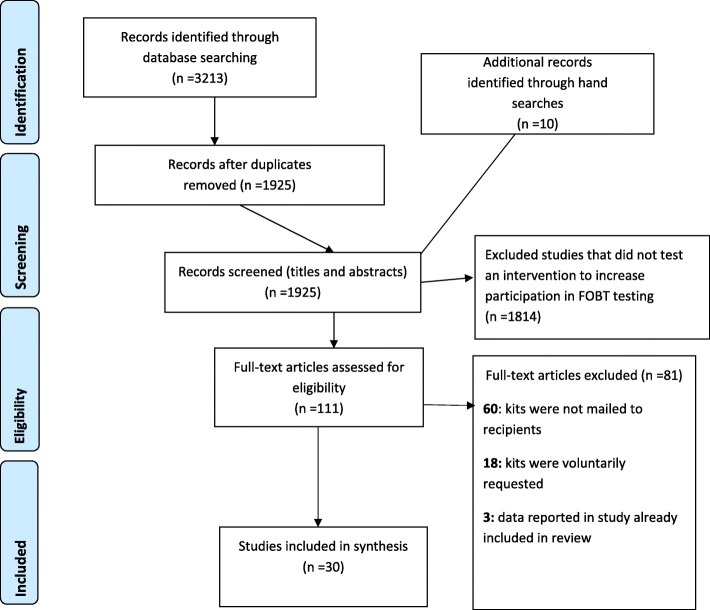
Five electronic databases (PubMed, PsycINFO, Scopus, CINAHL, and ProQuest Dissertations and Theses) were searched for articles published before the 10th of March 2018. Studies were included if they reported the results of an intervention designed to increase the return rate of FOBT kits that had been mailed to individuals' homes. PRISMA systematic review reporting methods were applied and each study was assessed using Cochrane's Risk of Bias tool. Pooled effect sizes were calculated for each intervention type and the risk of bias was tested as a moderator for sensitivity analysis.
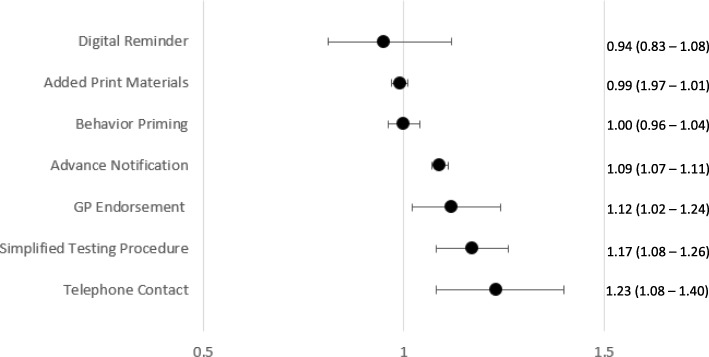
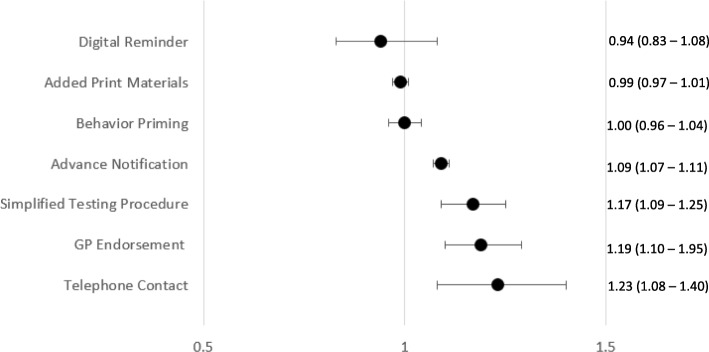
The review identified 53 interventions from 30 published studies from which nine distinct intervention strategy types emerged. Sensitivity analysis showed that the risk of bias marginally moderated the overall effect size. Pooled risk ratios and confidence intervals for each intervention type revealed that telephone contact RR = 1.23, 95% CI (1.08-1.40), GP endorsement RR = 1.19, 95% CI (1.10-1.29), simplified test procedures RR = 1.17, 95% CI (1.09-1.25), and advance notifications RR = 1.09, 95% CI (1.07-1.11) were effective intervention strategies with small to moderate effect sizes. Studies with a high risk of bias were removed and pooled effects remained relatively unchanged.
Interventions that combine program-level changes incorporating the issue of advance notification and alternative screening tools with the involvement of primary health professionals through endorsement letters and telephone contact should lead to increases in kit return in mail-out CRC screening programs.
This review is registered with PROSPERO; registration number CRD42017064652.
人群邮件筛查计划是一种方便、具有成本效益且敏感的结直肠癌(CRC)检测方法。尽管早期发现 CRC 可提高生存率,但在许多国家,仍有 50%或更多符合条件的个体未参与此类计划。本研究系统地回顾了旨在提高粪便潜血试验(FOBT)试剂盒回收率的干预措施,特别是在人群邮件筛查计划中。
检索了五个电子数据库(PubMed、PsycINFO、Scopus、CINAHL 和 ProQuest Dissertations and Theses),以获取截至 2018 年 3 月 10 日前发表的文章。如果研究报告了旨在提高寄往个人家中的 FOBT 试剂盒回收率的干预措施的结果,则纳入研究。应用 PRISMA 系统评价报告方法,并用 Cochrane 偏倚风险工具评估每项研究。计算了每种干预类型的汇总效应量,并测试了偏倚风险作为敏感性分析的调节因素。
该综述从 30 项已发表的研究中确定了 53 项干预措施,从中出现了 9 种不同的干预策略类型。敏感性分析表明,偏倚风险适度调节了总体效应量。每种干预类型的汇总风险比和置信区间表明,电话联系 RR=1.23,95%CI(1.08-1.40),全科医生认可 RR=1.19,95%CI(1.10-1.29),简化检测程序 RR=1.17,95%CI(1.09-1.25),和预先通知 RR=1.09,95%CI(1.07-1.11)是有效的干预策略,具有较小到中等的效应量。去除高偏倚风险的研究后,汇总效应基本保持不变。
将包含预先通知问题和替代筛查工具的计划层面的改变与通过认可信和电话联系让初级卫生专业人员参与相结合的干预措施,应可增加邮件筛查 CRC 计划中的试剂盒返还率。
本综述在 PROSPERO 注册;注册号 CRD42017064652。