Institut des Sciences du Mouvement, Faculté des Sciences du Sport, Aix-Marseille Université, Marseille, France.
Centre National de la Recherche Scientifique, Paris, France.
Clin Interv Aging. 2019 Aug 22;14:1503-1514. doi: 10.2147/CIA.S211568. eCollection 2019.
We compared Nordic walking training (NW) to a multicomponent training (MCT) program of an equivalent intensity, in older adults. Our main hypothesis was that MCT would result in larger effects on cognitive processes than NW.
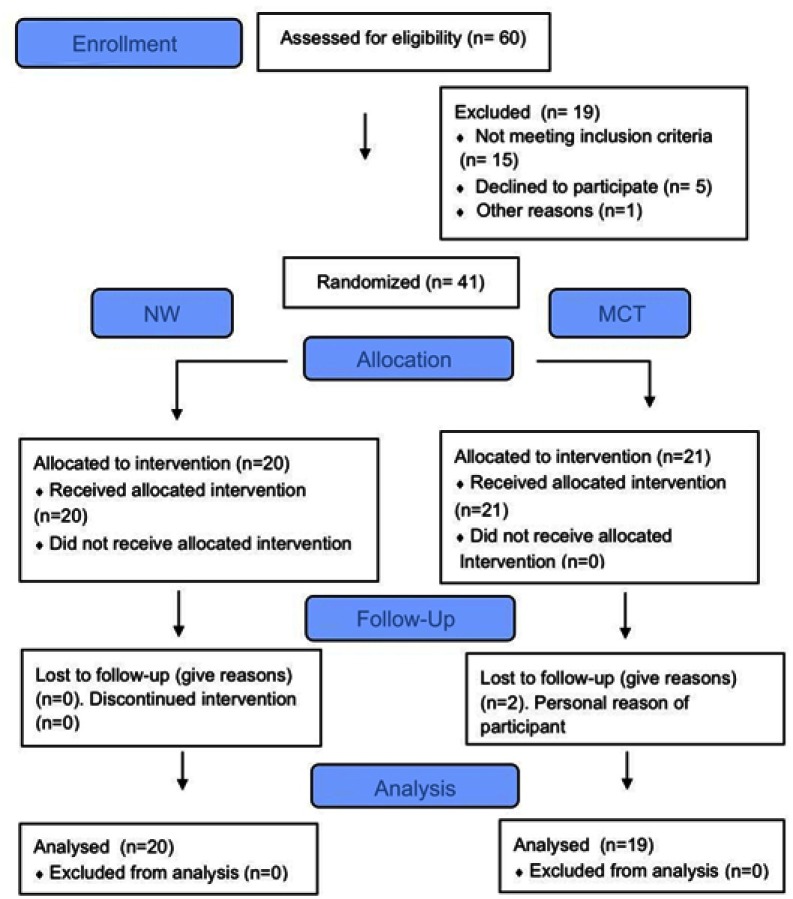
Thirty-nine healthy older adults, divided into two groups (NW and MCT), took part in the study (17 males, 22 females, mean age =70.8±0.8 years). They were tested for cardiovascular fitness, motor fitness and cognitive performance during the two weeks preceding and following the 12-week training session (3 times/week), respectively. For both the NW and MCT interventions, the training sessions were supervised by a trainer. Heart rate of participants was monitored during the sessions and then used to make training loads as similar as possible between the two groups (TRaining IMPulse method).
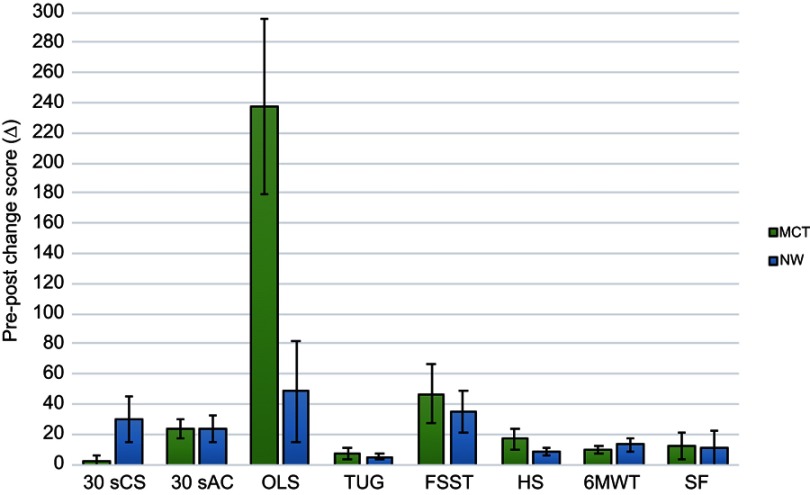
Results showed that training resulted in better performance for cardiovascular and motor fitness tests. Among these tests, only two revealed a significant difference between the two groups. The NW group progressed more than the MCT group in the 30 Seconds Chair Stand test, while in the One Leg Stance test, the MCT group progressed more. For the cognitive assessment, a significant effect of training was found for executive functions, spatial memory score, and information processing speed response time, with no differences between the two groups.
The study confirmed that physical exercise has a positive impact on cognitive processes with no advantage of MCT intervention over NW training. A possible reason is that NW intervention not only improved cardiovascular capacities, but also motor fitness, including coordination capacities.
我们比较了北欧式健走训练(NW)和同等强度的多组分训练(MCT)方案对老年人的影响。我们的主要假设是,MCT 对认知过程的影响会大于 NW。
39 名健康的老年人被分为两组(NW 和 MCT)参与研究(男性 17 名,女性 22 名,平均年龄=70.8±0.8 岁)。他们分别在 12 周训练期的前两周和后两周接受心血管健康、运动健康和认知表现的测试(每周 3 次)。对于 NW 和 MCT 两种干预措施,训练课程都由一名教练监督。在课程期间监测参与者的心率,然后使用 TRaining IMPulse 方法使两组的训练负荷尽可能相似。
结果表明,训练使心血管和运动健康测试的表现得到改善。在这些测试中,只有两个测试显示两组之间存在显著差异。NW 组在 30 秒椅子站立测试中比 MCT 组进步更大,而在单腿站立测试中,MCT 组进步更大。对于认知评估,执行功能、空间记忆得分和信息处理速度反应时间均显示出训练的显著效果,两组之间没有差异。
该研究证实,体育锻炼对认知过程有积极影响,MCT 干预并不优于 NW 训练。一个可能的原因是,NW 干预不仅提高了心血管能力,还提高了运动健康,包括协调能力。