Department of Clinical Medicine, School of Medicine, Trinity College Dublin, Trinity Centre for Health Sciences, Dublin 8, Ireland.
Department of Biochemistry, St James's Healthcare Campus, Dublin 8, Ireland.
Clin Interv Aging. 2019 Oct 15;14:1751-1761. doi: 10.2147/CIA.S222143. eCollection 2019.
Maintaining skeletal muscle function throughout life is a crucial component of successful ageing. Adequate vitamin D status may be important in preserving muscle function. We aimed to determine the association between impaired muscle function and serum vitamin D status in community-dwelling older adults. Falls were explored as a secondary aim.
Data were analyzed from adults aged ≥60 years, from Wave 6 of the English Longitudinal Study of Aging (ELSA). Handgrip strength (HGS) and the short physical performance battery (SPPB) were employed as measures of muscle strength and physical function, respectively. Serum 25-hydroxyvitamin D [25(OH)D] was assessed with concentration <30 nmol/L classed as vitamin D deficient.
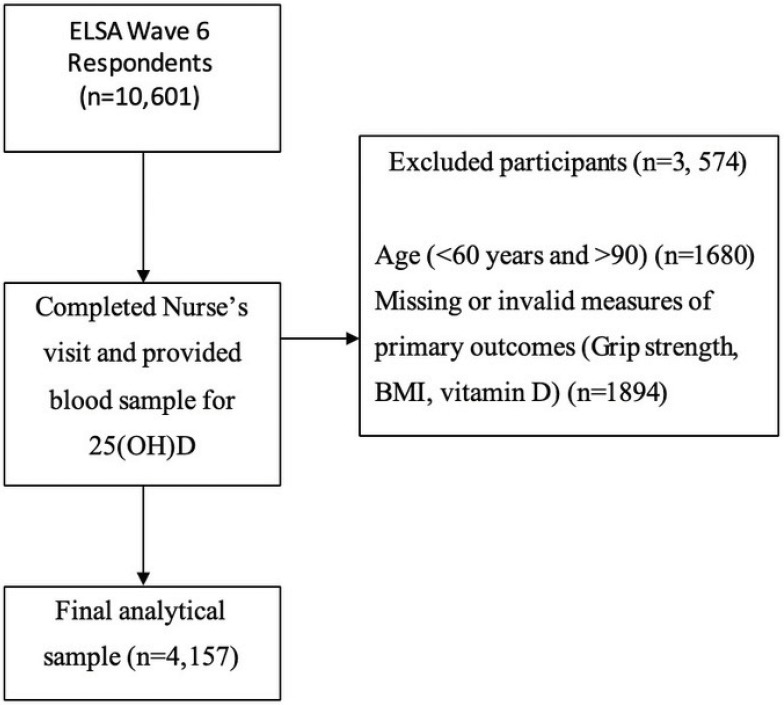
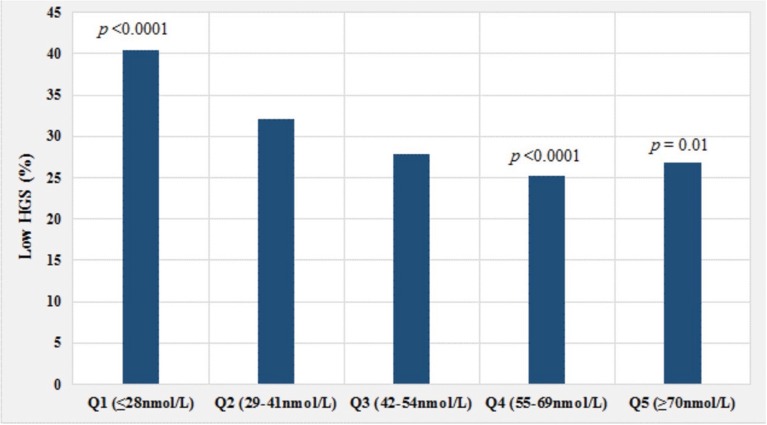
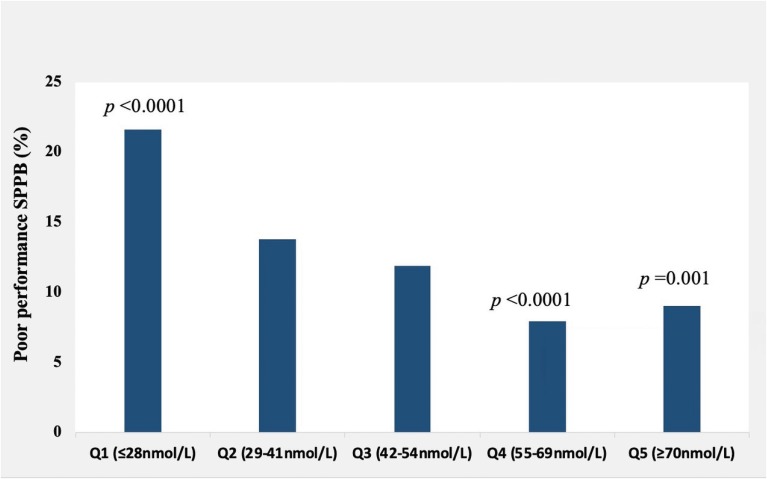
The study comprised 4157 community-dwelling adults with a mean age of 69.8 (SD 6.9). Overall, 30.6% had low HGS and 12.7% had low SPPB (≤6). Participants with the lowest serum 25(OH)D (<30 nmol/L) had the highest prevalence of impaired muscle strength and performance (40.4% and 25.2%) compared with participants with levels ≥50 nmol/L (21.6% and 7.9%). Consistent with this, vitamin D deficiency (<30 nmol/L) was a significant determinant of low HGS (OR 1.44 [1.22, 1.71], p<0.001) and poor physical performance (OR 1.65 [1.31, 2.09], p<0.001) in the logistic regression models. Older adults partaking in regular moderate physical activity had significantly lower odds of impaired muscle strength (OR 0.65 [0.58, 0.79]) and physical function (OR 0.30 [0.24, 0.38]), <0.001, respectively. Single or multiple falls (15.8% and 10.5% in past year) were not associated with vitamin D status.
Vitamin D deficiency was associated with impaired muscle strength and performance in a large study of community-dwelling older people. It is generally accepted that vitamin D deficiency at the <30 nmol/L cut-off should be reversed to prevent bone disease, a strategy that may also protect skeletal muscle function in ageing.
维持终生的骨骼肌功能是成功老龄化的关键组成部分。充足的维生素 D 状态可能对维持肌肉功能很重要。我们旨在确定社区居住的老年人中肌肉功能障碍与血清维生素 D 状态之间的关联。跌倒被作为次要目标进行了探讨。
对年龄≥60 岁的成年人进行了数据分析,这些成年人来自英国老龄化纵向研究(ELSA)的第 6 波。握力(HGS)和简短体能表现电池(SPPB)分别用作肌肉力量和身体功能的衡量标准。使用浓度<30 nmol/L 的血清 25-羟维生素 D [25(OH)D]来评估维生素 D 缺乏。
该研究包括 4157 名居住在社区的成年人,平均年龄为 69.8(SD 6.9)岁。总体而言,30.6%的人握力较低,12.7%的人 SPPB 较低(≤6)。与血清 25(OH)D 水平≥50 nmol/L 的参与者相比,血清 25(OH)D 水平最低的参与者(<30 nmol/L)肌肉力量和表现受损的患病率最高(40.4%和 25.2%)。同样,维生素 D 缺乏症(<30 nmol/L)是握力较低(OR 1.44 [1.22,1.71],p<0.001)和身体机能不佳的重要决定因素(OR 1.65 [1.31,2.09],p<0.001),这在逻辑回归模型中得到了证实。定期进行适度身体活动的老年人肌肉力量受损的可能性显著降低(OR 0.65 [0.58,0.79])和身体功能(OR 0.30 [0.24,0.38]),<0.001。过去一年中,单次或多次跌倒(15.8%和 10.5%)与维生素 D 状态无关。
在一项针对社区居住的老年人的大型研究中,维生素 D 缺乏与肌肉力量和功能障碍有关。人们普遍认为,应逆转<30 nmol/L 截止值的维生素 D 缺乏症,以预防骨骼疾病,这种策略可能也能保护衰老过程中的骨骼肌功能。