Canadian Sport Institute-Pacific, Institute for Sport Excellence, 4371 Interurban Road, Victoria, BC, V9E 2C5, Canada.
Department of Exercise Science, Physical and Health Education, University of Victoria, Victoria, BC, Canada.
Sports Med. 2019 Dec;49(Suppl 2):169-184. doi: 10.1007/s40279-019-01159-w.
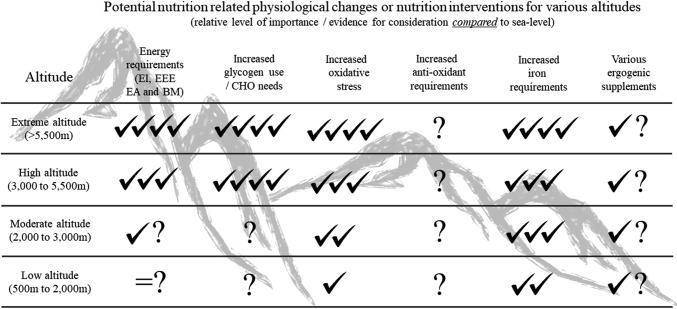
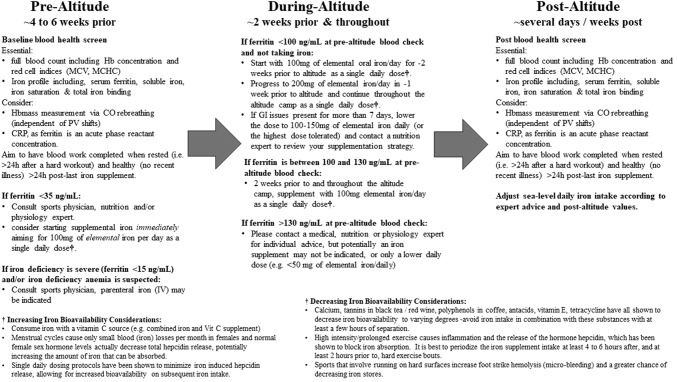
Training at low to moderate altitudes (~ 1600-2400 m) is a common approach used by endurance athletes to provide a distinctive environmental stressor to augment training stimulus in the anticipation of increasing subsequent altitude- and sea-level-based performance. Despite some scientific progress being made on the impact of various nutrition-related changes in physiology and associated interventions at mountaineering altitudes (> 3000 m), the impact of nutrition and/or supplements on further optimization of these hypoxic adaptations at low-moderate altitudes is only an emerging topic. Within this narrative review we have highlighted six major themes involving nutrition: altered energy availability, iron, carbohydrate, hydration, antioxidant requirements and various performance supplements. Of these issues, emerging data suggest that particular attention be given to the potential risk for poor energy availability and increased iron requirements at the altitudes typical of elite athlete training (~ 1600-2400 m) to interfere with optimal adaptations. Furthermore, the safest way to address the possible increase in oxidative stress associated with altitude exposure is via the consumption of antioxidant-rich foods rather than high-dose antioxidant supplements. Meanwhile, many other important questions regarding nutrition and altitude training remain to be answered. At the elite level of sport where the differences between winning and losing are incredibly small, the strategic use of nutritional interventions to enhance the adaptations to altitude training provides an important consideration in the search for optimal performance.
在低海拔到中海拔(约 1600-2400 米)进行训练是耐力运动员常用的方法,他们希望通过提供独特的环境压力源来增强训练刺激,以提高随后的高原和海平面运动表现。尽管在登山高海拔(>3000 米)时,生理学和相关干预措施中各种与营养相关的变化的影响方面已经取得了一些科学进展,但营养和/或补充剂对在低海拔到中海拔进一步优化这些低氧适应的影响只是一个新兴话题。在这篇叙述性综述中,我们强调了涉及营养的六个主要主题:能量可用性改变、铁、碳水化合物、水合作用、抗氧化剂需求和各种性能补充剂。在这些问题中,新出现的数据表明,特别需要注意在精英运动员训练的典型海拔(约 1600-2400 米)下,能量可用性差和铁需求增加的潜在风险,以干扰最佳适应。此外,通过食用富含抗氧化剂的食物而不是高剂量的抗氧化补充剂来解决与海拔暴露相关的氧化应激增加的问题是最安全的方法。同时,关于营养和高原训练的许多其他重要问题仍有待回答。在运动的精英水平上,胜负之间的差距非常小,因此,战略性地利用营养干预措施来增强对高原训练的适应能力,是寻找最佳表现的重要考虑因素。