Agricultural Big-Data Research Center and College of Plant Protection, Shandong Agricultural University, Tai'an 271018, China.
Database (Oxford). 2019 Jan 1;2019. doi: 10.1093/database/baz127.
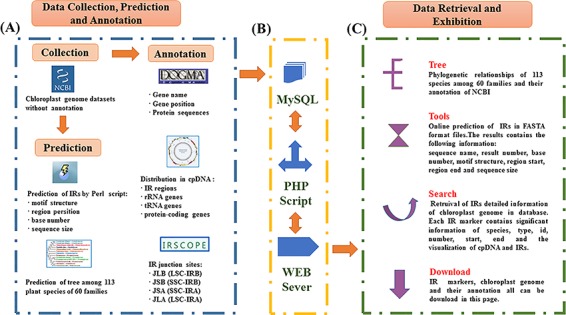
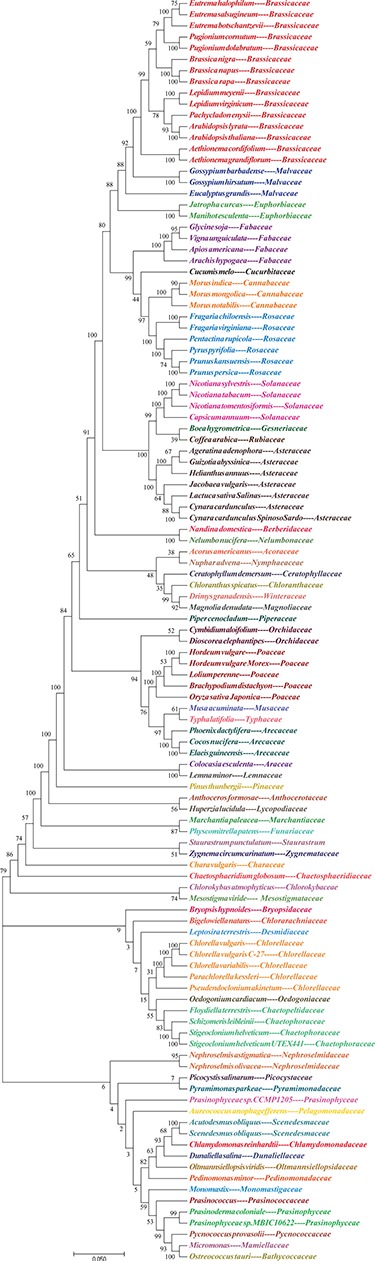
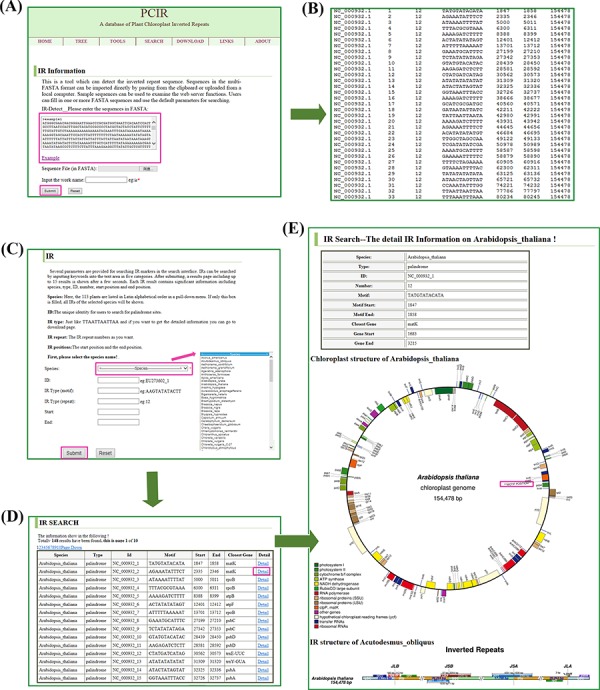
Inverted repeats (IRs) serve as potential biomarkers for genomic instability, DNA replication and other genetic processes. However, little information can be found in databases to help researchers recognize potential IR nucleotides, explore junction sites and annotate related functional genes. Plant Chloroplast Inverted Repeats (PCIR) is an interactive, web-based platform containing various sequenced chloroplast genomes that enables detection, searching and visualization of large-scale detailed information on IRs. PCIR contains many datasets, including 21 433 IRs, 113 plants chloroplast genomes, 16 948 functional genes and 21 659 visual maps. This database offers an online prediction tool for detecting IRs based on DNA sequences. PCIR can also analyze phylogenetic relationships using IR information among different species and provide users with high-quality marker maps. This database will be a valuable resource for IR distribution patterns, related genes and architectural features.
反向重复序列 (IRs) 可作为基因组不稳定性、DNA 复制和其他遗传过程的潜在生物标志物。然而,数据库中几乎没有关于潜在 IR 核苷酸的信息,无法帮助研究人员识别、探索连接位点并注释相关功能基因。植物叶绿体反向重复序列 (PCIR) 是一个交互式的、基于网络的平台,包含各种已测序的叶绿体基因组,能够检测、搜索和可视化大规模的 IR 详细信息。PCIR 包含许多数据集,包括 21433 个 IR、113 种植物叶绿体基因组、16948 个功能基因和 21659 个可视化图谱。该数据库提供了一个基于 DNA 序列的在线预测工具,用于检测 IR。PCIR 还可以利用不同物种之间的 IR 信息分析系统发育关系,并为用户提供高质量的标记图谱。这个数据库将成为研究 IR 分布模式、相关基因和结构特征的有价值资源。