Kocaballi Ahmet Baki, Berkovsky Shlomo, Quiroz Juan C, Laranjo Liliana, Tong Huong Ly, Rezazadegan Dana, Briatore Agustina, Coiera Enrico
Australian Institute of Health Innovation , Faculty of Medicine and Health Sciences, Macquarie University, Sydney, Australia.
Health Information Systems Office, Ministry of Health, Buenos Aires, Argentina.
J Med Internet Res. 2019 Nov 7;21(11):e15360. doi: 10.2196/15360.
The personalization of conversational agents with natural language user interfaces is seeing increasing use in health care applications, shaping the content, structure, or purpose of the dialogue between humans and conversational agents.
The goal of this systematic review was to understand the ways in which personalization has been used with conversational agents in health care and characterize the methods of its implementation.
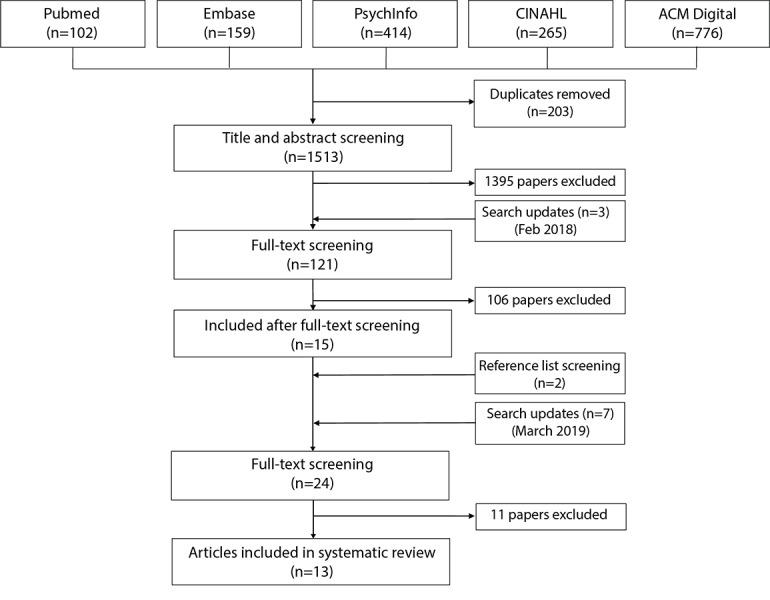
We searched on PubMed, Embase, CINAHL, PsycInfo, and ACM Digital Library using a predefined search strategy. The studies were included if they: (1) were primary research studies that focused on consumers, caregivers, or health care professionals; (2) involved a conversational agent with an unconstrained natural language interface; (3) tested the system with human subjects; and (4) implemented personalization features.
The search found 1958 publications. After abstract and full-text screening, 13 studies were included in the review. Common examples of personalized content included feedback, daily health reports, alerts, warnings, and recommendations. The personalization features were implemented without a theoretical framework of customization and with limited evaluation of its impact. While conversational agents with personalization features were reported to improve user satisfaction, user engagement and dialogue quality, the role of personalization in improving health outcomes was not assessed directly.
Most of the studies in our review implemented the personalization features without theoretical or evidence-based support for them and did not leverage the recent developments in other domains of personalization. Future research could incorporate personalization as a distinct design factor with a more careful consideration of its impact on health outcomes and its implications on patient safety, privacy, and decision-making.
具有自然语言用户界面的对话代理个性化在医疗保健应用中越来越多地被使用,塑造了人与对话代理之间对话的内容、结构或目的。
本系统评价的目的是了解在医疗保健中对话代理的个性化使用方式,并描述其实施方法。
我们使用预定义的搜索策略在PubMed、Embase、CINAHL、PsycInfo和ACM数字图书馆中进行搜索。纳入的研究需满足以下条件:(1)是针对消费者、护理人员或医疗保健专业人员的原发性研究;(2)涉及具有无约束自然语言界面的对话代理;(3)对人类受试者进行系统测试;(4)实施个性化功能。
搜索共找到1958篇出版物。经过摘要和全文筛选,13项研究被纳入本评价。个性化内容的常见示例包括反馈、每日健康报告、警报、警告和建议。个性化功能的实施缺乏定制的理论框架,对其影响的评估也有限。虽然据报道具有个性化功能的对话代理可提高用户满意度、用户参与度和对话质量,但个性化对改善健康结果的作用并未得到直接评估。
我们评价中的大多数研究在实施个性化功能时没有理论或循证支持,也未利用其他个性化领域的最新进展。未来的研究可以将个性化作为一个独特的设计因素,更仔细地考虑其对健康结果的影响及其对患者安全、隐私和决策的影响。