Department of Biochemistry and Molecular Genetics, University of Colorado Denver - Anschutz Medical Campus, Aurora, CO.
Center for Biologics Evaluation and Research, Food and Drug Administration, Silver Spring, MD.
Haematologica. 2020 Aug;105(8):2174-2186. doi: 10.3324/haematol.2019.229930. Epub 2019 Nov 7.
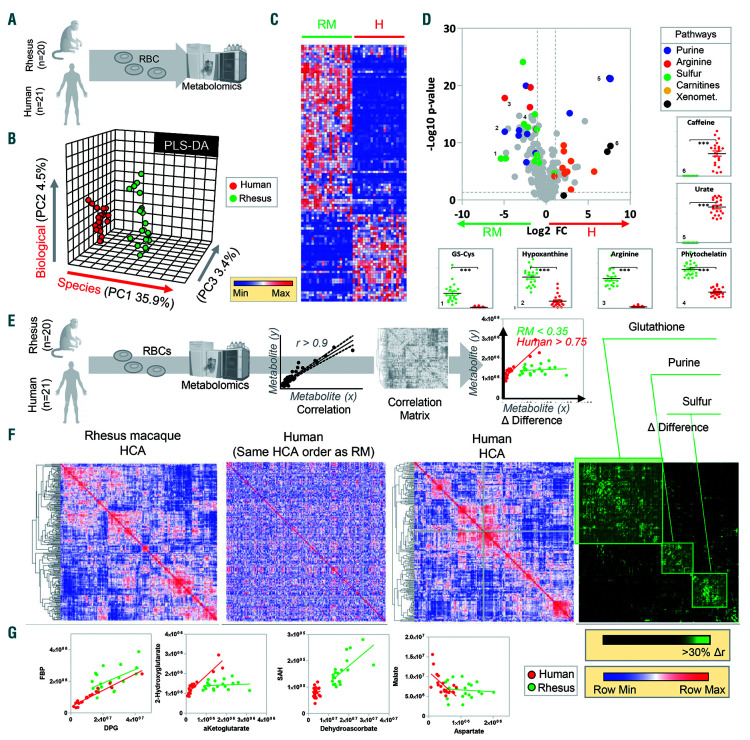
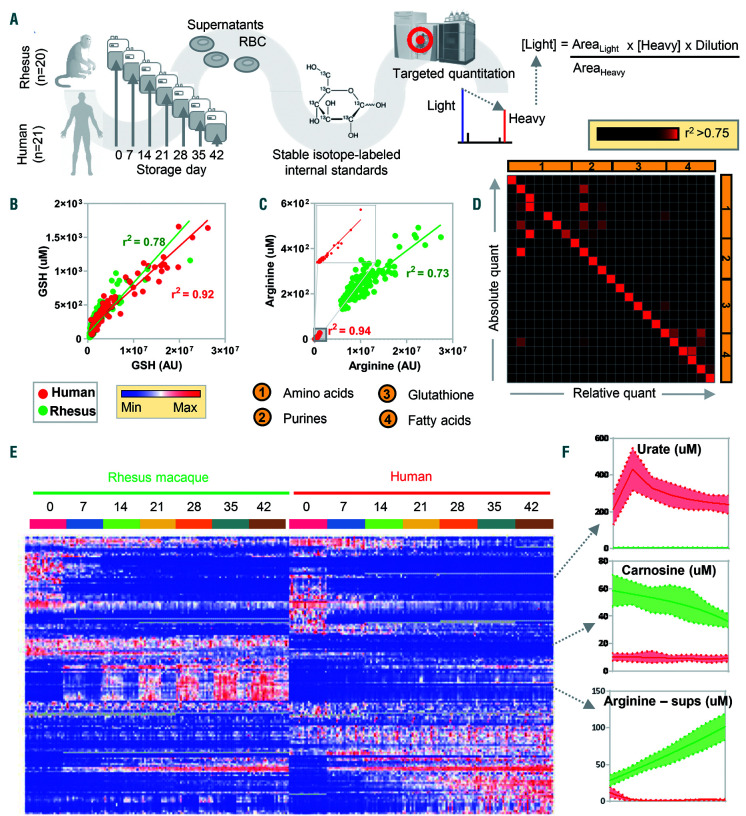
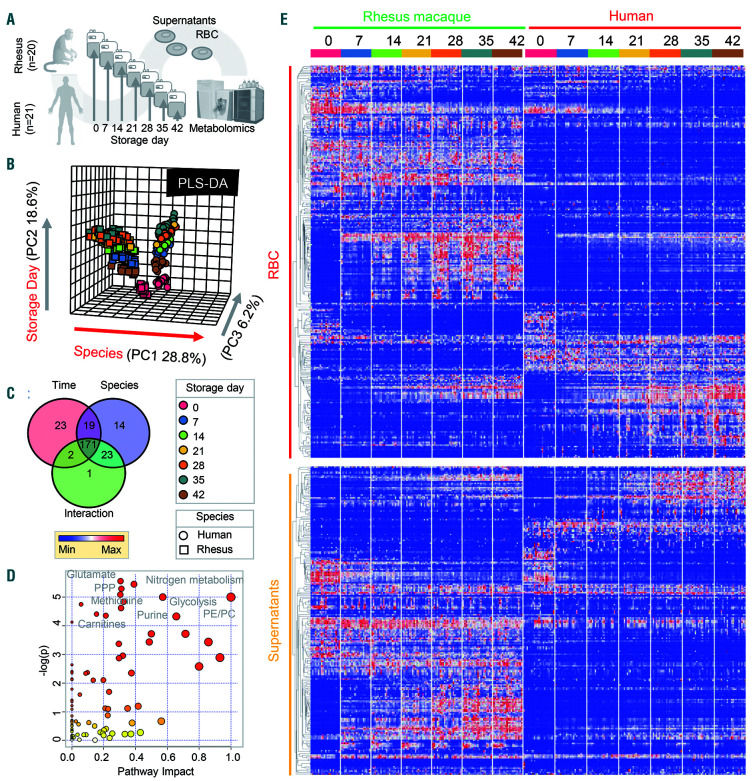
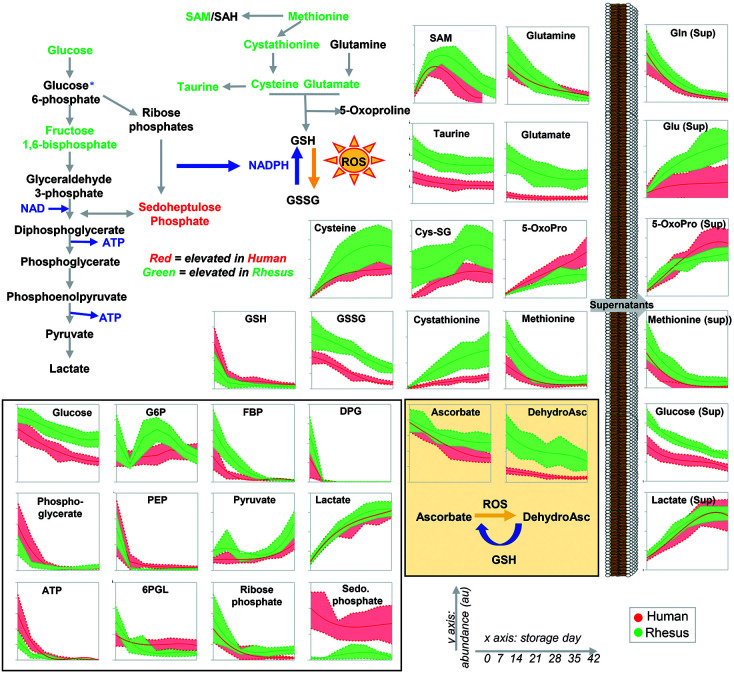
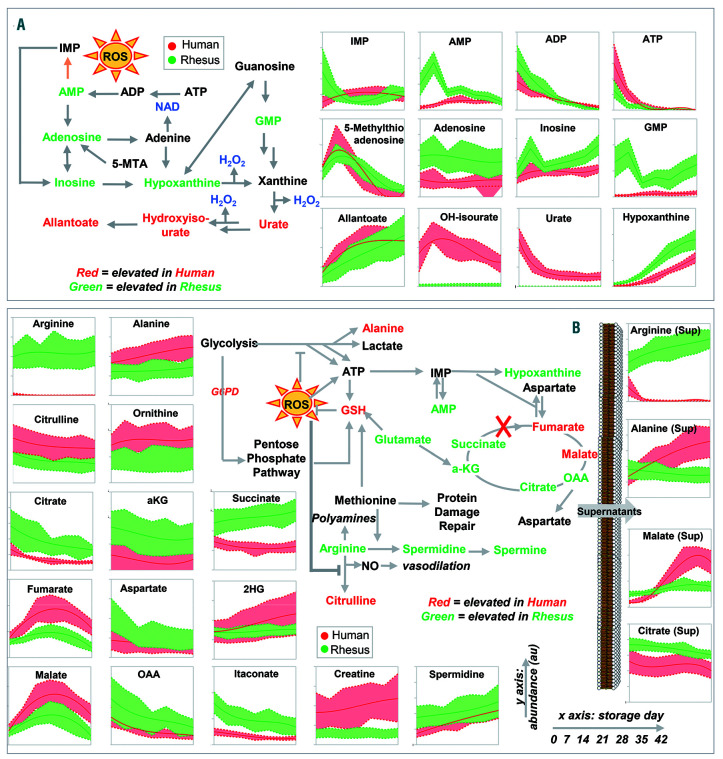
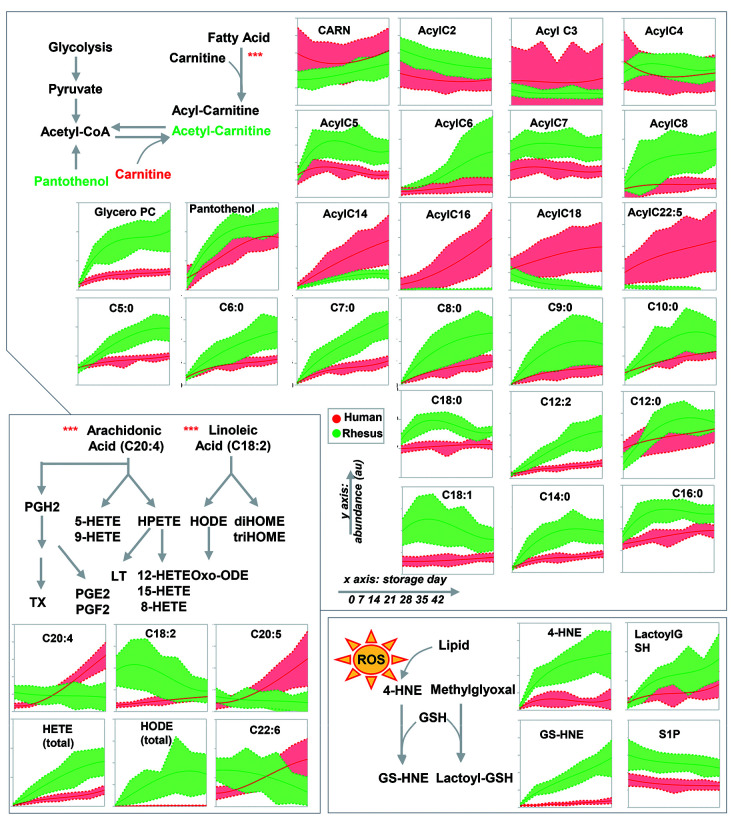
Macaques are emerging as a critical animal model in transfusion medicine, because of their evolutionary similarity to humans and perceived utility in discovery and translational science. However, little is known about the metabolism of Rhesus macaque red blood cells (RBC) and how this compares to human RBC metabolism under standard blood banking conditions. Metabolomic and lipidomic analyses, and tracing experiments with [1,2,3-C]glucose, were performed using fresh and stored RBC (sampled weekly until storage day 42) obtained from Rhesus macaques (n=20) and healthy human volunteers (n=21). These results were further validated with targeted quantification against stable isotope-labeled internal standards. Metabolomic analyses demonstrated inter-species differences in RBC metabolism independent of refrigerated storage. Although similar trends were observed throughout storage for several metabolic pathways, species- and sex-specific differences were also observed. The most notable differences were in glutathione and sulfur metabolites, purine and lipid oxidation metabolites, acylcarnitines, fatty acyl composition of several classes of lipids (including phosphatidylserines), glyoxylate pathway intermediates, and arginine and carboxylic acid metabolites. Species-specific dietary and environmental compounds were also detected. Overall, the results suggest an increased basal and refrigerator-storage-induced propensity for oxidant stress and lipid remodeling in Rhesus macaque RBC cells, as compared to human red cells. The overlap between Rhesus macaque and human RBC metabolic phenotypes suggests the potential utility of a translational model for simple RBC transfusions, although inter-species storage-dependent differences need to be considered when modeling complex disease states, such as transfusion in trauma/hemorrhagic shock models.
猕猴在输血医学中作为一种重要的动物模型而出现,这是因为它们与人类在进化上具有相似性,并且在发现和转化科学中具有潜在的应用价值。然而,人们对恒河猴红细胞(RBC)的代谢知之甚少,也不知道在标准血库条件下,猕猴 RBC 代谢与人类 RBC 代谢有何不同。本研究使用来自恒河猴(n=20)和健康人类志愿者(n=21)的新鲜和储存 RBC(分别在储存第 7、14、21、28 和 42 天采集)进行了代谢组学和脂质组学分析以及[1,2,3-C]葡萄糖示踪实验。这些结果通过与稳定同位素标记内标物的靶向定量进一步验证。代谢组学分析表明,在冷藏储存的情况下,RBC 代谢存在种间差异,而与冷藏储存无关。尽管在整个储存过程中观察到几种代谢途径的相似趋势,但也观察到了种间和性别特异性差异。最显著的差异是在谷胱甘肽和硫代谢物、嘌呤和脂质氧化代谢物、酰基辅酶 A、几类脂质(包括磷脂酰丝氨酸)的脂肪酸组成、乙醛酸途径中间产物以及精氨酸和羧酸代谢物中。还检测到了种特异性的饮食和环境化合物。总的来说,与人类 RBC 相比,恒河猴 RBC 细胞表现出更高的基础和冰箱储存诱导的氧化应激和脂质重塑倾向。恒河猴和人类 RBC 代谢表型之间的重叠表明,该模型可能具有用于简单 RBC 输血的转化潜力,尽管在模拟复杂疾病状态(如创伤/失血性休克模型中的输血)时,需要考虑种间储存依赖性差异。