Health Economics Unit, Melbourne School of Population and Global Health, University of Melbourne, Level 4, 207 Bouverie Street, Parkville, VIC, 3010, Australia.
Centre for Health Economics, University of York, York, UK.
Appl Health Econ Health Policy. 2020 Apr;18(2):177-188. doi: 10.1007/s40258-019-00530-2.
Serious mental illness (SMI) is a set of disabling conditions associated with poor outcomes and high healthcare utilisation. However, little is known about patterns of utilisation and costs across sectors for people with SMI.
The aim was to develop a costing methodology and estimate annual healthcare costs for people with SMI in England across primary and secondary care settings.
A retrospective observational cohort study was conducted using linked administrative records from primary care, emergency departments, inpatient admissions, and community mental health services, covering financial years 2011/12-2013/14. Costs were calculated using bottom-up costing and are expressed in 2013/14 British pounds (GBP). Determinants of annual costs by sector were estimated using generalised linear models.
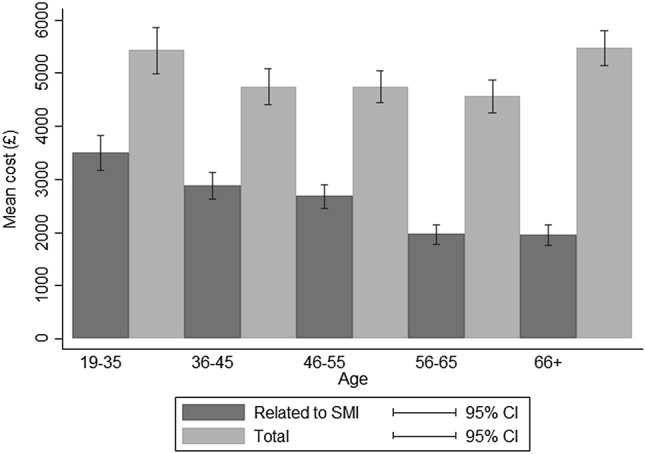
Mean annual total healthcare costs for 13,846 adults with SMI were £4989 (median £1208), comprising 19% from primary care (£938, median £531), 34% from general hospital care (£1717, median £0), and 47% from inpatient and community-based specialist mental health services (£2334, median £0). Mean annual costs related specifically to mental health, as distinct from physical health, were £2576 (median £290). Key predictors of total cost included physical comorbidities, ethnicity, neighbourhood deprivation, SMI diagnostic subgroup, and age. Some associations varied across care context; for example, older age was associated with higher primary care and hospital costs, but lower mental healthcare costs.
Annual healthcare costs for people with SMI vary significantly across clinical and socioeconomic characteristics and healthcare sectors. This analysis informs policy and research, including estimation of health budgets for particular patient profiles, and economic evaluation of health services and policies.
严重精神疾病(SMI)是一组与不良结局和高医疗保健利用相关的致残疾病。然而,对于患有 SMI 的人群,在整个医疗体系中,其利用模式和成本知之甚少。
旨在开发一种成本核算方法,并估算英格兰 SMI 患者在初级保健和二级保健环境中的年度医疗保健成本。
采用回顾性观察队列研究,使用初级保健、急诊科、住院和社区精神卫生服务的链接行政记录,涵盖 2011/12 年至 2013/14 年的财政年度。使用自下而上的成本核算方法计算成本,并以 2013/14 年的英镑(GBP)表示。使用广义线性模型估算按部门划分的年度成本决定因素。
13846 名患有 SMI 的成年人的年平均总医疗保健费用为 4989 英镑(中位数 1208 英镑),其中 19%来自初级保健(938 英镑,中位数 531 英镑),34%来自综合医院护理(1717 英镑,中位数 0 英镑),47%来自住院和基于社区的专科精神卫生服务(2334 英镑,中位数 0 英镑)。与心理健康相关而非身体健康相关的年平均费用为 2576 英镑(中位数 290 英镑)。总费用的主要预测因素包括身体合并症、种族、社区贫困程度、SMI 诊断亚组和年龄。一些关联因护理环境而异;例如,年龄较大与初级保健和医院费用较高相关,但与精神保健费用较低相关。
患有 SMI 的人群的年度医疗保健费用在临床和社会经济特征以及医疗保健部门之间存在显著差异。该分析为政策和研究提供了信息,包括为特定患者群体估算卫生预算,以及对卫生服务和政策进行经济评估。