Shader Maureen J, Nguyen Nicole, Cleary Miranda, Hertzano Ronna, Eisenman David J, Anderson Samira, Gordon-Salant Sandra, Goupell Matthew J
Department of Hearing and Speech Sciences, University of Maryland, College Park, Maryland, USA.
Department of Otorhinolaryngology Head and Neck Surgery, University of Maryland School of Medicine, Baltimore, Maryland, USA.
Ear Hear. 2020 May/Jun;41(3):640-651. doi: 10.1097/AUD.0000000000000793.
Cochlear implants (CIs) are considered a safe and effective intervention for more severe degrees of hearing loss in adults of all ages. Although older CI users ≥65 years of age can obtain large benefits in speech understanding from a CI, there is a growing body of literature suggesting that older CI users may not perform as well as younger CI users. One reason for this potential age-related limitation could be that default CI stimulation settings are not optimal for older CI users. The goal of this study was to determine whether improvements in speech understanding were possible when CI users were programmed with nondefault stimulation rates and to determine whether lower-than-default stimulation rates improved older CI users' speech understanding.
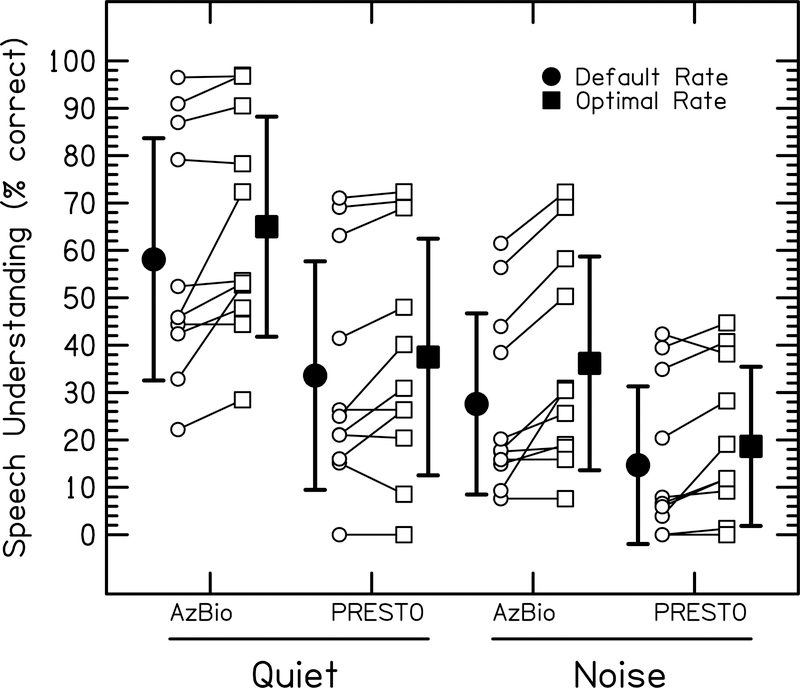
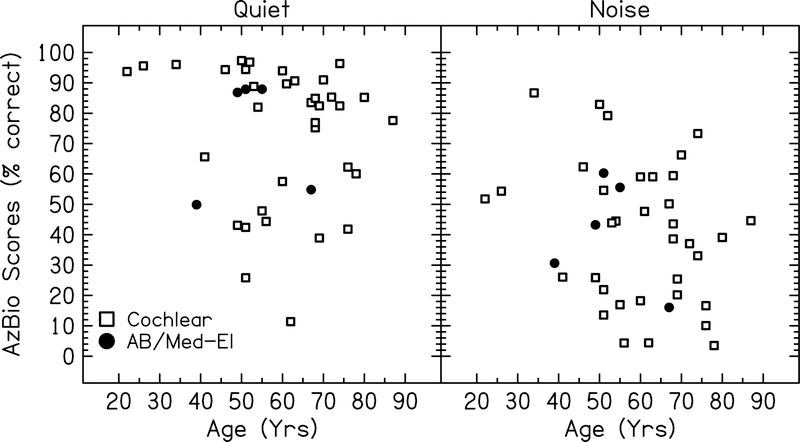
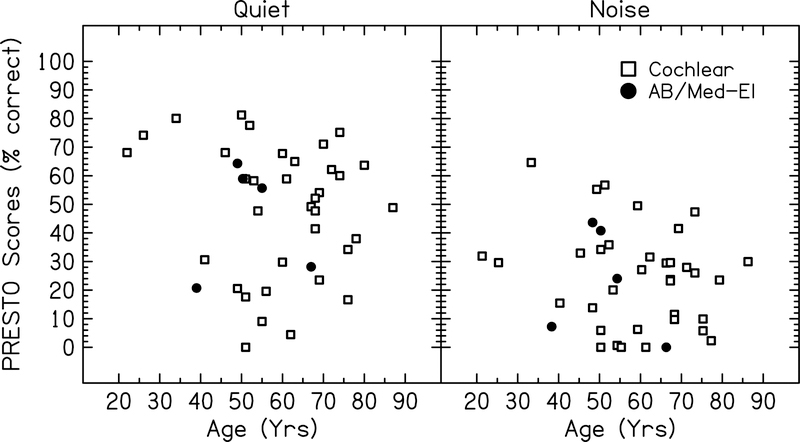
Sentence recognition was measured acutely using different stimulation rates in 37 CI users ranging in age from 22 to 87 years. Maps were created using rates of 500, 720, 900, and 1200 pulses per second (pps) for each subject. An additional map using a rate higher than 1200 pps was also created for individuals who used a higher rate in their clinical processors. Thus, the clinical rate of each subject was also tested, including non-default rates above 1200 pps for Cochlear users and higher rates consistent with the manufacturer defaults for subjects implanted with Advanced Bionics and Med-El devices. Speech understanding performance was evaluated at each stimulation rate using AzBio and Perceptually Robust English Sentence Test Open-set (PRESTO) sentence materials tested in quiet and in noise.
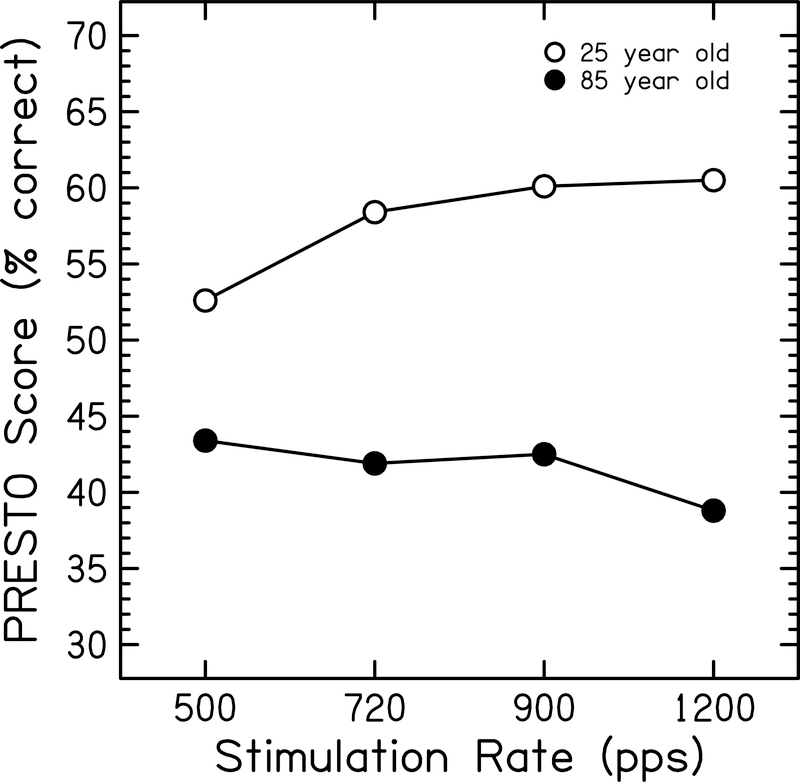
For Cochlear-brand users, speech understanding performance using non-default rates was slightly poorer when compared with the default rate (900 pps). However, this effect was offset somewhat by age, in which older subjects were able to maintain comparable performance using a 500-pps map compared with the default rate map when listening to the more difficult PRESTO sentence material. Advanced Bionics and Med-El users showed modest improvements in their overall performance using 720 pps compared with the default rate (>1200 pps). On the individual-subject level, 10 subjects (11 ears) showed a significant effect of stimulation rate, with 8 of those ears performing best with a lower-than-default rate.
Results suggest that default stimulation rates are likely sufficient for many CI users, but some CI users at any age can benefit from a lower-than-default rate. Future work that provides experience with novel rates in everyday life has the potential to identify more individuals whose performance could be improved with changes to stimulation rate.
人工耳蜗(CI)被认为是一种安全有效的干预措施,可用于各年龄段成年人中更严重程度的听力损失。尽管65岁及以上的老年CI使用者能从CI中在言语理解方面获得很大益处,但越来越多的文献表明老年CI使用者的表现可能不如年轻CI使用者。这种潜在的与年龄相关的局限性的一个原因可能是默认的CI刺激设置对老年CI使用者并非最佳。本研究的目的是确定当CI使用者采用非默认刺激率进行编程时,言语理解是否有可能得到改善,并确定低于默认的刺激率是否能提高老年CI使用者的言语理解。
对37名年龄在22至87岁之间的CI使用者,使用不同刺激率急性测量句子识别能力。为每个受试者创建了每秒500、720、900和1200脉冲(pps)的刺激率图谱。对于在临床处理器中使用更高刺激率的个体,还创建了一个高于1200 pps的额外图谱。因此,也测试了每个受试者的临床刺激率,包括Cochlear使用者高于1200 pps的非默认刺激率,以及植入Advanced Bionics和Med-El设备的受试者与制造商默认值一致的更高刺激率。使用AzBio和在安静和噪声环境中测试的感知稳健英语句子测试开放集(PRESTO)句子材料,在每个刺激率下评估言语理解表现。
对于Cochlear品牌的使用者,与默认刺激率(900 pps)相比,使用非默认刺激率时言语理解表现略差。然而,这种影响在一定程度上被年龄所抵消,即老年受试者在听更难的PRESTO句子材料时,使用500 pps的图谱与默认率图谱相比能够保持相当的表现。Advanced Bionics和Med-El的使用者与默认刺激率(>1200 pps)相比,使用720 pps时整体表现有适度改善。在个体受试者层面,10名受试者(11只耳朵)显示出刺激率的显著影响,其中8只耳朵在低于默认率时表现最佳。
结果表明默认刺激率可能对许多CI使用者足够,但任何年龄的一些CI使用者都能从低于默认的刺激率中受益。未来在日常生活中提供新型刺激率体验的工作有可能识别出更多通过改变刺激率其表现可得到改善的个体。