James Chris J, Graham Petra L, Betances Reinoso Frank A, Breuning Silvia N, Durko Marcin, Huarte Irujo Alicia, Royo López Juan, Müller Lida, Perenyi Adam, Jaramillo Saffon Rafael, Salinas Garcia Sandra, Schüssler Mark, Schwarz Langer Margarita J, Skarzynski Piotr H, Mecklenburg Dianne J
Cochlear France SAS, Toulouse, France.
Department of Mathematics and Statistics, Macquarie University, North Ryde, NSW, Australia.
Front Aging Neurosci. 2021 Feb 25;13:589296. doi: 10.3389/fnagi.2021.589296. eCollection 2021.
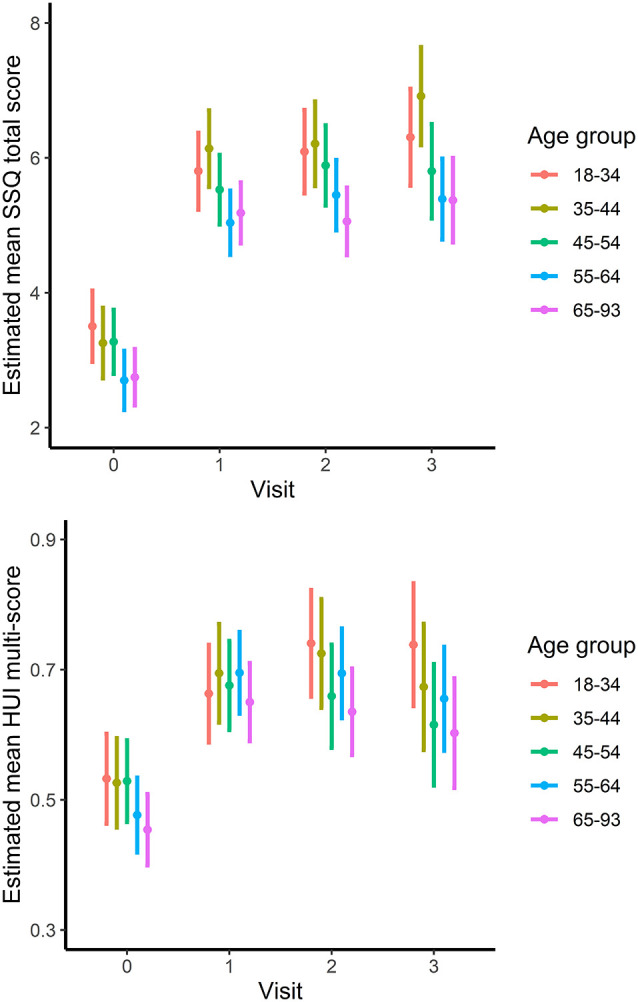
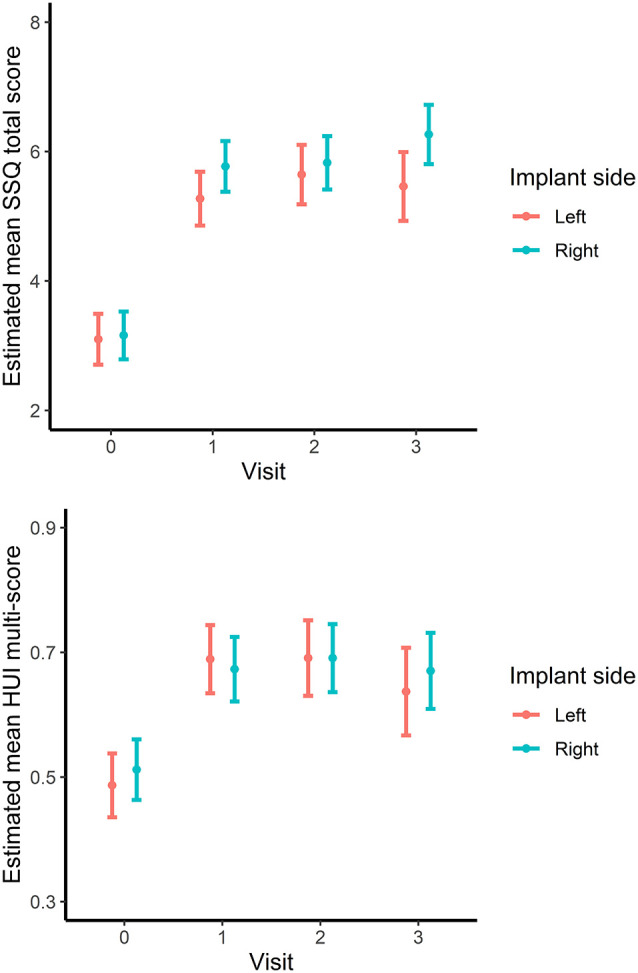
Older adults with mild or no hearing loss make more errors and expend more effort listening to speech. Cochlear implants (CI) restore hearing to deaf patients but with limited fidelity. We hypothesized that patient-reported hearing and health-related quality of life in CI patients may similarly vary according to age. Speech Spatial Qualities (SSQ) of hearing scale and Health Utilities Index Mark III (HUI) questionnaires were administered to 543 unilaterally implanted adults across Europe, South Africa, and South America. Data were acquired before surgery and at 1, 2, and 3 years post-surgery. Data were analyzed using linear mixed models with visit, age group (18-34, 35-44, 45-54, 55-64, and 65+), and side of implant as main factors and adjusted for other covariates. Tinnitus and dizziness prevalence did not vary with age, but older groups had more preoperative hearing. Preoperatively and postoperatively, SSQ scores were significantly higher (Δ0.75-0.82) for those aged <45 compared with those 55+. However, gains in SSQ scores were equivalent across age groups, although postoperative SSQ scores were higher in right-ear implanted subjects. All age groups benefited equally in terms of HUI gain (0.18), with no decrease in scores with age. Overall, younger adults appeared to cope better with a degraded hearing before and after CI, leading to better subjective hearing performance.
轻度听力损失或无听力损失的老年人在听语音时会犯更多错误,且需要付出更多努力。人工耳蜗(CI)可恢复聋人患者的听力,但保真度有限。我们假设人工耳蜗植入患者报告的听力及与健康相关的生活质量可能会因年龄不同而存在类似差异。我们对欧洲、南非和南美洲的543名单侧植入人工耳蜗的成年人进行了听力量表的语音空间质量(SSQ)和健康效用指数第三版(HUI)问卷调查。在手术前以及术后1年、2年和3年收集数据。使用线性混合模型进行数据分析,将就诊时间、年龄组(18 - 34岁、35 - 44岁、45 - 54岁、55 - 64岁和65岁以上)以及植入侧作为主要因素,并对其他协变量进行校正。耳鸣和头晕的患病率不随年龄变化,但年龄较大的组术前听力更好。术前和术后,年龄小于45岁者的SSQ得分显著高于55岁以上者(差值为0.75 - 0.82)。然而,尽管右耳植入受试者术后SSQ得分较高,但各年龄组的SSQ得分增幅相当。所有年龄组在HUI得分提升方面(0.18)获益相同,得分不会随年龄降低。总体而言,较年轻的成年人似乎在人工耳蜗植入前后能更好地应对听力下降问题,从而获得更好的主观听力表现。