Department of Neuroscience and Center for Magnetic Resonance Research University of Minnesota, Minneapolis, MN, United States of America.
Department of Neurobiology and Behavior, Cornell University, Ithaca, NY, United States of America.
PLoS Comput Biol. 2019 Nov 8;15(11):e1007475. doi: 10.1371/journal.pcbi.1007475. eCollection 2019 Nov.
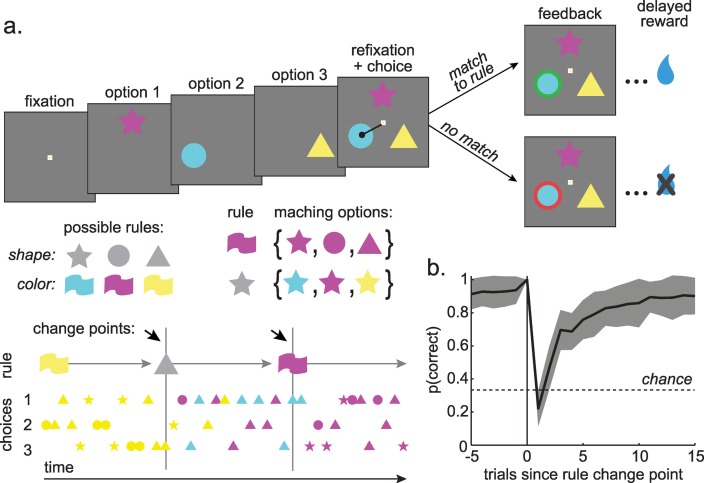
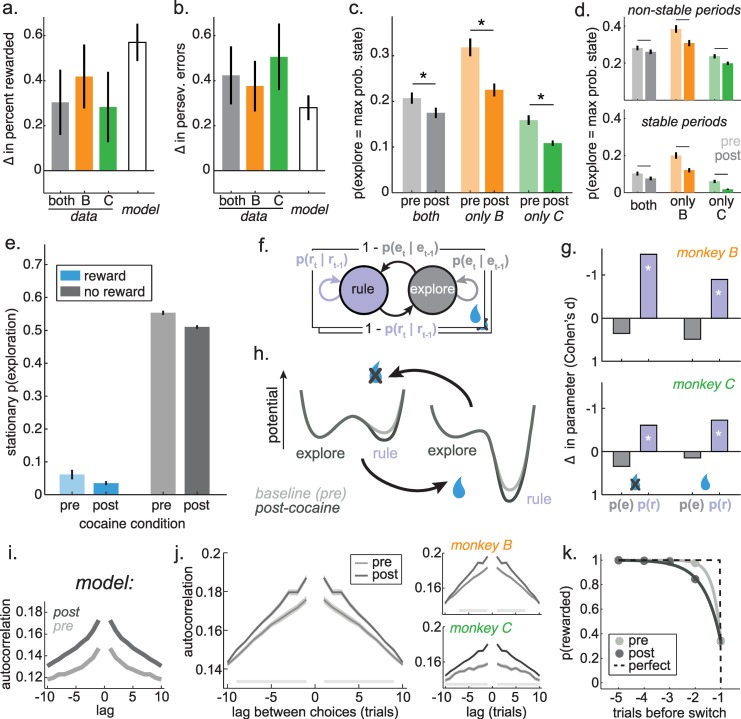
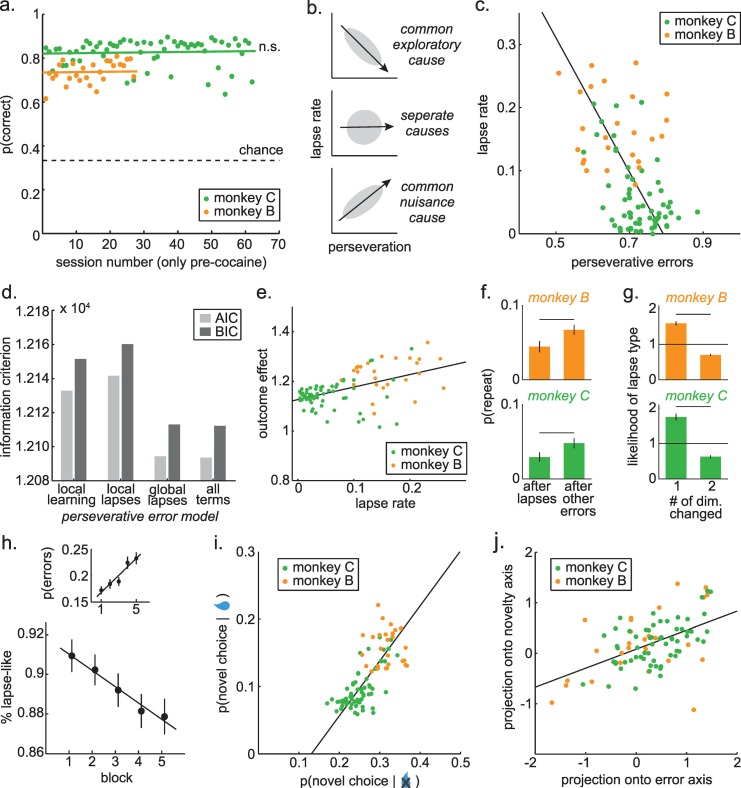
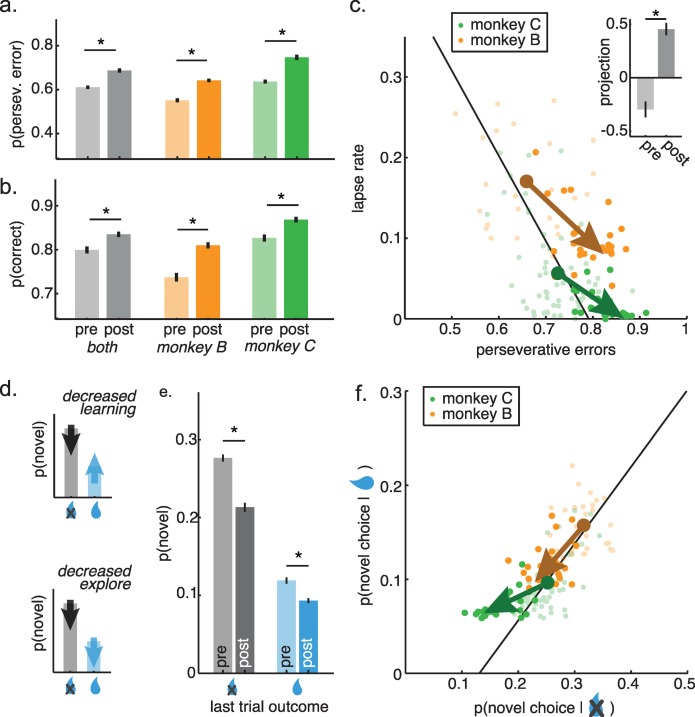
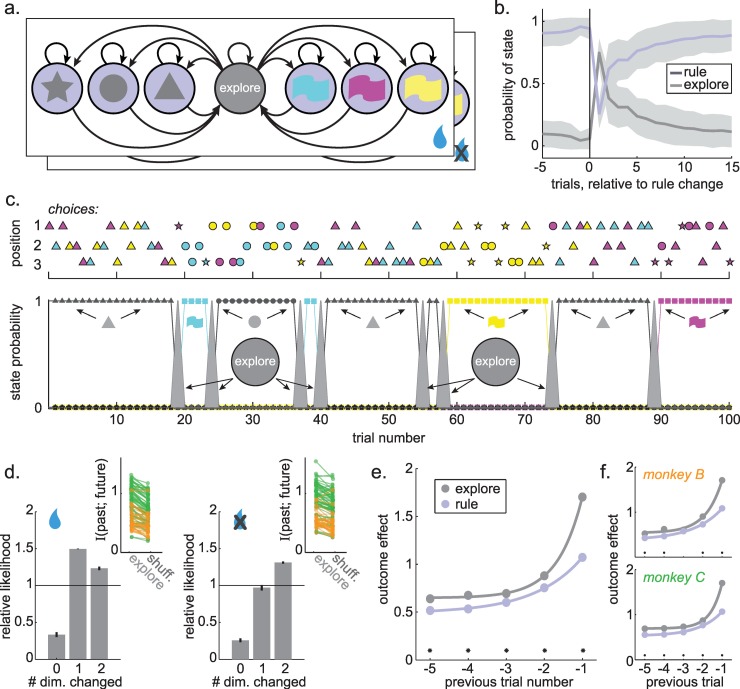
In many cognitive tasks, lapses (spontaneous errors) are tacitly dismissed as the result of nuisance processes like sensorimotor noise, fatigue, or disengagement. However, some lapses could also be caused by exploratory noise: randomness in behavior that facilitates learning in changing environments. If so, then strategic processes would need only up-regulate (rather than generate) exploration to adapt to a changing environment. This view predicts that more frequent lapses should be associated with greater flexibility because these behaviors share a common cause. Here, we report that when rhesus macaques performed a set-shifting task, lapse rates were negatively correlated with perseverative error frequency across sessions, consistent with a common basis in exploration. The results could not be explained by local failures to learn. Furthermore, chronic exposure to cocaine, which is known to impair cognitive flexibility, did increase perseverative errors, but, surprisingly, also improved overall set-shifting task performance by reducing lapse rates. We reconcile these results with a state-switching model in which cocaine decreases exploration by deepening attractor basins corresponding to rule states. These results support the idea that exploratory noise contributes to lapses, affecting rule-based decision-making even when it has no strategic value, and suggest that one key mechanism for regulating exploration may be the depth of rule states.
在许多认知任务中,失误(自发错误)被默认为是由传感器运动噪声、疲劳或注意力不集中等干扰过程引起的。然而,一些失误也可能是由探索性噪声引起的:在变化的环境中,行为的随机性促进了学习。如果是这样的话,那么策略性过程只需要上调(而不是产生)探索,以适应不断变化的环境。这一观点预测,更频繁的失误应该与更大的灵活性相关,因为这些行为有共同的原因。在这里,我们报告说,当恒河猴执行一种转变任务时,失误率与各次会话中的坚持错误频率呈负相关,这与探索有共同的基础。这些结果不能用局部学习失败来解释。此外,慢性接触可卡因已知会损害认知灵活性,这确实增加了坚持错误,但令人惊讶的是,通过降低失误率,也提高了整体的转变任务表现。我们用状态切换模型来解释这些结果,该模型认为可卡因通过加深与规则状态对应的吸引子盆地来减少探索。这些结果支持了这样一种观点,即探索性噪声会导致失误,即使在没有战略价值的情况下,也会影响基于规则的决策,并表明调节探索的一个关键机制可能是规则状态的深度。