Laboratoire PMMH, UMR 7636 CNRS-ESPCI-Sorbonne Université-Université Paris Diderot, 7-9 quai Saint-Bernard, 75005, Paris, France.
Departamento de Física, FCFM, Universidad de Chile, Av. Blanco Encalada 2008, Santiago, Chile.
Nat Commun. 2019 Nov 8;10(1):5082. doi: 10.1038/s41467-019-13031-6.
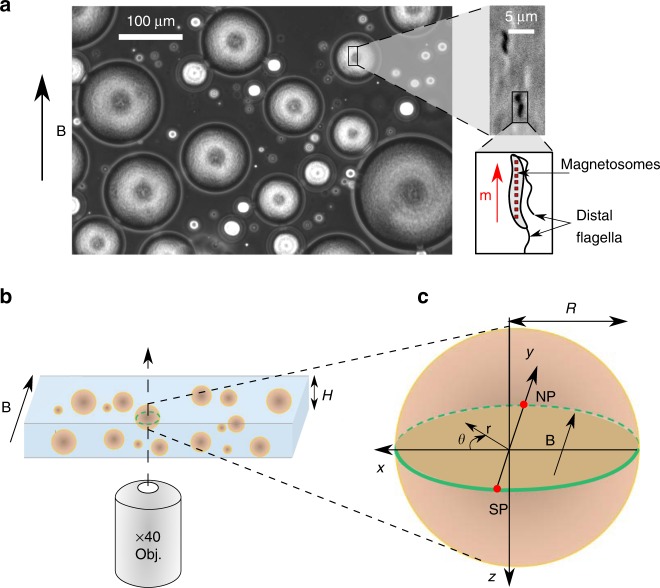
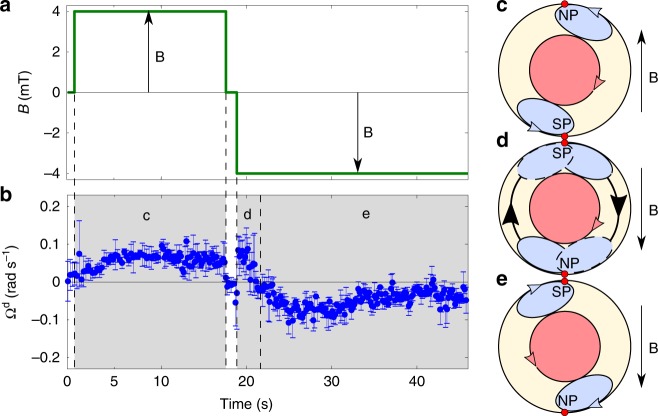
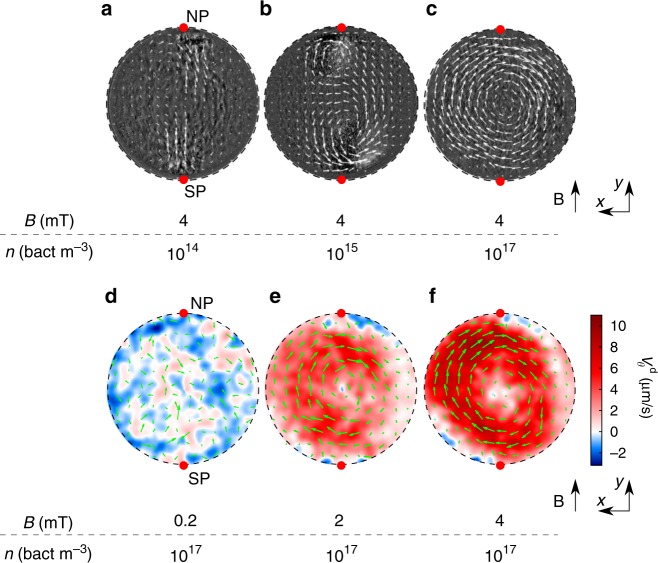
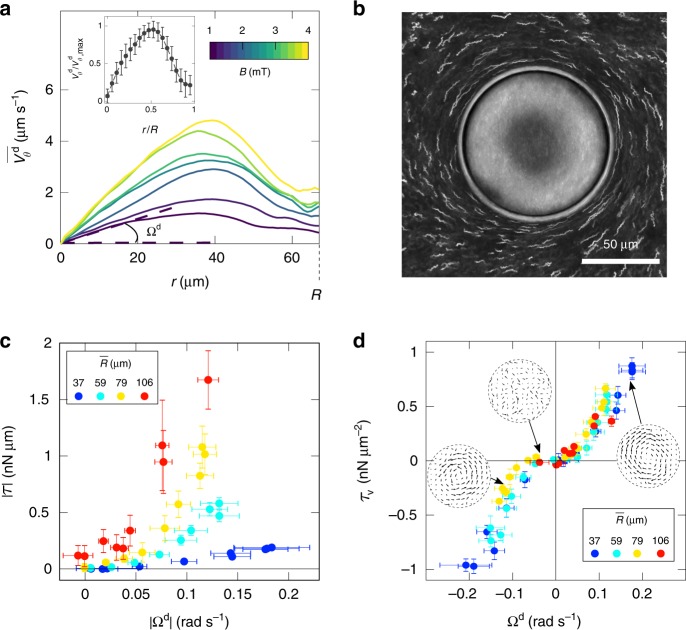
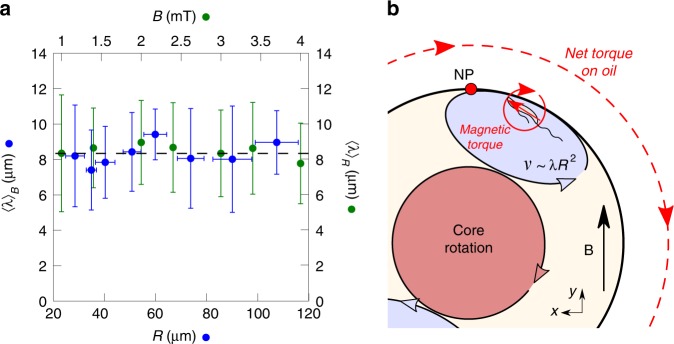
From intracellular protein trafficking to large-scale motion of animal groups, the physical concepts driving the self-organization of living systems are still largely unraveled. Self-organization of active entities, leading to novel phases and emergent macroscopic properties, recently shed new light on these complex dynamical processes. Here we show that under the application of a constant magnetic field, motile magnetotactic bacteria confined in water-in-oil droplets self-assemble into a rotary motor exerting a torque on the external oil phase. A collective motion in the form of a large-scale vortex, reversable by inverting the field direction, builds up in the droplet with a vorticity perpendicular to the magnetic field. We study this collective organization at different concentrations, magnetic fields and droplet radii and reveal the formation of two torque-generating areas close to the droplet interface. We characterize quantitatively the mechanical energy extractable from this new biological and self-assembled motor.
从细胞内蛋白质运输到动物群体的大规模运动,驱动生命系统自组织的物理概念在很大程度上仍未被揭示。活性实体的自组织导致了新的相和涌现的宏观性质,最近为这些复杂的动力学过程提供了新的视角。在这里,我们表明,在施加恒磁场的情况下,被限制在油包水液滴中的游动磁细菌会自组装成一个旋转马达,对外部油相施加扭矩。在液滴中形成了一种大规模的漩涡集体运动,通过反转磁场方向可以使其反向,该漩涡的涡度垂直于磁场。我们在不同的浓度、磁场和液滴半径下研究这种集体组织,并揭示了在液滴界面附近形成的两个产生扭矩的区域。我们定量地表征了从这个新的生物和自组装马达中提取的机械能。