Cardiovascular Division, Department of Medicine (P.S.V., K.-H.A.C., F.K., P.S.N., O.O., C.S.), University of Minnesota Medical School, Minneapolis, MN.
Department of Medicine (C.C.), University of Minnesota Medical School, Minneapolis, MN.
Circ Cardiovasc Imaging. 2019 Nov;12(11):e009723. doi: 10.1161/CIRCIMAGING.119.009723. Epub 2019 Nov 11.
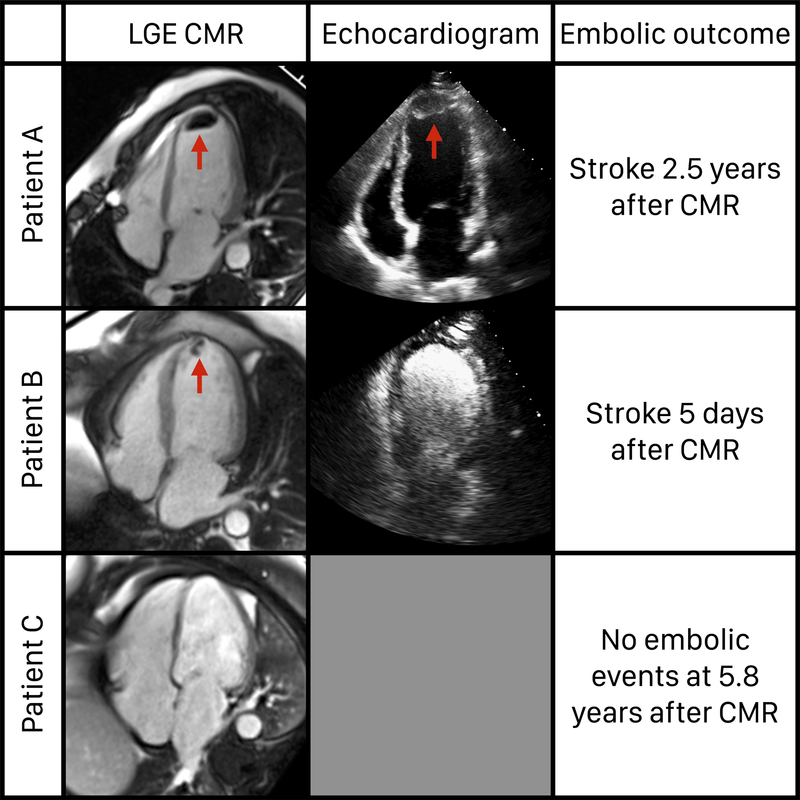
Late gadolinium enhancement (LGE) cardiovascular magnetic resonance (CMR) imaging is more sensitive than echocardiography for the detection of intracardiac thrombus because of its unique ability to identify thrombus based on tissue characteristics related to avascularity. The long-term prognostic significance of left ventricular (LV) thrombus detected by LGE CMR is unknown.
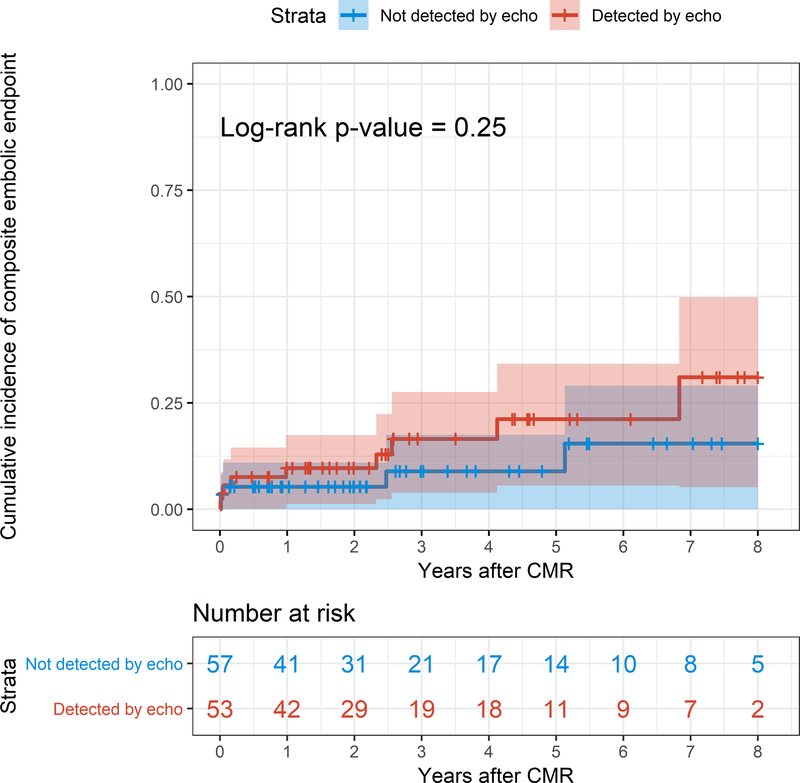
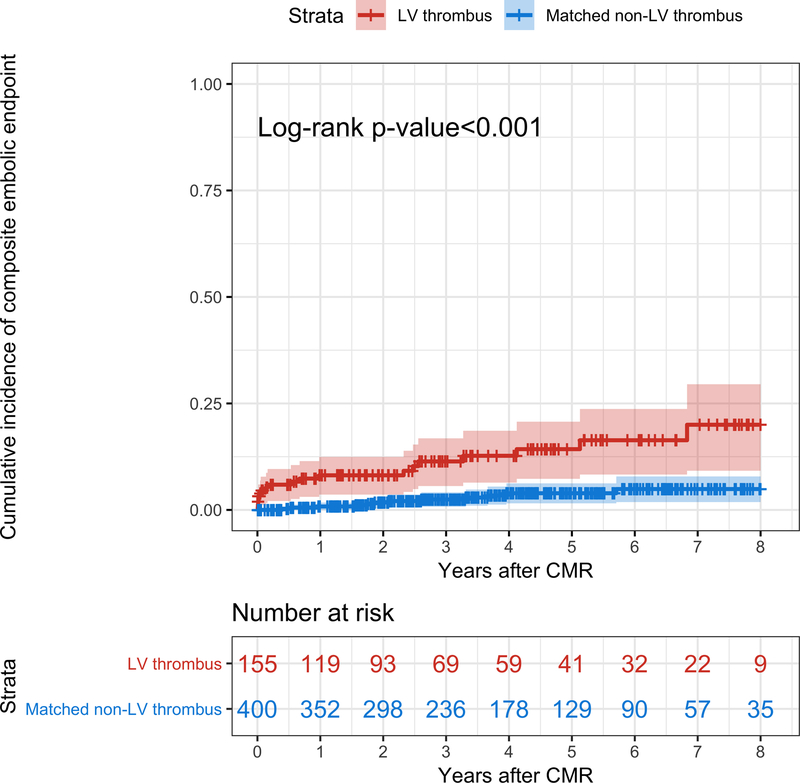
We performed a matched cohort study of consecutive adult patients with LV thrombus detected by LGE CMR who were matched on the date of CMR, age, and LV ejection fraction to up to 3 patients without LV thrombus. We investigated the long-term incidence of a composite of embolic events: stroke, transient ischemic attack, or extracranial systemic arterial embolism. We also compared outcomes among patients with LV thrombus detected by LGE CMR stratified by whether the LV thrombus was also detected by echocardiography or not.
Of 157 LV thrombus patients, 155 were matched to 400 non-LV thrombus patients. During a median follow-up of 3.3 years, the cumulative incidence of embolism was significantly higher in LV thrombus patients compared with the matched non-LV thrombus patients (<0.001), with annualized rates of 3.7% and 0.8% for LV thrombus and matched non-LV thrombus patients, respectively. LV thrombus was the only independent predictor of the composite embolic end point (hazard ratio, 3.99 [95% CI, 1.54-10.35]; =0.004). The cumulative incidence of embolism was not different in patients with LV thrombus that was also detected by echocardiography versus patients with LV thrombus not detected by echocardiography (=0.25).
Despite contemporary antithrombotic treatment, LV thrombus detected by LGE CMR is associated with a 4-fold higher long-term incidence of embolism compared with matched non-LV thrombus patients. LV thrombus detected by LGE CMR but not by echocardiography is associated with a similar risk of embolism as that detected by both LGE CMR and echocardiography.
相较于超声心动图,钆延迟增强(late gadolinium enhancement,LGE)心血管磁共振(cardiovascular magnetic resonance,CMR)成像在检测心腔内血栓方面更具优势,因为其具有基于与无血管组织特征相关的组织特征识别血栓的独特能力。LGE CMR 检测到的左心室(left ventricular,LV)血栓的长期预后意义尚不清楚。
我们对连续接受 LGE CMR 检查且发现 LV 血栓的成年患者进行了匹配队列研究,按照 CMR 检查日期、年龄和左心室射血分数,将这些患者与最多 3 例未发现 LV 血栓的患者进行了匹配。我们调查了 LGE CMR 检测到的 LV 血栓患者发生复合栓塞事件(卒中和短暂性脑缺血发作或颅外全身动脉栓塞)的长期发生率。我们还比较了根据 LGE CMR 是否检测到 LV 血栓以及是否同时检测到超声心动图进行分层的 LV 血栓患者的结局。
在 157 例 LV 血栓患者中,155 例与 400 例非 LV 血栓患者相匹配。在中位随访 3.3 年期间,LV 血栓患者的栓塞累积发生率明显高于匹配的非 LV 血栓患者(P<0.001),LV 血栓患者和匹配的非 LV 血栓患者的年化发生率分别为 3.7%和 0.8%。LV 血栓是复合栓塞终点的唯一独立预测因子(风险比,3.99[95%置信区间,1.54~10.35];P=0.004)。在同时通过超声心动图检测到 LV 血栓的患者与未通过超声心动图检测到 LV 血栓的患者中,栓塞的累积发生率无差异(P=0.25)。
尽管接受了当代抗血栓治疗,LGE CMR 检测到的 LV 血栓与匹配的非 LV 血栓患者相比,其长期栓塞发生率仍高出 4 倍。LGE CMR 检测到但未通过超声心动图检测到的 LV 血栓与同时通过 LGE CMR 和超声心动图检测到的 LV 血栓的栓塞风险相似。