Phuah YuZhi, Tan Ying Xin, Zaghloul Sheref, Sim Sharmaine, Wong Joshua, Usmani Saba, Snell Lily, Thavabalan Karish, García-Pérez Carmen Lucia, Kumar Niraj S, Glatzel Hannah, Ahmad Reubeen Rashid, Candilio Luciano, Bray Jonathan J H, Ahmed Mahmood, Providencia Rui
University College London Medical School, 74 Huntley St, London WC1E 6DE, UK.
Department of Cardiology, Royal Free Hospital, London, UK.
Eur Heart J Imaging Methods Pract. 2023 Dec 7;1(2):qyad041. doi: 10.1093/ehjimp/qyad041. eCollection 2023 Sep.
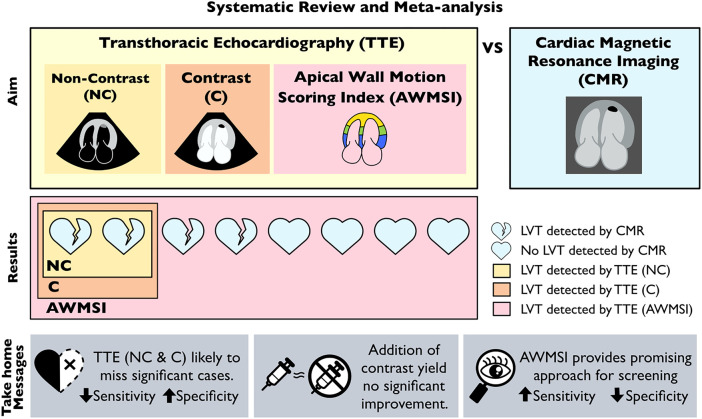
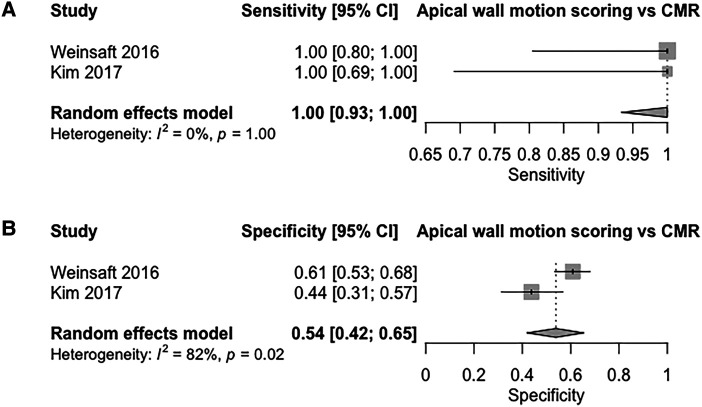
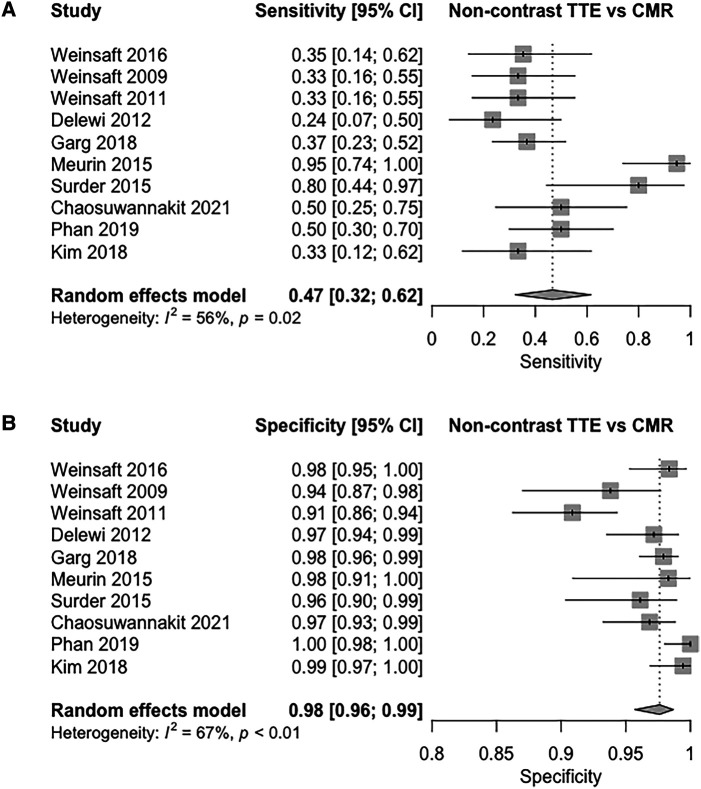
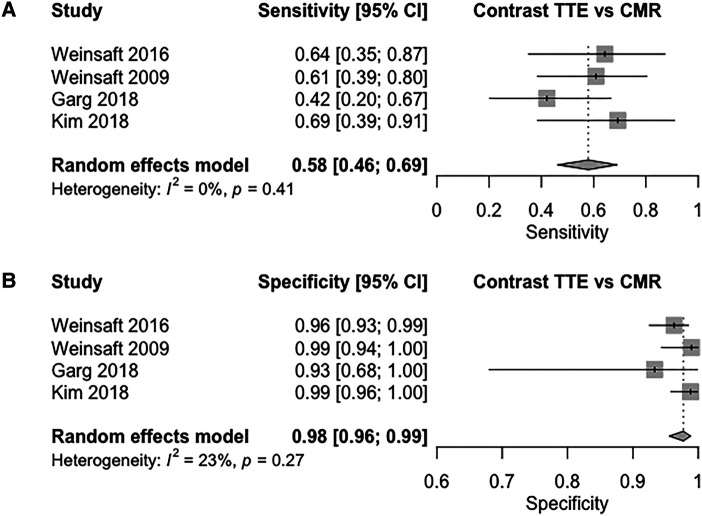
Transthoracic echocardiography (TTE) is the most commonly used imaging modality to diagnose left ventricular thrombus (LVT), however, cardiac magnetic resonance (CMR) remains the gold standard investigation. A comparison of the diagnostic performance between two modalities is needed to inform guidelines on a diagnostic approach towards LVT. We performed a systematic review and meta-analysis to investigate the diagnostic performance of three methods of TTE (non-contrast, contrast, and apical wall motion scoring) for the detection of LVT compared to CMR as a reference test. Studies comprising 2113 patients investigated for LVT using both TTE and CMR were included in the meta-analysis. For non-contrast TTE, pooled sensitivity and specificity were 47% [95% confidence interval (CI): 32-62%], and 98% (95% CI: 96-99%), respectively. In contrast, TTE pooled sensitivity and specificity values were 58% (95% CI: 46-69%), and 98% (95% CI: 96-99%), respectively. Apical wall motion scoring on non-contrast TTE yielded a sensitivity of 100% [95% CI: 93-100%] and a specificity of 54% (95% CI: 42-65%). The area under the curve (AUC) values from our summary receiver operating characteristic curve (SROC) for non-contrast and contrast TTE were 0.87 and 0.86 respectively, with apical wall motion studies having the highest AUC of 0.93. Despite high specificity, routine contrast and non-contrast TTE are likely to miss a significant number of LVT, making it a suboptimal screening tool. The addition of apical wall motion scoring provides a promising method to reliably identify patients requiring further investigations for LVT, whilst excluding others from unnecessary testing.
经胸超声心动图(TTE)是诊断左心室血栓(LVT)最常用的成像方式,然而,心脏磁共振成像(CMR)仍是金标准检查方法。需要比较这两种检查方式的诊断性能,以便为LVT的诊断方法制定指南提供依据。我们进行了一项系统评价和荟萃分析,以研究与作为参考检查的CMR相比,TTE的三种方法(非增强、增强和心尖壁运动评分)对LVT的诊断性能。荟萃分析纳入了2113例同时使用TTE和CMR检查LVT的患者。对于非增强TTE,汇总敏感性和特异性分别为47%[95%置信区间(CI):32 - 62%]和98%(95%CI:96 - 99%)。相比之下,增强TTE的汇总敏感性和特异性值分别为58%(95%CI:46 - 69%)和98%(95%CI:96 - 99%)。非增强TTE的心尖壁运动评分敏感性为100%[95%CI:93 - 100%],特异性为54%(95%CI:42 - 65%)。我们汇总的受试者工作特征曲线(SROC)中,非增强和增强TTE的曲线下面积(AUC)值分别为0.87和0.86,心尖壁运动研究的AUC最高,为0.93。尽管特异性较高,但常规的增强和非增强TTE可能会遗漏大量LVT,使其成为一种次优的筛查工具。增加心尖壁运动评分提供了一种有前景的方法,能够可靠地识别需要进一步检查LVT的患者,同时避免其他患者进行不必要的检查。