Chun Rene F, Shieh Albert, Gottlieb Carter, Yacoubian Vahe, Wang Jeffrey, Hewison Martin, Adams John S
Department of Orthopaedic Surgery, David Geffen School of Medicine at UCLA, Los Angeles, CA, United States.
Department of Medicine, David Geffen School of Medicine at UCLA, Los Angeles, CA, United States.
Front Endocrinol (Lausanne). 2019 Oct 24;10:718. doi: 10.3389/fendo.2019.00718. eCollection 2019.
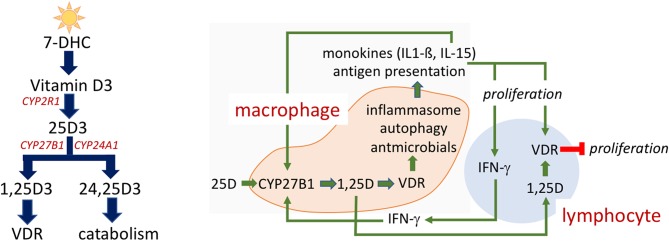
Vitamin D has a long-established role in bone health. In the last two decades, there has been a dramatic resurgence in research interest in vitamin D due to studies that have shown its possible benefits for non-skeletal health. Underpinning the renewed interest in vitamin D was the identification of the vital role of intracrine or localized, tissue-specific, conversion of inactive pro-hormone 25-hydroxyvitamin D [25(OH)D] to active 1,25-dihydroxyvitamin D [1,25(OH)D]. This intracrine mechanism is the likely driving force behind vitamin D action resulting in positive effects on human health. To fully capture the effect of this localized, tissue-specific conversion to 1,25(OH)D, adequate 25(OH)D would be required. As such, low serum concentrations of 25(OH)D would compromise intracrine generation of 1,25(OH)D within target tissues. Consistent with this is the observation that all adverse human health consequences of vitamin D deficiency are associated with a low serum 25(OH)D level and not with low 1,25(OH)D concentrations. Thus, clinical investigators have sought to define what concentration of serum 25(OH)D constitutes adequate vitamin D status. However, since 25(OH)D is transported in serum bound primarily to vitamin D binding protein (DBP) and secondarily to albumin, is the total 25(OH)D (bound plus free) or the unbound free 25(OH)D the crucial determinant of the non-classical actions of vitamin D? While DBP-bound-25(OH)D is important for renal handling of 25(OH)D and endocrine synthesis of 1,25(OH)D, how does DBP impact extra-renal synthesis of 1,25(OH)D and subsequent 1,25(OH)D actions? Are their pathophysiological contexts where total 25(OH)D and free 25(OH)D would diverge in value as a marker of vitamin D status? This review aims to introduce and discuss the concept of free 25(OH)D, the molecular biology and biochemistry of vitamin D and DBP that provides the context for free 25(OH)D, and surveys , animal, and human studies taking free 25(OH)D into consideration.
维生素D在骨骼健康方面的作用早已确立。在过去二十年中,由于研究表明维生素D对非骨骼健康可能有益,对它的研究兴趣急剧复苏。对维生素D重新产生兴趣的基础是,人们发现了内分泌或局部、组织特异性地将无活性的激素原25-羟基维生素D [25(OH)D] 转化为活性1,25-二羟基维生素D [1,25(OH)D] 的重要作用。这种内分泌机制可能是维生素D发挥作用并对人类健康产生积极影响的驱动力。为了充分捕捉这种局部、组织特异性转化为1,25(OH)D的效果,需要足够的25(OH)D。因此,血清中25(OH)D浓度低会损害靶组织内1,25(OH)D的内分泌生成。与此一致的是,观察发现维生素D缺乏对人类健康的所有不良影响都与血清25(OH)D水平低有关,而与1,25(OH)D浓度低无关。因此,临床研究人员试图确定血清25(OH)D的何种浓度构成充足的维生素D状态。然而,由于25(OH)D在血清中主要与维生素D结合蛋白 (DBP) 结合运输,其次与白蛋白结合,那么是总25(OH)D(结合的加上游离的)还是未结合的游离25(OH)D是维生素D非经典作用的关键决定因素呢?虽然与DBP结合的25(OH)D对肾脏处理25(OH)D和1,25(OH)D的内分泌合成很重要,但DBP如何影响肾脏外1,25(OH)D的合成以及随后的1,25(OH)D作用呢?是否存在病理生理背景,使得总25(OH)D和游离25(OH)D作为维生素D状态标志物的值会出现差异?这篇综述旨在介绍和讨论游离25(OH)D的概念、为游离25(OH)D提供背景的维生素D和DBP的分子生物学及生物化学,并综述考虑到游离25(OH)D的细胞、动物和人体研究。