Julius Center for Health Sciences and Primary Care, University Medical Center Utrecht (UMCU), Utrecht, The Netherlands.
Centre for Infectious Disease Control, National Institute for Public Health and the Environment (RIVM), Bilthoven, The Netherlands.
J Antimicrob Chemother. 2020 Feb 1;75(2):342-350. doi: 10.1093/jac/dkz462.
ESBL-producing Enterobacteriaceae (ESBL-E) are observed in many reservoirs. Pets might play an important role in the dissemination of ESBL-E to humans since they live closely together.
To identify prevalence, risk factors, molecular characteristics, persistence and acquisition of ESBL-E in dogs and cats, and co-carriage in human-pet pairs belonging to the same household.
In a nationwide study, one person per household was randomly invited to complete a questionnaire and to submit a faecal sample. Dog and cat owners were invited to also submit a faecal sample from their pet. Repeated sampling after 1 and 6 months was performed in a subset. ESBL-E were obtained through selective culture and characterized by WGS. Logistic regression analyses and random forest models were performed to identify risk factors.
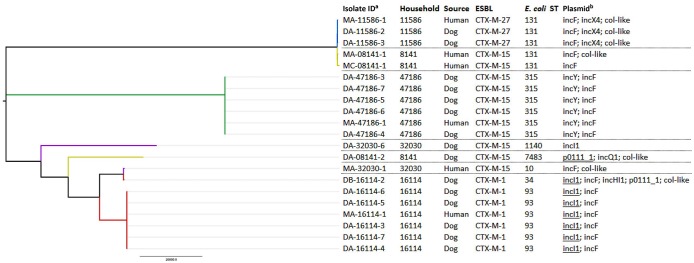
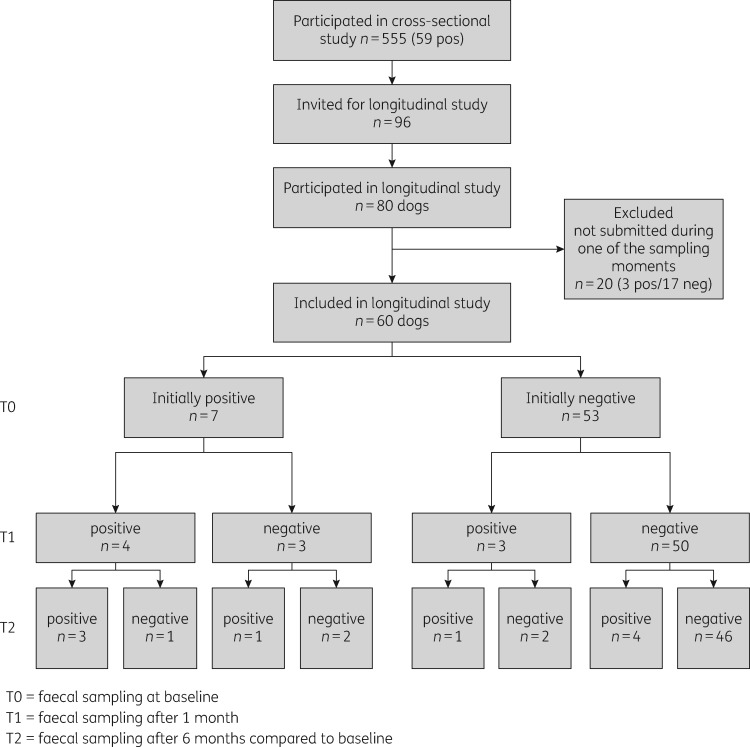
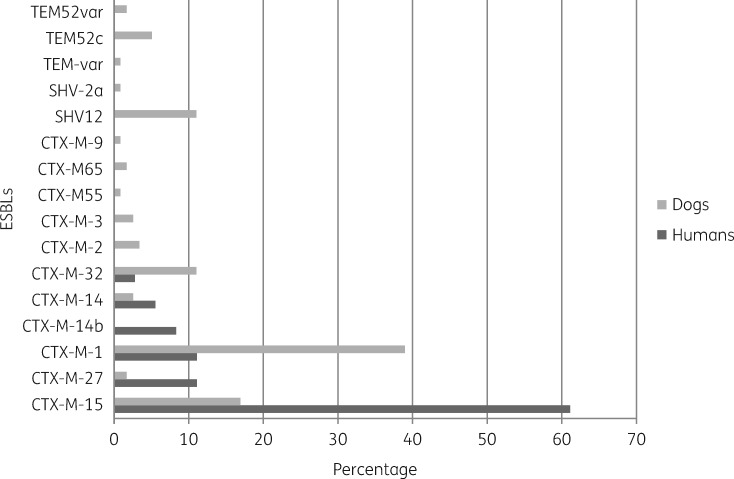
The prevalence of ESBL-E carriage in these cohorts was 3.8% (95% CI: 2.7%-5.4%) for human participants (n=550), 10.7% (95% CI: 8.3%-13.7%) for dogs (n=555) and 1.4% (95% CI: 0.5%-3.8%) for cats (n=285). Among animals, blaCTX-M-1 was most abundant, followed by blaCTX-M-15. In dogs, persistence of carriage was 57.1% at 1 month and 42.9% at 6 months. Eating raw meat [OR: 8.8, 95% CI: 4.7-16.4; population attributable risk (PAR): 46.5%, 95% CI: 41.3%-49.3%] and dry food (OR: 0.2, 95% CI: 0.1-0.5; PAR: 56.5%, 95% CI: 33.2%-66.6%) were predictors for ESBL-E carriage in dogs. Human-dog co-carriage was demonstrated in five households. Human-cat co-carriage was not observed.
ESBL-E prevalence was higher in dogs than in humans and lowest in cats. The main risk factor for ESBL-E carriage was eating raw meat. Co-carriage in dogs and household members was uncommon.
产超广谱β-内酰胺酶肠杆菌科(ESBL-E)在许多储层中都有发现。由于宠物与人类生活在一起,因此它们可能在 ESBL-E 向人类传播方面发挥着重要作用。
确定狗和猫中 ESBL-E 的流行率、危险因素、分子特征、持续性和获得性,以及属于同一家庭的人-宠物对的共同携带。
在一项全国性研究中,每户随机邀请一人填写问卷并提交粪便样本。还邀请狗和猫的主人提交宠物的粪便样本。在一小部分人群中,进行了 1 个月和 6 个月后的重复采样。通过选择性培养获得 ESBL-E,并通过 WGS 进行特征分析。进行逻辑回归分析和随机森林模型以确定危险因素。
这些队列中人类参与者(n=550)的 ESBL-E 携带率为 3.8%(95%CI:2.7%-5.4%),狗(n=555)为 10.7%(95%CI:8.3%-13.7%),猫(n=285)为 1.4%(95%CI:0.5%-3.8%)。在动物中,blaCTX-M-1 最为丰富,其次是 blaCTX-M-15。在狗中,1 个月时的携带持续性为 57.1%,6 个月时为 42.9%。食用生肉[OR:8.8,95%CI:4.7-16.4;人群归因风险(PAR):46.5%,95%CI:41.3%-49.3%]和干粮(OR:0.2,95%CI:0.1-0.5;PAR:56.5%,95%CI:33.2%-66.6%)是狗中 ESBL-E 携带的预测因素。在五个家庭中发现了人与狗的共同携带。未观察到人-猫的共同携带。
狗中 ESBL-E 的流行率高于人类,而在猫中则最低。ESBL-E 携带的主要危险因素是食用生肉。狗和家庭成员之间的共同携带并不常见。