Department of Surgery, Manipal Hospital, New Delhi, India.
Department of Surgery, BARC Hospital, WHO Collaboration Center for Research in Surgical Care Delivery in LMIC, Mumbai, India.
Qual Life Res. 2020 Mar;29(3):683-692. doi: 10.1007/s11136-019-02351-1. Epub 2019 Nov 11.
Breast cancer is the commonest cancer in women worldwide. Surgery is a central part of the treatment. Modified radical mastectomy (MRM) is often replaced by breast conserving therapy (BCT) in high-income countries. MRM is still the standard choice, in low- and middle-income countries (LMICs) as radiotherapy, a mandatory component of BCT is not widely available. It is important to understand whether quality of life (QOL) after MRM is comparable to that after BCT. This has not been studied well in LMICs. We present, 5-year follow-up of QOL scores in breast cancer patients from India.
We interviewed women undergoing breast cancer surgery preoperatively, at 6 months after surgery, and at 1 year and 5 years, postoperatively. QOL scores were evaluated using FACT B questionnaire. Average QOL scores of women undergoing BCT were compared with those undergoing MRM. Total scores, domain scores and trends of scores over time were analyzed.
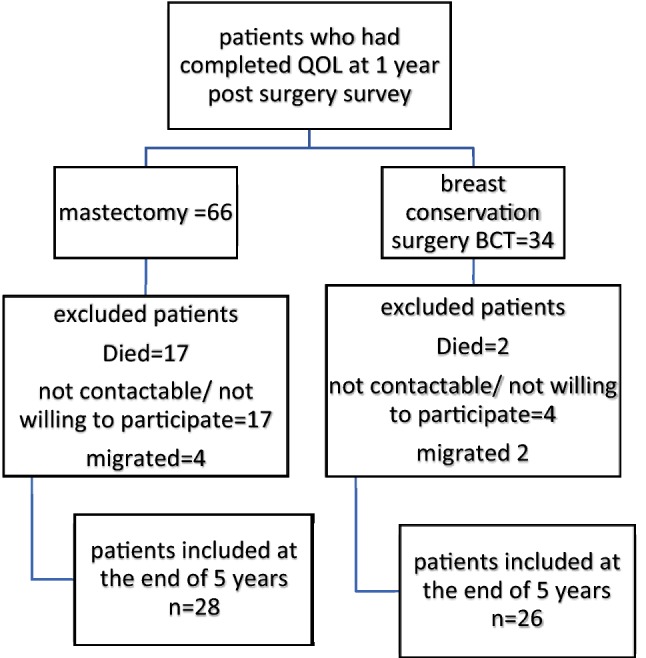
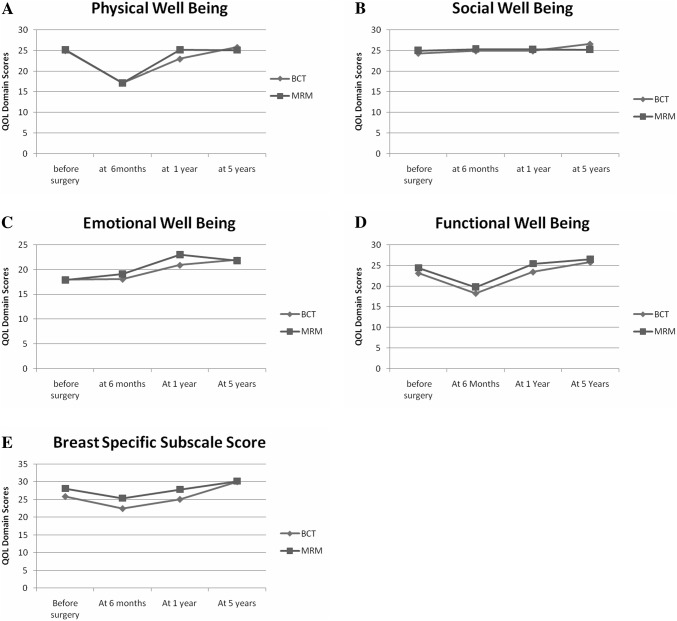
We interviewed 54 women with a mean age of 53 years (SD 9 ± years). QOL scores in all the women, dipped during the treatment period, in all subscales but improved thereafter and even surpassed the baseline in physical, emotional and breast-specific domains (p < 0.05) at 5 years. At the end of 5 years, there was no statistically significant difference between the MRM and BCT groups in any of the total or domain scores.
QOL scores in Indian women did not differ significantly between MRM and BCT in the long term. Both options are acceptable in the study setting.
乳腺癌是全球女性最常见的癌症。手术是治疗的核心部分。在高收入国家,改良根治性乳房切除术(MRM)通常被保乳治疗(BCT)所取代。在中低收入国家(LMICs),由于 BCT 的强制性组成部分放疗并不广泛,MRM 仍然是标准选择。了解 MRM 后生活质量(QOL)是否与 BCT 后相当非常重要。在 LMICs 中,这方面的研究还不够充分。我们介绍了来自印度的乳腺癌患者 5 年 QOL 评分随访结果。
我们在术前、术后 6 个月和 1 年和 5 年时对接受乳腺癌手术的女性进行了采访。使用 FACT-B 问卷评估 QOL 评分。比较接受 BCT 和 MRM 的女性的平均 QOL 评分。分析总评分、各领域评分以及随时间的评分趋势。
我们采访了 54 名平均年龄为 53 岁(SD 9±岁)的女性。所有女性的 QOL 评分在治疗期间所有子量表均下降,但此后有所改善,甚至在 5 年后超过了基线水平,在身体、情感和乳房特定领域(p<0.05)。在 5 年末,MRM 和 BCT 组在任何总评分或领域评分上均无统计学差异。
在长期随访中,印度女性的 MRM 和 BCT 之间的 QOL 评分没有显著差异。在研究环境中,这两种选择都可以接受。