The City University of New York-Queens College, Flushing, USA.
Northeastern University, Boston, Massachusetts, USA.
Nat Commun. 2019 Nov 13;10(1):5146. doi: 10.1038/s41467-019-12650-3.
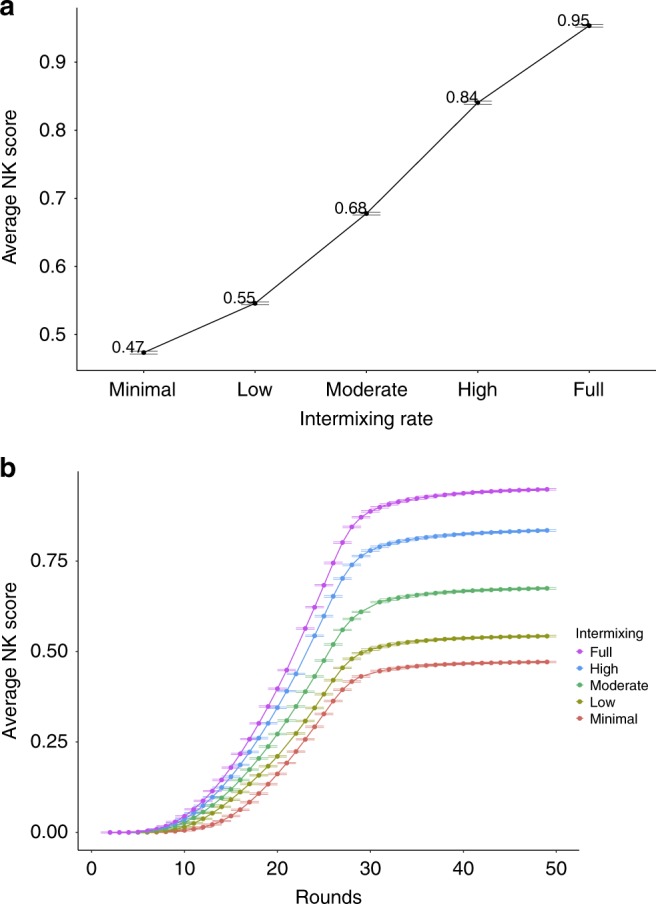
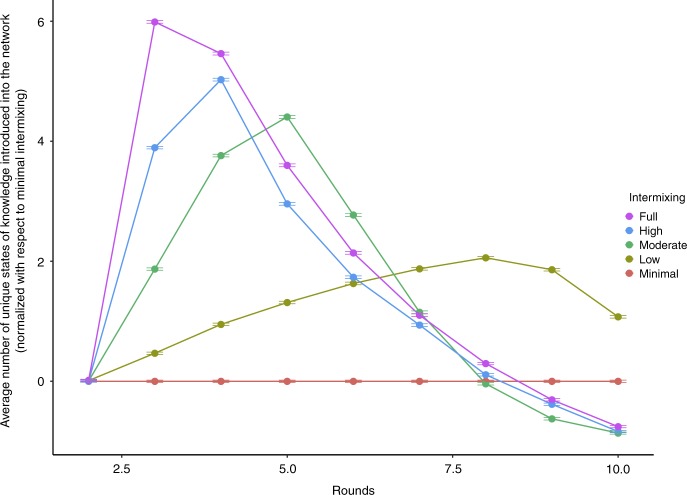
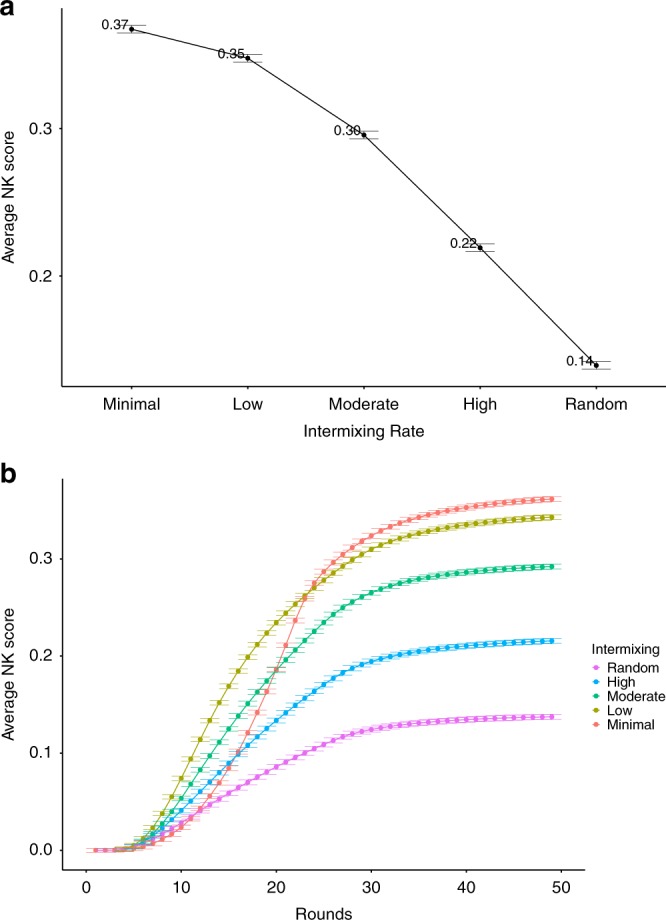
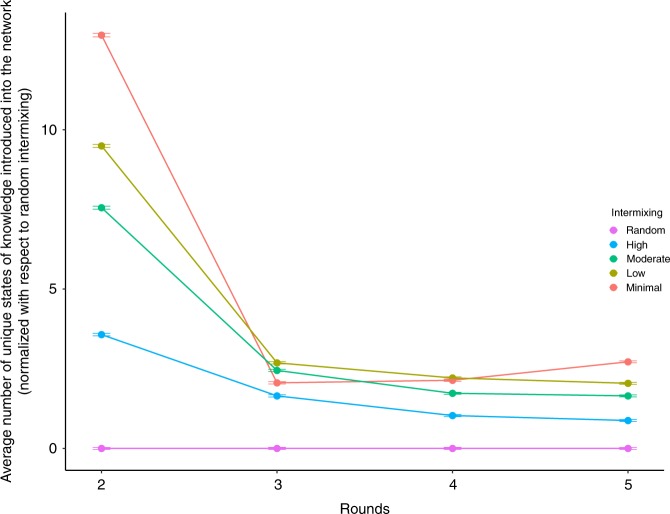
Diversity tends to generate more and better ideas in social settings, ranging in scale from small-deliberative groups to tech-clusters and cities. Implicit in this research is that there are knowledge-generating benefits from diversity that comes from mixing different individuals, ideas, and perspectives. Here, we utilize agent-based modeling to examine the emergent outcomes resulting from the manipulation of how diversity is distributed and how knowledge is generated within communicative social structures. In the context of problem solving, we focus on cognitive diversity and its two forms: ability and knowledge. For diversity of ability, we find that local diversity (intermixing of different agents) performs best at all time scales. However, for diversity of knowledge, we find that local homogeneity performs best in the long-run, because it maintains global diversity, and thus the knowledge-generating ability of the group, for a longer period.
多样性往往会在社会环境中产生更多更好的想法,其规模从小型审议团体到技术集群和城市不等。这项研究隐含的意思是,多样性从不同的个体、想法和观点的混合中产生了知识生成的好处。在这里,我们利用基于代理的建模来研究如何分配多样性以及如何在交际社会结构中生成知识的操作所产生的突发结果。在解决问题的背景下,我们专注于认知多样性及其两种形式:能力和知识。对于能力的多样性,我们发现局部多样性(不同代理的混合)在所有时间尺度上表现最佳。然而,对于知识的多样性,我们发现局部同质性在长期内表现最佳,因为它保持了全局多样性,从而保持了群体的知识生成能力更长的时间。