CeMM Research Center for Molecular Medicine of the Austrian Academy of Sciences, Lazarettgasse 14, AKH BT 25.3, A-1090, Vienna, Austria.
Cancer Research UK Cancer Therapeutics Unit, The Institute of Cancer Research, London, UK.
Nat Commun. 2019 Nov 13;10(1):5140. doi: 10.1038/s41467-019-13058-9.
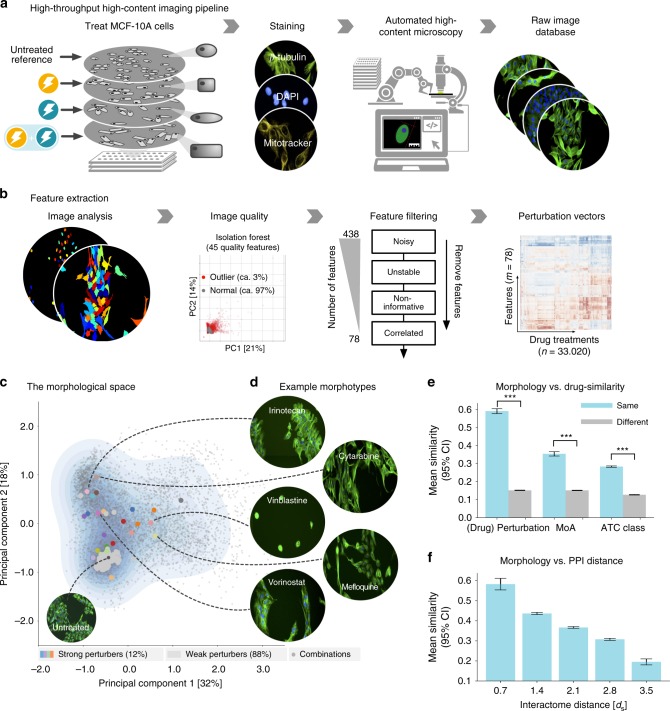
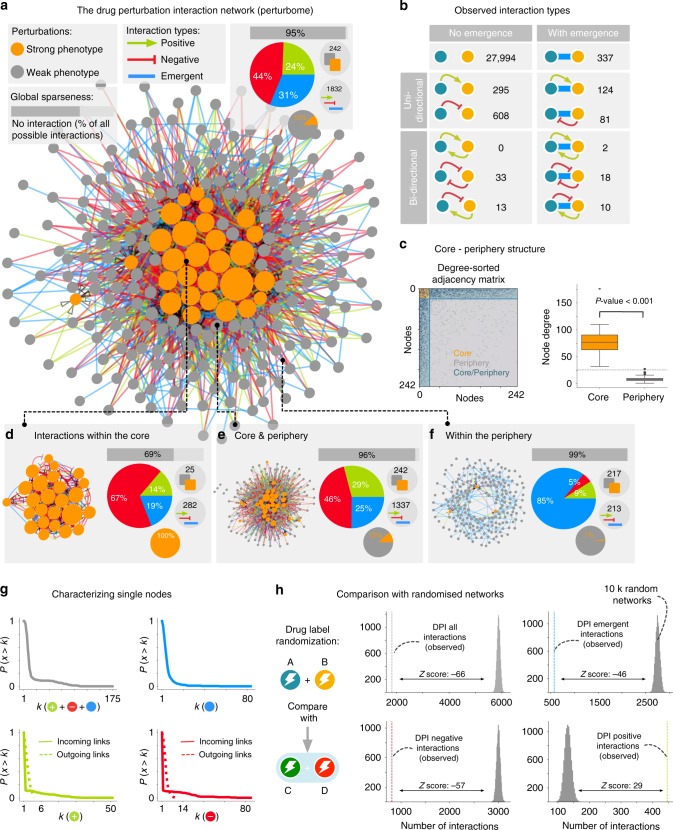
Drug combinations provide effective treatments for diverse diseases, but also represent a major cause of adverse reactions. Currently there is no systematic understanding of how the complex cellular perturbations induced by different drugs influence each other. Here, we introduce a mathematical framework for classifying any interaction between perturbations with high-dimensional effects into 12 interaction types. We apply our framework to a large-scale imaging screen of cell morphology changes induced by diverse drugs and their combination, resulting in a perturbome network of 242 drugs and 1832 interactions. Our analysis of the chemical and biological features of the drugs reveals distinct molecular fingerprints for each interaction type. We find a direct link between drug similarities on the cell morphology level and the distance of their respective protein targets within the cellular interactome of molecular interactions. The interactome distance is also predictive for different types of drug interactions.
药物组合为多种疾病提供了有效的治疗方法,但也代表了不良反应的主要原因。目前,我们还没有系统地了解不同药物引起的复杂细胞扰动如何相互影响。在这里,我们引入了一种数学框架,将具有高维效应的任何扰动之间的相互作用分类为 12 种相互作用类型。我们将我们的框架应用于由不同药物及其组合引起的细胞形态变化的大规模成像筛选,得到了 242 种药物和 1832 种相互作用的扰动组网络。我们对药物的化学和生物学特征进行分析,揭示了每种相互作用类型的独特分子指纹。我们发现细胞形态水平上药物相似性与细胞内分子相互作用的细胞相互作用组中它们各自蛋白质靶标的距离之间存在直接联系。相互作用组的距离也可预测不同类型的药物相互作用。