Department of Chemical and Biomolecular Engineering, University of Illinois at Urbana-Champaign, Urbana, IL, 61801, USA.
Carl R. Woese Institute for Genomic Biology, University of Illinois at Urbana-Champaign, Urbana, IL, 61801, USA.
Nat Commun. 2019 Nov 13;10(1):5150. doi: 10.1038/s41467-019-13189-z.
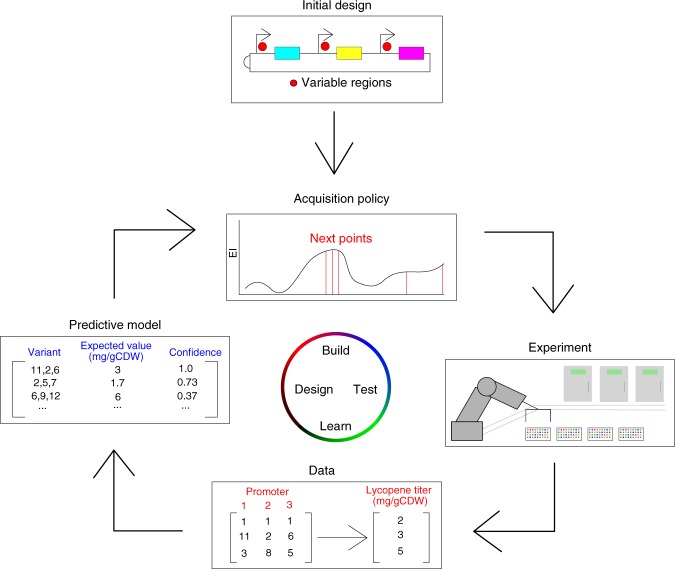
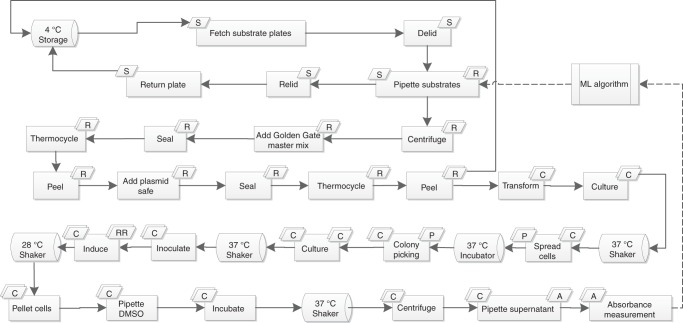
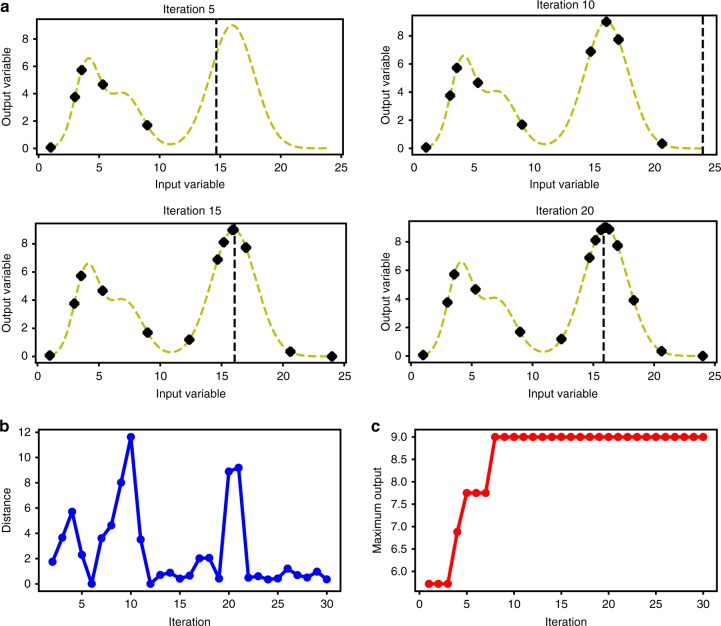
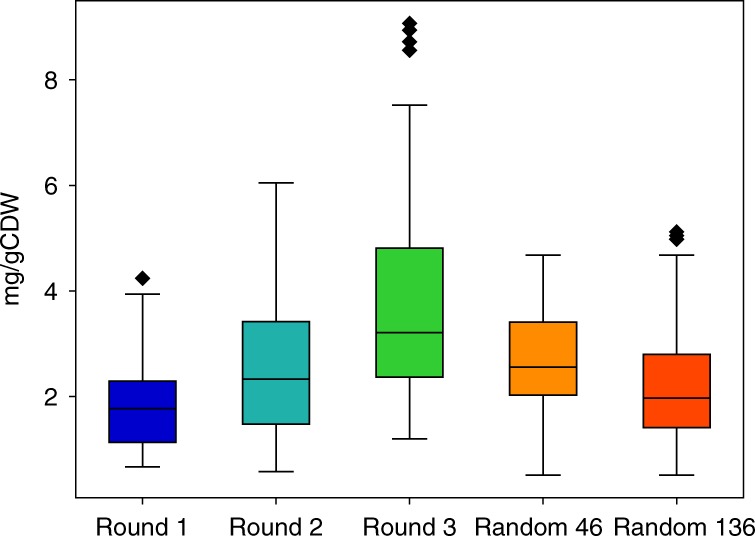
Large-scale data acquisition and analysis are often required in the successful implementation of the design, build, test, and learn (DBTL) cycle in biosystems design. However, it has long been hindered by experimental cost, variability, biases, and missed insights from traditional analysis methods. Here, we report the application of an integrated robotic system coupled with machine learning algorithms to fully automate the DBTL process for biosystems design. As proof of concept, we have demonstrated its capacity by optimizing the lycopene biosynthetic pathway. This fully-automated robotic platform, BioAutomata, evaluates less than 1% of possible variants while outperforming random screening by 77%. A paired predictive model and Bayesian algorithm select experiments which are performed by Illinois Biological Foundry for Advanced Biomanufacturing (iBioFAB). BioAutomata excels with black-box optimization problems, where experiments are expensive and noisy and the success of the experiment is not dependent on extensive prior knowledge of biological mechanisms.
在生物系统设计的设计、构建、测试和学习(DBTL)周期的成功实施中,通常需要进行大规模的数据采集和分析。然而,由于传统分析方法的实验成本、可变性、偏差和错失的见解,长期以来一直受到阻碍。在这里,我们报告了将集成机器人系统与机器学习算法结合应用于生物系统设计的 DBTL 过程的完全自动化。作为概念验证,我们通过优化番茄红素生物合成途径证明了其能力。这个完全自动化的机器人平台,BioAutomata,在表现优于随机筛选 77%的同时,只评估了不到 1%的可能变体。配对的预测模型和贝叶斯算法选择由伊利诺伊州生物制造先进中心(iBioFAB)执行的实验。BioAutomata 在黑盒优化问题方面表现出色,在这些问题中,实验成本高昂且嘈杂,实验的成功与否并不依赖于对生物机制的广泛先验知识。