School of Anthropology and Conservation, University of Kent, Canterbury, Kent, UK.
School of Human Evolution and Social Change, Arizona State University, Tempe, AZ, USA.
Sci Rep. 2019 Nov 13;9(1):16724. doi: 10.1038/s41598-019-53332-w.
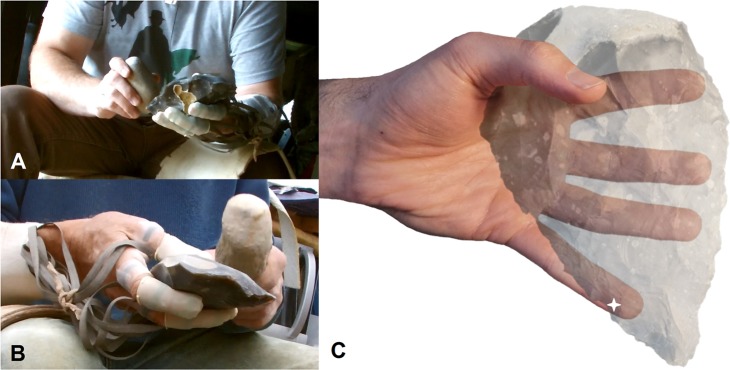
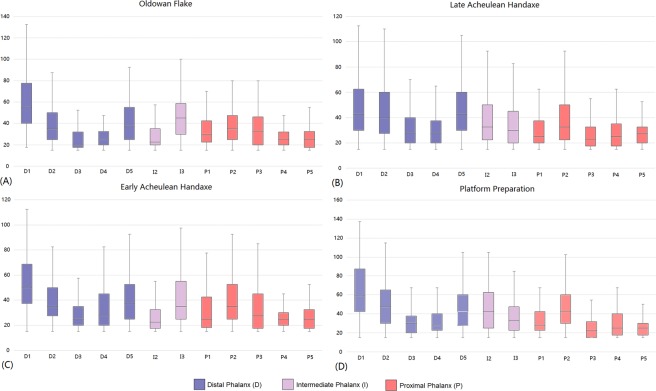
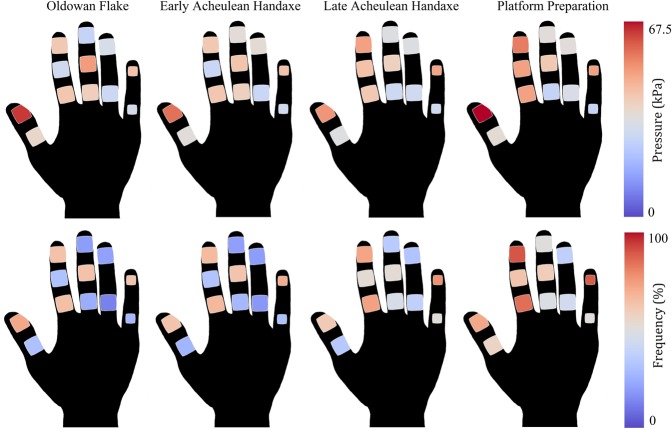
Unique anatomical features of the human hand facilitate our ability to proficiently and forcefully perform precision grips and in-hand manipulation of objects. Extensive research has been conducted into the role of digits one to three during these manual behaviours, and the origin of the highly derived first digit anatomy that facilitates these capabilities. Stone tool production has long been thought a key influence in this regard. Despite previous research stressing the unique derived morphology of the human fifth digit little work has investigated why humans alone display these features. Here we examine the recruitment frequency, loading magnitude, and loading distribution of all digits on the non-dominant hand of skilled flintknappers during four technologically distinct types of Lower Palaeolithic stone tool production. Our data reveal the fifth digit to be heavily and frequently recruited during all studied behaviours. It occasionally incurred pressures, and was used in frequencies, greater or equal to those of the thumb, and frequently the same or greater than those of the index finger. The fifth digit therefore appears key to >2 million years of stone tool production activities, a behaviour that likely contributed to the derived anatomy observed in the modern human fifth ray.
人类手部独特的解剖结构使我们能够熟练而有力地进行精确握持和手中物体操作。大量研究已经探讨了在这些手动行为中,一到三指的作用,以及促进这些能力的高度衍生的第一指解剖结构的起源。石器制作长期以来一直被认为是这方面的关键影响因素。尽管之前的研究强调了人类第五指独特的衍生形态,但很少有研究探讨为什么只有人类具有这些特征。在这里,我们研究了熟练的燧石工匠在进行四种不同技术类型的旧石器时代石器制作时,非主导手上所有手指的募集频率、加载幅度和加载分布。我们的数据显示,在所有研究的行为中,第五指都被大量且频繁地募集。它偶尔会承受压力,使用频率与拇指相同或更大,并且经常与食指相同或更大。因此,第五指似乎是 200 多万年石器制作活动的关键,这种行为可能促成了现代人类第五掌骨的衍生解剖结构。