Key Alastair J M, Dunmore Christopher J
School of Anthropology and Conservation, University of Kent, Canterbury, Kent, United Kingdom.
PeerJ. 2018 Aug 16;6:e5399. doi: 10.7717/peerj.5399. eCollection 2018.
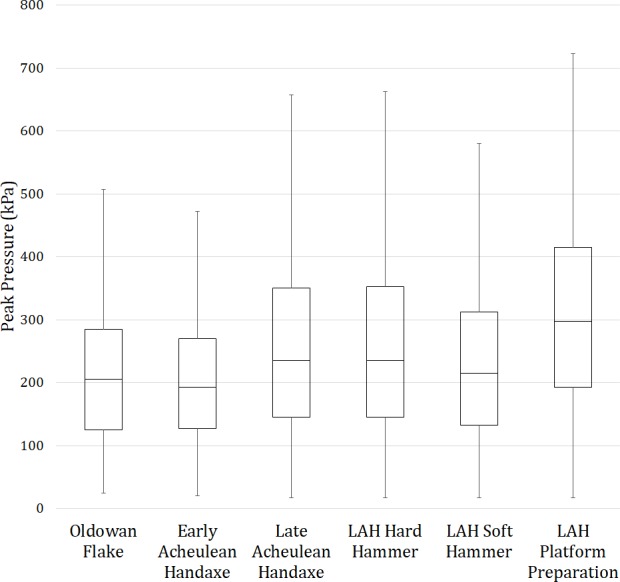
The causes of technological innovation in the Palaeolithic archaeological record are central to understanding Plio-Pleistocene hominin behaviour and temporal trends in artefact variation. Palaeolithic archaeologists frequently investigate the Oldowan-Acheulean transition and technological developments during the subsequent million years of the Acheulean technocomplex. Here, we approach the question of why innovative stone tool production techniques occur in the Lower Palaeolithic archaeological record from an experimental biomechanical and evolutionary perspective. Nine experienced flintknappers reproduced Oldowan flake tools, 'early Acheulean' handaxes, and 'late Acheulean' handaxes while pressure data were collected from their non-dominant (core-holding) hands. For each flake removal or platform preparation event performed, the percussor used, the stage of reduction, the core securing technique utilised, and the relative success of flake removals were recorded. Results indicate that more heavily reduced, intensively shaped handaxes with greater volumetric controls do not necessarily require significantly greater manual pressure than Oldowan flake tools or earlier 'rougher' handaxe forms. Platform preparation events do, however, require significantly greater pressure relative to either soft or hard hammer flake detachments. No significant relationships were identified between flaking success and pressure variation. Our results suggest that the preparation of flake platforms, a technological behaviour associated with the production of late Acheulean handaxes, could plausibly have been restricted prior to the emergence of more forceful precision-manipulative capabilities than those required for earlier lithic technologies.
旧石器时代考古记录中的技术创新原因对于理解上新世-更新世古人类行为和人工制品变化的时间趋势至关重要。旧石器时代考古学家经常研究奥杜威文化-阿舍利文化的转变以及阿舍利技术复合体随后一百万年中的技术发展。在此,我们从实验生物力学和进化的角度探讨旧石器时代考古记录中创新石器制作技术出现的原因。九位经验丰富的燧石打制者复制了奥杜威文化的片状工具、“早期阿舍利文化”手斧和“晚期阿舍利文化”手斧,同时从他们的非优势手(持核手)收集压力数据。对于每次进行的片状石器去除或台面准备操作,记录所使用的敲击工具、石器制作阶段、所采用的核心固定技术以及片状石器去除的相对成功率。结果表明,相比奥杜威文化的片状工具或早期“更粗糙”的手斧形式,体积控制更好、制作更精细且经过更多加工的手斧并不一定需要显著更大的手部压力。然而,相对于软锤或硬锤片状石器剥离,台面准备操作确实需要显著更大的压力。在石器剥落成功率与压力变化之间未发现显著关系。我们的结果表明,片状石器台面的准备工作,这一与晚期阿舍利文化手斧制作相关的技术行为,在比早期石器技术所需更强大的精确操作能力出现之前,可能确实受到了限制。