School of Public Health, Sun Yat-sen University, Guangzhou, China.
Xiamen Branch, Zhongshan Hospital, Fudan University, Xiamen, China.
Cancer Med. 2020 Jan;9(1):385-393. doi: 10.1002/cam4.2707. Epub 2019 Nov 14.
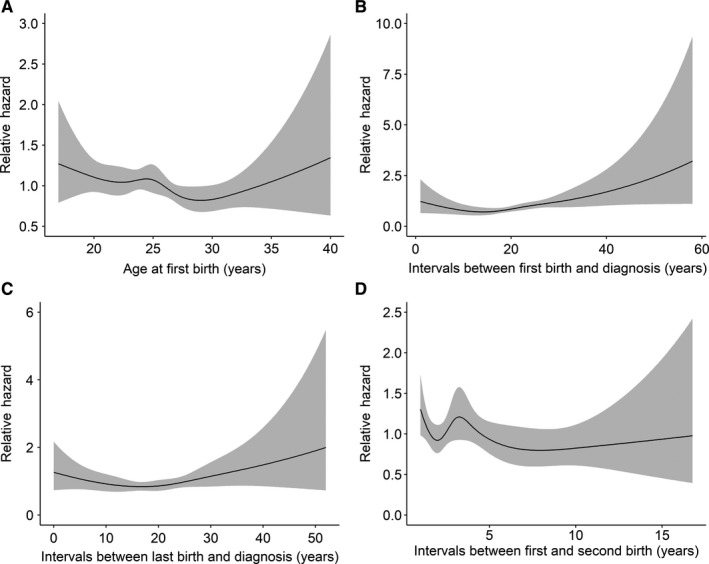
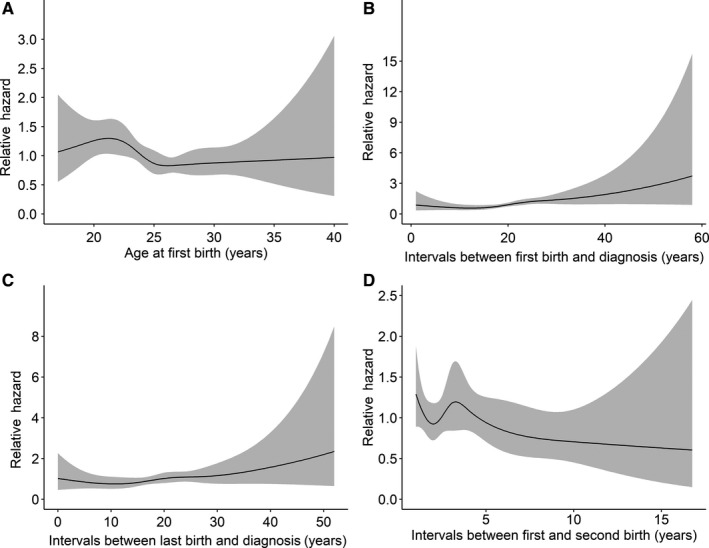
Reproductive factors associated with breast cancer risk may also affect the prognosis. This study aimed to evaluate the associations of multiple reproductive factors with breast cancer prognosis and the modifying effects of menopausal status. We obtained data from 3805 breast cancer patients recruited between October 2008 and June 2016 in Guangzhou. The subjects were followed up until 30 June 2018. The hazard ratios (HRs) and 95% confidence intervals (95% CIs) were calculated using multivariate Cox models to estimate the associations. It was found that there were U-shaped patterns for the associations of age at first birth and durations from first/last birth to diagnosis with breast cancer prognosis. The adverse effects of old age at first birth [>30 years vs 23-30 years, HR (95% CI): 1.59 (1.01-2.50)] and long intervals from first [≥20 years vs 10-19 years, HR (95% CI): 1.55 (1.07-2.27)] or last [≥20 years vs 10-19 years, HR (95% CI): 1.63 (1.08-2.46)] birth to diagnosis on progression-free survival (PFS) were significantly more pronounced among premenopausal women. Additionally, long interval (>5 years) between first and second birth was associated with a better PFS [HR (95% CI): 0.64 (0.42-0.97)]. These results suggested that age at first birth, durations from first/last birth to diagnosis, and intervals between first and second birth should be taken into account when following the patients and assessing the prognosis of breast cancer, particularly for premenopausal patients. These findings would also have implications for further insight into the mechanisms of breast cancer development.
与乳腺癌风险相关的生殖因素也可能影响预后。本研究旨在评估多种生殖因素与乳腺癌预后的关系,并探讨绝经状态的修饰作用。我们从 2008 年 10 月至 2016 年 6 月在广州招募的 3805 名乳腺癌患者中获取数据。对这些患者进行随访,随访截止日期为 2018 年 6 月 30 日。使用多变量 Cox 模型计算风险比(HR)和 95%置信区间(95%CI)来评估关联。结果发现,初产年龄和首次/末次生育与诊断的时间间隔与乳腺癌预后之间存在 U 型关联模式。初产年龄较大(>30 岁比 23-30 岁,HR(95%CI):1.59(1.01-2.50))和首次(≥20 年比 10-19 年,HR(95%CI):1.55(1.07-2.27))或末次生育(≥20 年比 10-19 年,HR(95%CI):1.63(1.08-2.46))与诊断之间的时间间隔较长对无进展生存期(PFS)的不良影响在绝经前妇女中更为显著。此外,首次和第二次生育之间的间隔时间较长(>5 年)与较好的 PFS 相关[HR(95%CI):0.64(0.42-0.97)]。这些结果表明,在随访患者和评估乳腺癌预后时,应考虑初产年龄、首次/末次生育与诊断的时间间隔以及首次和第二次生育之间的间隔,尤其是对于绝经前患者。这些发现也将对进一步深入了解乳腺癌发生的机制产生影响。