Changchun University of Chinese Medicine, Changchun, Jilin, People's Republic of China.
Northeast Normal University, Changchun, Jilin, People's Republic of China.
Integr Cancer Ther. 2019 Jan-Dec;18:1534735419886655. doi: 10.1177/1534735419886655.
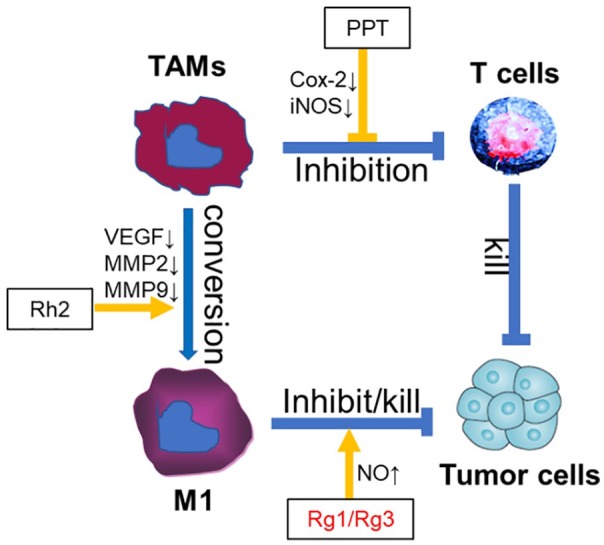
Ginsenosides, the key components isolated from ginseng, have been extensively studied in antitumor treatment. Numerous studies have shown that ginsenosides have direct function in tumor cells through the induction of cancer cell apoptosis and the inhibition of cancer cell growth and enhance the antitumor immunity through the activation of cytotoxic T lymphocytes and natural killer cells. However, little is known about the function of ginsenosides on myeloid immunosuppressive cells including dendritic cells in tumor, tumor-associated macrophages, and myeloid-derived suppressor cells in the tumor microenvironments. Those myeloid immunosuppressive cells play important roles in promoting tumor angiogenesis, invasion, and metastasis. In the review, we summarize the regulatory functions of ginsenosides on myeloid immunosuppressive cells in tumor microenvironment, providing the novel therapeutic methods for clinical cancer treatment.
人参中的关键成分——人参皂苷,在抗肿瘤治疗方面已得到广泛研究。大量研究表明,人参皂苷通过诱导癌细胞凋亡、抑制癌细胞生长,以及通过激活细胞毒性 T 淋巴细胞和自然杀伤细胞来增强抗肿瘤免疫力,从而在肿瘤细胞中发挥直接作用。然而,人参皂苷对肿瘤微环境中的髓源性抑制细胞(包括树突状细胞、肿瘤相关巨噬细胞和髓源性抑制细胞)的功能知之甚少。这些髓源性抑制细胞在促进肿瘤血管生成、侵袭和转移方面发挥着重要作用。在这篇综述中,我们总结了人参皂苷对肿瘤微环境中髓源性抑制细胞的调节作用,为临床癌症治疗提供了新的治疗方法。