Department of Gastrointestinal Surgery, the First Affiliated Hospital of Guangxi Medical University, NO.6 of Shuangyong Road, Qingxiu District, Nanning, 530021, China.
Department of General Surgery, the Second Affiliated Hospital of Guangxi Medical University, Nanning, 530007, China.
BMC Gastroenterol. 2019 Nov 15;19(1):188. doi: 10.1186/s12876-019-1098-6.
The aim of this study was to explore the prognostic factors and establish a nomogram to predict the long-term survival of gastric cancer patients.
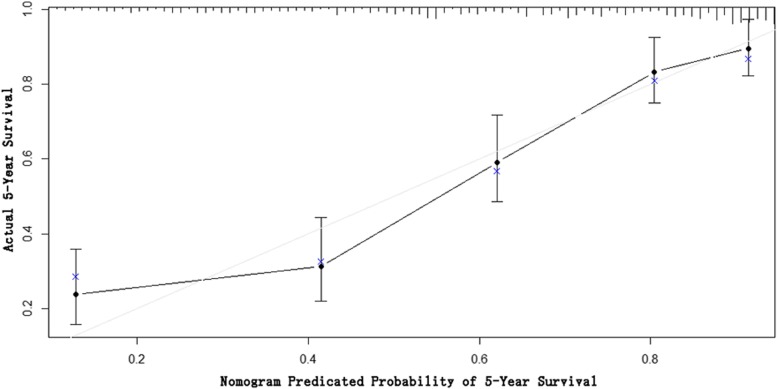
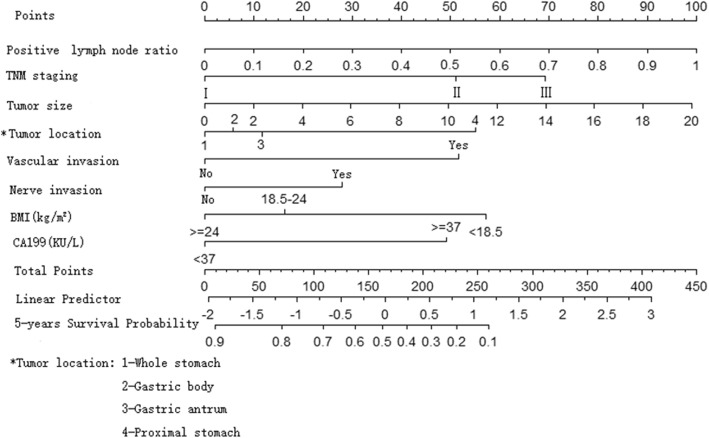
The clinicopathological data of 421 gastric cancer patients, who were treated with radical D2 lymphadenectomy by the same surgical team between January 2009 and March 2017, were collected. The analysis of long-term survival was performed using Cox regression analysis. Based on the multivariate analysis results, a prognostic nomogram was formulated to predict the 5-year survival rate probability.
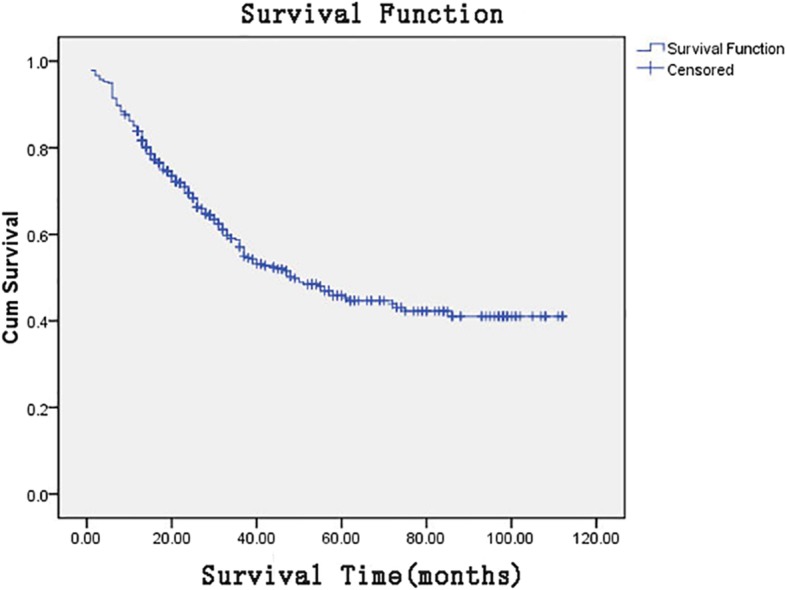
In the present study, the total overall 3-year and 5-year survival rates were 58.7 and 45.8%, respectively. The results of the univariate Cox regression analysis revealed that tumor staging, tumor location, Borrmann type, the number of lymph nodes dissected, the number of lymph node metastases, positive lymph nodes ratio, lymphocyte count, serum albumin, CEA, CA153, CA199, BMI, tumor size, nerve invasion, and vascular invasion were prognostic factors for gastric cancer (all, P < 0.05). However, merely tumor staging, tumor location, positive lymph node ratio, CA199, BMI, tumor size, nerve invasion, and vascular invasion were independent risk factors, based on the results of the multivariate Cox regression analysis (all, P < 0.05). The nomogram based on eight independent prognostic factors revealed a well-degree of differentiation with a concordance index of 0.76 (95% CI: 0.72-0.79, P < 0.001), which was better than the AJCC-7 staging system (concordance index = 0.68).
The present study established a nomogram based on eight independent prognostic factors to predict long-term survival in gastric cancer patients. The nomogram would be beneficial for more accurately predicting the prognosis of gastric cancer, and provide important basis for making individualized treatment plans following surgery.
本研究旨在探讨影响胃癌患者长期生存的预后因素,并建立列线图以预测胃癌患者的长期生存。
收集了 2009 年 1 月至 2017 年 3 月间同一外科团队进行根治性 D2 淋巴结清扫术的 421 例胃癌患者的临床病理资料。采用 Cox 回归分析进行长期生存分析。基于多因素分析结果,制定了一个预后列线图以预测 5 年生存率概率。
本研究中,总 3 年和 5 年生存率分别为 58.7%和 45.8%。单因素 Cox 回归分析结果显示,肿瘤分期、肿瘤部位、Bormann 分型、淋巴结清扫总数、淋巴结转移数、阳性淋巴结比率、淋巴细胞计数、血清白蛋白、CEA、CA153、CA199、BMI、肿瘤大小、神经侵犯和血管侵犯是胃癌的预后因素(均 P<0.05)。然而,多因素 Cox 回归分析结果显示,仅肿瘤分期、肿瘤部位、阳性淋巴结比率、CA199、BMI、肿瘤大小、神经侵犯和血管侵犯是独立的危险因素(均 P<0.05)。基于这 8 个独立预后因素的列线图具有良好的区分度,一致性指数为 0.76(95%CI:0.72-0.79,P<0.001),优于 AJCC-7 分期系统(一致性指数=0.68)。
本研究建立了一个基于 8 个独立预后因素的列线图来预测胃癌患者的长期生存。该列线图有助于更准确地预测胃癌的预后,并为术后制定个体化治疗方案提供重要依据。